


























Sharp as a stiletto heel, the satirical new film “Veni Vidi Vici” plunges its blade straight into the heart of the billionaire class. This sly Austrian entry skewers the untouchable super-rich, who glide through life facing little consequence for even their most destructive actions.
At the bloody center of “Veni Vidi Vici” is the Maynard clan, led by charming yet vacant patriarch Amon Maynard (Laurence Rupp). When big-game hunting grows tiresome, Amon turns to more dangerous prey – randomly murdering ordinary folks in broad daylight. Yet backed by his vast wealth, Amon evades any scrutiny from the authorities or media.
Helming this icy satire is the daring duo of Daniel Hoesl and Julia Niemann, who blast open questions about greed, entitlement and power. They drag their razor wit across capitalist psychology, probing the God complex and moral rot festering among too many elites. Visually, Hoesl and Niemann opt for a sleek, detached aesthetic that contrasts gorgeously with the gruesome acts on display.
For all its Continental cool, “Veni Vidi Vici” definitely has flaws. A one-note premise gets stretched thin at times, tension wavers, and the overt messaging borders on heavy-handed. Yet when this bad boy clicks, hoo boy – it cuts deep. Drenched in irony and propelled by its game cast, “Veni Vidi Vici” earns its stripes as a scathingly good time. Viewers may leave feeling slightly nauseous, but that’s part of the point – and part of the pleasure.
So come armed with an open mind and prepare for some gleeful evisceration. With its keen eye and quick wit, “Veni Vidi Vici” shows the billionaire elite no mercy. Beneath all the dark comedy and style lurks an earnest call to action. Can we build a just world when a privileged few play by their own rules, facing no repercussions? The answer’s unclear, but the needling questions this film raises linger long after the credits roll.
Meet the Maynards: Murderous Mayhem Behind a Gleaming Facade
At first glimpse, the Maynards seem to lead a gilded life. Patriarch Amon Maynard helms a powerful battery company, while his wife Viktoria works as a public defender. They’re raising three children in an opulent mansion and want for nothing. But behind the polished veneer, darkness dwells.
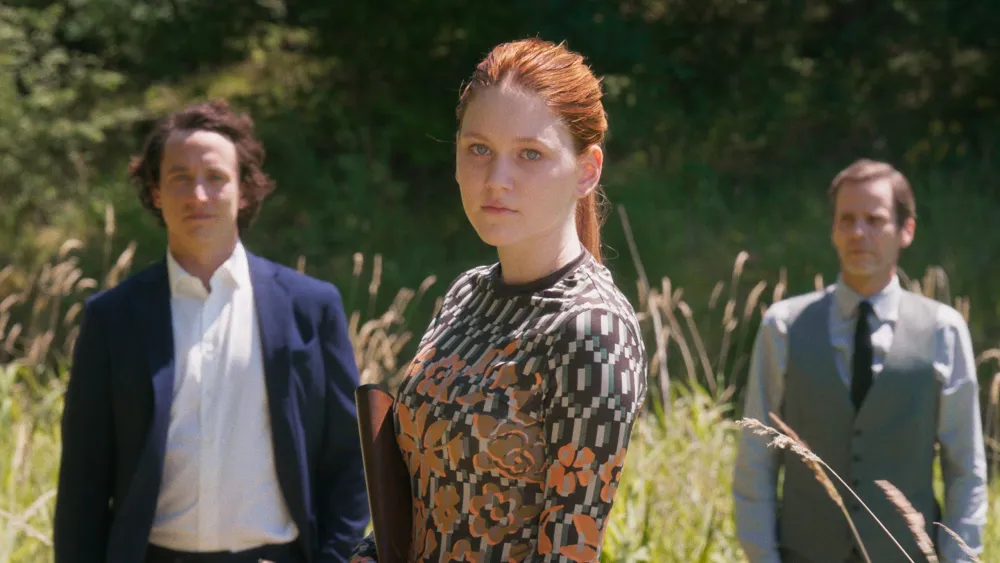
Amon satisfies his killer cravings by randomly murdering people out in broad daylight. He cycles through a fleet of white Porsches to arrive at his crime scenes, then switches to a nondescript van afterwards – driven by his loyal butler Alfred – to cover his tracks. Though local authorities suspect Amon is the serial sniper terrorizing their idyllic city, they turn a blind eye to his spree.
We see Amon commit two cold-blooded killings early on. First, he guns down a passing bicyclist to nab his bike. Later, he slaughters two hikers with zero remorse. Amon’s daughter Paula – who serves as our narrator – clearly idolizes her dad’s ruthless ways. To Paula, slyly breaking rules and getting away with it means you deserve to win.
As Amon plots construction of a massive European battery factory, he backstabs his mentor Carl without batting an eye. Yet at home, Amon dotes on his family, weeping when a bird accidentally dies flying into their window. His selective empathy highlights the warped psychology so common among the billionaire set.
Two working-class men attempt to implicate Amon over the course of Veni Vidi Vici’s 85 minutes. Local gamekeeper Alois witnesses Amon murder the hikers firsthand. But when Alois tries reporting the crime, the police ridicule his claims. Distraught over this corruption, Alois ultimately shoots himself.
Meanwhile, obsessed journalist Volter seeks to expose Amon’s killing spree in the press. Though he compiles extensive evidence, his publisher ex-girlfriend refuses to run the story, valuing profits over principles. Volter finally confronts Amon himself and – shockingly – Amon admits that yes, he is the notorious serial murderer. He dares Volter to prove it publicly. Cowed by the challenge, Volter eventually ends up working for Amon, becoming his new butler Alfred.
In the twisted climax, Paula herself guns down butler Alfred in a deranged imitation of her beloved father. But there are still no consequences for the Maynards’ misdeeds. They will continue getting away with murder, literally and figuratively, as the untouchable elite class always does in the end. Veni Vidi Vici closes by taunting us to challenge these unjust societal norms before signing off with Paula’s icy narration: “I came, I saw, I conquered.”
Slicing Open the Psyches of the Super-Rich
Sharp social commentary simmers at the core of Veni Vidi Vici, which wields satire and absurdity to hack away at notions of wealth, power and impunity. This savage cinematic essay questions the ethical rot festering among the billionaire class, probing the warped psychology that divorces the ultra-elite from any normal standards of decency.
By making its central villain – the affable-yet-vacant Amon Maynard – a serial killer who faces zero consequences, the film hyperbolizes the real-world issue of powerful magnates acting however they wish, no matter how unethical. The police refusal to arrest Amon despite overwhelming evidence satirizes the selective enforcement that lets big CEOs get away figurative murder daily – stealing wages or ravaging the environment.
Beyond just mocking billionaire misconduct, Veni Vidi Vici digs into the attendant god complexes driving it. Amon views himself as untouchable and superior, free to eradicate “lesser” lives on a whim. His noble justifications for backstabbing business partners echo the mendacious PR of corporate raiders who ruin companies and livelihoods through hostile takeovers. All while enriching themselves immensely.
This links Veni Vidi Vici to other contemporary “eat the rich” parables like Triangle of Sadness and The Menu, which also indict the wealthy’s indifference to human costs. But Hoesl and Niemann’s chilly, cerebral approach eschews gross-out gore for something more insidious. The clinical style heightens how violence permeates the Maynards’ world – from Paula’s childhood glee at nasty fouls during polo to her shooting the butler by film’s end.
Ultimately, through this family’s dissolution, the film argues ethical norms themselves dissolve wherever runaway power and capital concentrate. The Maynards’ selective empathy, warped logic and pettiness get amplified to sociopathic extremes by their isolated privilege. Yet stripped of stylistic exaggerations, their mindset differs little from many real-life billionaires, just taken to furthest ends.
This ties into the film’s most damning theme – the total complicity of broader institutions like media and government with toxic wealthy elites. Veni Vidi Vici condemns how politicians, while paying lip service to “justice”, twist laws to accommodate monsters like Amon rather than leashing them. Whether it’s newspapers ignoring scandals, police tossing away evidence, or economic systems rewarding psychopathic behavior, corrupt incentives reign supreme.
The film’s bitter punchline is that challenging all this feels fruitless when power skews so lopsidedly. Veni Vidi Vici ultimately leaves us with more bleak questions than solutions – how can morality function when tycoons like Amon rig all the rules? Does wealth intrinsically corrupt? Are checks and balances themselves checked out? The answers seem grim, but simply wrestling with these arguments makes Veni Vidi Vici worthwhile. Even if its flawed execution only scratches the surface, these tip-of-the-iceberg ideas around billionaire pathology linger hauntingly.
Gorgeous Visuals, Gorgeous Monsters
Veni Vidi Vici thrives on juxtaposition – namely, the contrast between its lavish, mannered visual palette and the ugliness it depicts. Polish and cruelty make strange yet compelling bedfellows here.
Much of the film adopts a detached, clinical perspective on the Maynards, favoring stiff medium shots or distant glimpses of the family on their estate grounds. When Amon commits murder, directors Hoesl and Niemann deploy handsome slow motion and opera cues rather than visceral, in-your-face violence. The effect is chilling yet seductive – we witness despicable acts carried out with elite refinement and privilege.
This heightened realist style, paradoxically marrying beauty with barbarity, makes the Maynards seem like exotic creatures observed in their native habitat. The lush cinematography lingers like a nature documentary might on a shiny but deadly beetle. And through the directors’ lens, these billionaires are insects – a different species rarefied from the common folk they slaughter for sport.
Adding to this impression, Hoesl and Niemann contrast sunny, verdant exteriors around the Maynard manor with darker interior shots highlighting the family’s ethical rot. One minute we gawk at partygoers lounging poolside, the next we gawk at Amon’s vast gun collection. The directors toggle between sweeping grandeur and creeping danger, rarely finding middle ground.
So too with the score, which pits stately classical compositions against eerie atonal rumbles. Dissonance rules the soundtrack, keeping viewers off-kilter even as painterly frames entrance our eyes. Brutality and beauty remain locked in perennial waltz.
The culmination of all this stylization is a billionaire class portrayed as remote apex predators, gods in their gilded garden. Hoesl and Niemann construct rarified images of the ultra-wealthy which match their bloodless affect. And that’s precisely the point – only by viewing the Maynards through this dramatic, irony-laced lens can Veni Vidi Vici fully capture their warped psychology in human form. Detachment proves essential.
Standout Performances Add Dimension
While the script leaves some roles thinly sketched, a captivating cast still manages to leave imprints on Veni Vidi Vici. Specifically, young phenom Olivia Goschler and versatile veteran Laurence Rupp deliver standout turns that pepper this satire with personality.
As vacant patriarch Amon Maynard, Rupp oozes affable yet sinister charm reminiscent of Christian Bale in American Psycho. His homicidal capitalist is no snarly villain, but a handsome cipher able to disarm others with friendly banter before calmly destroying their lives. Rupp smartly plays Amon straight rather than hammy, making his random murders and backstabbings seem more chillingly banal.
Meanwhile as daughter Paula, Goschler presents a frightening tabula rasa. Whether discussing grisly hunts with awe or blithely excusing her shoplifting, Paula demonstrates the next generation’s nonchalant embrace of their family’s ethical bankruptcy. Devoid of empathy, Paula soaks up her dad’s dubious teachings like a sponge. Goschler balances precocious intelligence with emotional isolation, crafting an unnerving portrait of someone formed entirely by privilege.
Unfortunately, the script denies other performers similar dimensions. Supporting roles come off disappointingly flat, mere cardboard cutouts lining the Maynards’ path of destruction. This becomes painfully apparent with underdeveloped characters like journalist Volker or Paula’s mentor Sylvester, who vacillate between righteous indignation and cowardly resignation without much interiority.
Of course, given the film’s satirical eye, this superficiality seems partly intentional. The plot device-like nature of secondary figures underscores the film’s perspective – outside the Maynard bubble, most folks are narrative props, not people. Their interchangeable fragility highlights the elite family’s heightened vividness, rendered more “real” by contrast.
Nonetheless, moments arise when decent scaffolding around the leads might have bolstered impact. Certain scenes lose dramatic weight since key reactions lack complexity, never moving beyond pro forma dismay or disbelief.
Had the directors lavished more attention on dimensionality for supporting roles, Veni Vidi Vici’s climactic moments might land sharper gut punches. As is, we keenly feel the absence of emotional investment whenever Amon shrugs off meek protests from paper-thin authority stand-ins. Outrage demands intimacy, sorrow demands connection – neither fully materialize.
Luckily, Goschler and Rupp pack enough charisma and intrigue to energize Veni Vidi Vici despite shortcomings elsewhere. Whenever these two commandeer scenes, riveting qualities emerge that trimmer characterization disappointingly fails to sustain.
Coming Up Short on Chuckles and Catharsis
While Veni Vidi Vici definitely drives home its message, this savage satire sometimes struggles to deliver proportional dramatic rewards. A one-note premise wears thinner than expected, starved for richer humor as the blithely ghoulish acts pile up. And perhaps most disappointingly, the film denies audiences the catharsis of long-awaited consequences for its vile protagonists.
After initially tantalizing viewers with Amon’s open serial murdering and taunts at justice, the plot plateaus in audacity. The formula grows stale, reduced to repeatedly showing clueless authorities dismissing crimes or partnership betrayals lacking fresh imagination. Where episodes of Succession might concoct gasp-worthy power plays, Veni Vidi Vici settles for more pedestrian indictments.
It doesn’t help that tension deflates early once we realize no authorities will challenge Amon. Nor do the script’s scattered attempts at gallows humor – an opera cue after a vicious shotgun blast, a wink at recycling when Amon steals a bicycle from his victim – land satisfactorily. The outrageous setup begs for much sharper, tar-black comedy.
Most disappointingly, everyone retains static positions by the final credits, sans epiphanies. The Maynards enjoy total impunity, reporters stay silent, systemic corruption continues unchecked. This passes up a precious chance to serve the rich their just desserts, the narrative equivalent of cold soufflé.
Had the film taken more risks in plotting, characterization or cinematic style, perhaps Veni Vidi Vici might equal the sum of its intriguing parts. Alas, we’re left with a primary metaphor – the ultra-elite as killers conversant with consequences – that feels exhausted halfway through. And lacking emotional investment in secondary figures, we’re robbed of the empathy needed to fully appreciate the horrors on display.
Veni Vidi Vici keeps its core critique razor-sharp, but struggles summoning complementary angles of attack. Some added imagination in tone and resolution would work wonders for achieving its admirable satirical goals with more punch and panache.
A Ruthless Romp That Rallies the Troops
For all its missteps in plot and tone, Veni Vidi Vici still delivers a savagely good time that rallies viewers to resent the billionaire class. This brazen satire may struggle sustaining consistent laughs or catharsis, but makes up for such shortcomings with vital, blood-boiling questions about impunity and power.
By training a gimlet eye upon figures like Amon Maynard – embodied with deceptive empathy by Laurence Rupp – the film strips away myths surrounding modern tycoons. Revealed underneath are interchangeable narcissists and sociopaths, reared on entitlement and devoid of accountability. Does great wealth intrinsically deaden moral fiber, or merely provide a fertile hotbed for corruption to bloom?
Either way, Veni Vidi Vici argues current systems enable bad incentives and worse behavior among elites. The film serves as a galling wakeup call for apathetic institutions to locate their spines. That the script denies us the satisfaction of consequences for its monsters proves the point – justice remains neutralized, the emerging status quo.
Flawed execution hampers Veni Vidi Vici from fully realizing its aspirations toward greater prestige filmmaking leagues. Yet quibbles over tension and tone shouldn’t obscure its merit as a conversation-starter. This mercurial movie leaves viewers stirred if not shaken, rallying frustrations against normalizing billionaire excess and ethical exceptions.
So while Hoesl and Niemann’s latest lacks the writing chops to fully skewer its targets, kudos are due for putting ruling-class hubris on blast. Veni Vidi Vici may not topple Goliaths or reform systems overnight. But as Paula’s last words remind, revolutions begin with individuals who refuse to look the other way.
The Review
Veni Vidi Vici
Veni Vidi Vici falls short of all-out satirical glory, but succeeds in unsettling complacency and rattling conscience. This flawed provocateur lacks the vision or discipline to earn masterpiece status. Yet it wields the power of ideas to illuminate real-world villains who skate by unexamined. Let Hoesl and Niemann’s latest serve not as the final word, but an opening salvo against normalizing rot at the top.
PROS
- Sharp, scathing satire of the wealthy and elite
- Strong lead performances from Rupp and Goschler
- Gorgeous, stylized cinematography
- Thought-provoking themes and questions raised
- Audacious premise and fearless provocation
CONS
- One-note premise stretched too thin
- Lacks consistent humor and tension
- Spotty secondary character development
- Messaging borders on heavy-handed
- Denies audiences a real sense of consequences