




























In the world of political dramas, we often get polished tales of inevitable ascents or catastrophic falls from grace, usually centered on characters who seem destined for the arena. Thirsty offers something different, something grittier and closer to the ground, reminding me of the scrappy, character-driven independent films of the 1990s.
The film introduces us to Audrey Allen, a passionate public defender in Oakland. After one conflict too many with a system she feels is failing people, she makes the stunning decision to resign from her job and launch an improbable campaign for mayor. It’s a move born of pure frustration and a deep-seated, almost naive, belief that she can do better for her community.
She is immediately positioned as a massive underdog against the city’s popular, powerful, and well-funded incumbent, Maya King. The film wastes no time establishing the immense personal stakes of this decision, giving us immediate, intimate glimpses into her life as a wife to a police officer and a mother to two young children, one still an infant.
We see the path ahead is not just a political battle against an established machine, but a deeply personal trial that will test every fiber of her being. The film sets its stage for a raw, determined woman attempting to bend a rigid system to her will.
The Truth in a Flawed Candidate
At the center of Thirsty is a refreshingly complicated and messy human being. Audrey Allen is not your typical cinematic hero designed for easy audience sympathy. Her backstory, which includes a tough upbringing in East Oakland and time in the foster care system alongside her sister, has forged a personality that is both idealistic and fiercely abrasive.
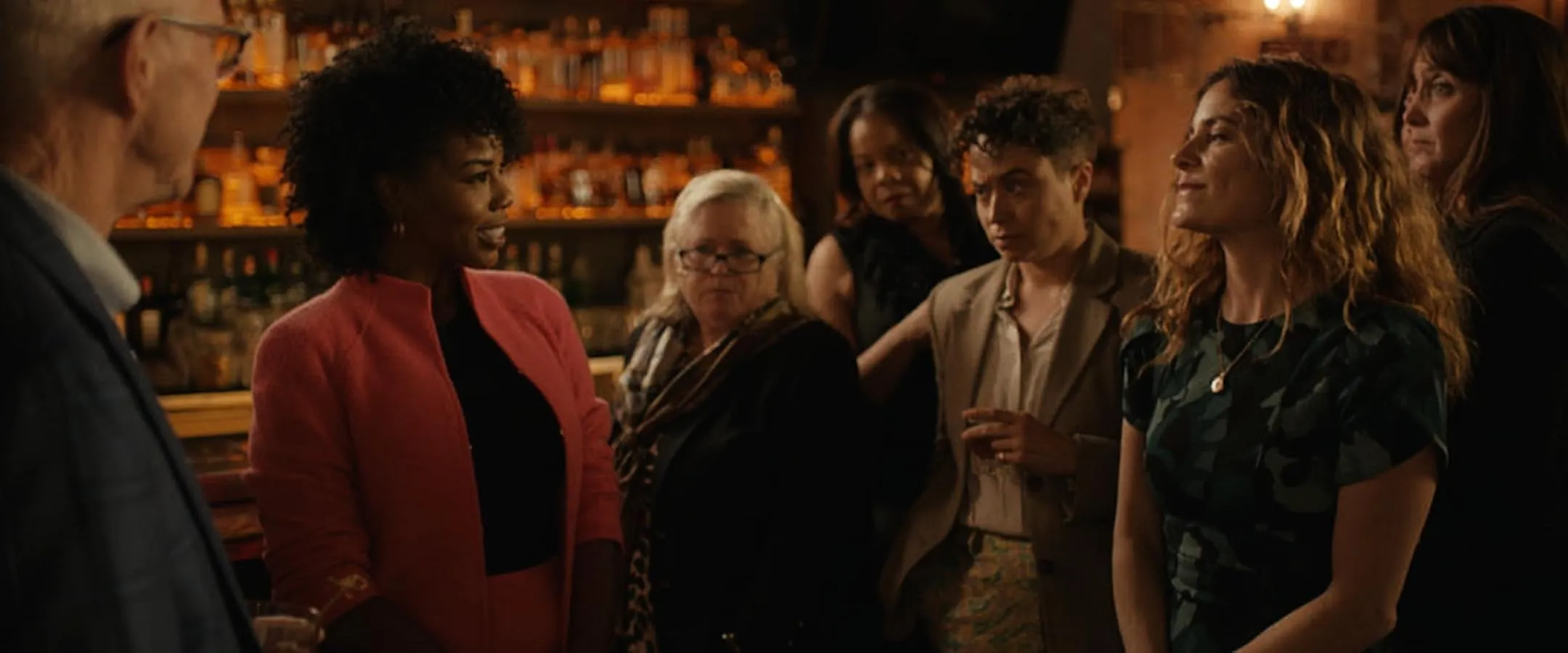
She can be inspiring in one moment and frustratingly self-centered the next, a person prone to making reckless, emotional choices. The entire film rests almost entirely on the shoulders of Jamie Neumann, who gives a phenomenal, anchoring performance. She presents Audrey’s strengths and faults with an unvarnished, unapologetic honesty, never asking for our pity or approval.
Neumann makes her feel like a real person I might know—full of contradictions and fighting to hold them all together without a manual. This is a woman who passionately advocates for police reform while sharing a bed with her police officer husband, T.K. She preaches community but struggles with her own sister. The film lives in these messy, authentic spaces, refusing to sand down its protagonist’s rough edges for our comfort, making her journey all the more believable.
When Ambition Comes Home
The story kicks into high gear when Audrey’s long-shot campaign gets an unexpected and morally ambiguous boost from the calculating State Governor, Anne Dixon, played with a steely resolve by Kyra Sedgwick. Dixon sees Audrey not as a future leader but as a useful pawn to weaken the incumbent mayor for her own political gain.

With the governor’s backing comes a professional campaign team and a flood of seed money, but these resources come with strings. A key figure introduced is the new field director, Derek Williams, a handsome and smooth operator who also happens to be a figure from Audrey’s past. His presence introduces an immediate and palpable romantic tension that threatens her already strained marriage.
The film expertly maps the personal cost of this political endeavor, showing how the campaign trail erodes her home life piece by piece. We feel the growing distance in her marriage to T.K., played with a quiet, weary anxiety by Sung Kang, as he watches their family life and finances become unstable.
We witness the painful, calculated choice she makes to distance herself from her recovering sister, Sonia, for the sake of political optics. Each step forward in her campaign seems to require a small piece of her personal life as payment, forcing Audrey to constantly confront the question of what parts of her soul are worth trading in her pursuit of power.
A Mirror to Modern Politics
More than just a character piece, Thirsty holds up a lens to our current political moment, examining the uniquely difficult path for anyone who doesn’t fit the traditional, pre-packaged mold. The film is a potent study of the different standards applied to ambitious women in the public square.

Audrey is constantly scrutinized for her temperament, her family roles, and her appearance in ways a male candidate would not be. This is captured perfectly in a small but telling moment when she is advised to drop her native “Oakland drawl” to sound more “mayoral.” That single piece of advice speaks volumes about the central theme of authenticity.
How much of your true self must you file away to be seen as a legitimate leader in an age of curated public personas? The film also wades into the complex waters of local politics, noting the social dynamics of a working-class white woman running to represent a deeply diverse city against a wealthy Black opponent. It feels less like a manufactured drama and more like a reflection of real-world conversations about who gets to represent whom, and what “authentic” representation even means today.
A Film as Messy as its Hero
Much like its protagonist, Thirsty is a film with a clear, ambitious vision that sometimes stumbles in its execution. Director Emily Abt’s commitment to building a story around such a difficult, flawed, and compellingly real woman is admirable. It’s a choice that feels fresh and necessary in the landscape of independent cinema.
However, the film’s technical aspects don’t always match its conceptual strength. I found the editing could be choppy and rhythmically odd, occasionally cutting the legs out from under a dramatic scene before it had a chance to fully land, leaving emotional beats unresolved. Some of the dialogue leans into being too direct, spelling out its message with a heaviness that feels unnatural, when a lighter touch would have been more effective.
While Neumann is a force, some supporting performances are uneven, hovering at a level that feels more suited to a television movie. The film’s biggest misstep is its final act; after building considerable tension and high stakes, the story loses its nerve.
The climax feels hurried and muted, and the resolution doesn’t quite feel earned. Still, it is a noteworthy picture, one whose provocative ideas and powerful central performance linger long after the credits roll, proving that sometimes a flawed attempt at something true is more interesting than a polished execution of something safe.
Thirsty was released digitally via Gravitas Ventures on June 6, 2025 and is available for rent or purchase on platforms like Fandango at Home and others.
Full Credits
Director: Emily Abt
Writer: Emily Abt
Producers and Executive Producers: Emily Abt, Jules Albert
Cast: Jamie Neumann, Sung Kang, Tyler Lepley, Kyra Sedgwick
The Review
Thirsty
Thirsty is a film with a powerful, timely idea and a phenomenal lead performance from Jamie Neumann that anchors the entire picture. It succeeds as a provocative character study of a flawed, ambitious woman navigating the messy realities of local politics. However, the film's admirable vision is hampered by an uneven execution, including choppy editing and a rushed, unsatisfying conclusion that prevents it from fully delivering on its promise. It's a worthy watch for its central performance and challenging themes, even if the filmmaking itself stumbles.
PROS
- A powerful and authentic lead performance by Jamie Neumann.
- An ambitious and timely story centered on a complex female protagonist.
- A provocative exploration of female ambition and political authenticity.
CONS
- The final act feels rushed and the ending is underwhelming.
- Technical execution is uneven, particularly the editing.
- Some supporting performances are weaker than the lead's.