























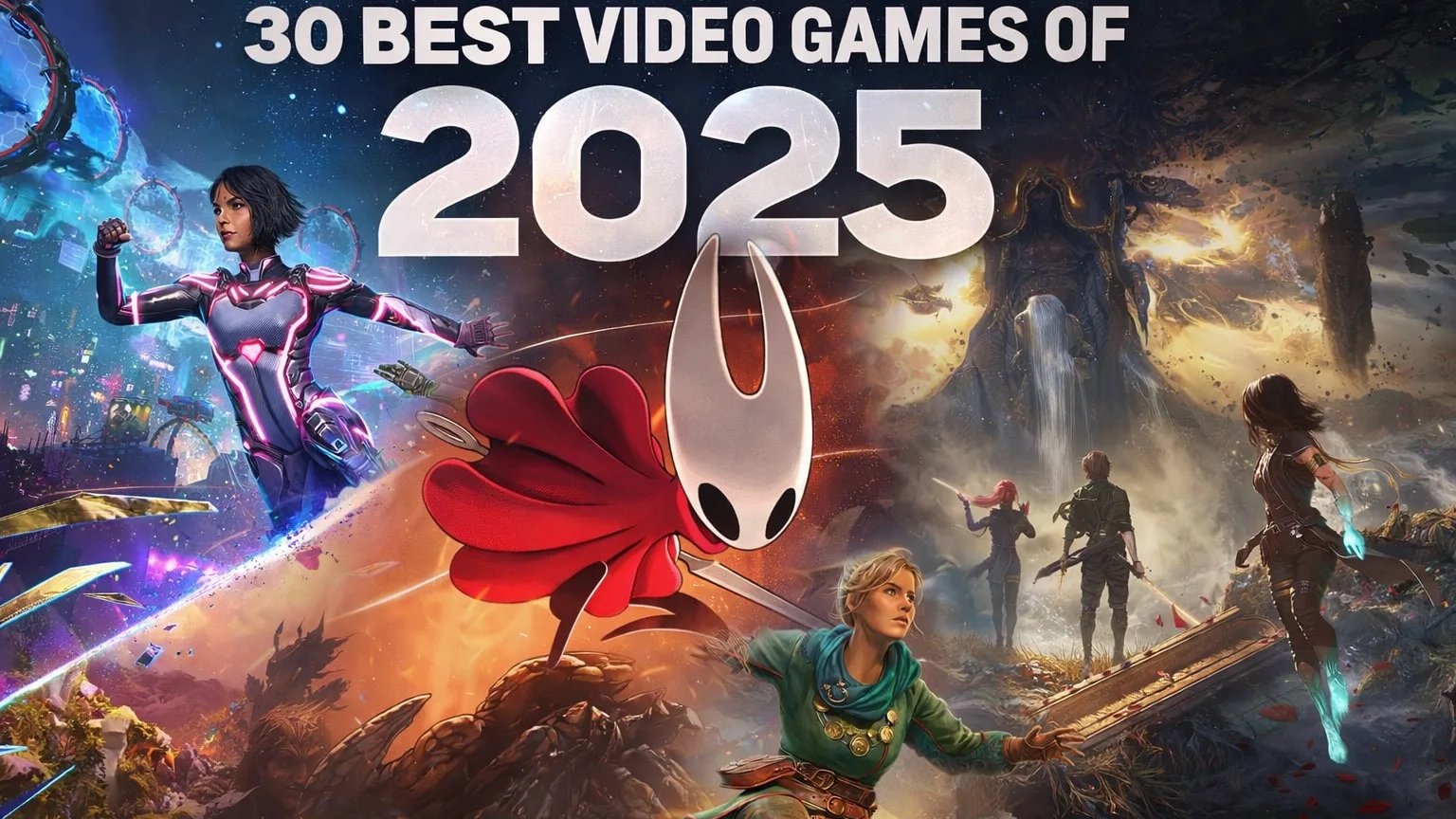

2025 was supposed to be the Year of GTA, the kind of calendar monopoly that turns every other release into background noise. Then the release windows shifted, and the spotlight moved. Suddenly, the year belonged to a swarm of sharp-edged experiments: European RPG rigor, indie weirdness that felt like a dare, and blockbuster sequels that remembered how to behave in public.
The PS5 and Xbox Series era also hit a late-stage maturity, the moment where “current gen” stops sounding like a marketing label and starts acting like a stable platform. Frame pacing tightened. Load times became a non-issue. Studios spent less energy fighting hardware and more energy writing systems that could actually breathe. Then the Switch 2 arrived and rearranged assumptions about portability, social play, and what “4K/60fps” even means in a living room where someone is also eating chips directly over your controller.
This list follows three yardsticks: technical polish, narrative depth, and genre momentum. Some games excel through storytelling that bites back. Others sharpen a mechanic until it becomes an argument. A few do both, then grin like they got away with something.
#30: Dynasty Warriors: Origins
Why play: A refined “tactical action” reset that trades mindless map-clearing for high-stakes, authored battlefield drama.
Platforms: PC, PS5, Xbox Series X/S • Release year: 2025 • Genre: Musou/Action • Best for: Fans of historical warfare who want tactical depth and meaningful scale without open-world bloat.
Developer: Omega Force | Playstyle: Single-player, third-person action, tactical-lite | Tone: Heroic, cinematic, focused | Core appeal: A more intimate, character-driven perspective on the Three Kingdoms featuring highly responsive battlefield AI.
Omega Force finally treated “open world” as a cautionary tale rather than a mandate, and Dynasty Warriors: Origins benefits from that restraint. The “Origins” philosophy narrows the frame: fewer distractions, cleaner objectives, and a battlefield that feels authored instead of scattered.
The nameless protagonist is a clever reset button. Rather than dragging in a preloaded legend, the game lets you watch the Three Kingdoms conflict from a more intimate angle, like a foot soldier who keeps accidentally becoming a myth. The scale still matters. Battlefield AI reads the flow of a skirmish with modern discipline, feeding that classic 1-vs-1,000 fantasy without turning it into a slideshow of identical grunts.
It plays like a genre homecoming, minus the dust.
#29: F1 25
Why play: The most tactile racing sim in years, where “Handling 2.0” makes the car feel like a living machine rather than a guided missile.
Platforms: PC, PS5, Xbox Series X/S • Release year: 2025 • Genre: Racing Sim • Best for: Competitive racers and F1 enthusiasts who crave physics-based consequences and authentic driver personalities.
Developer: Codemasters | Playstyle: Single-player career, online multiplayer | Tone: Professional, high-tension, prestigious | Core appeal: A deep career mode rebuild where real-world driver data dictates aggressive and believable AI behavior.
F1 25 hinges on “Handling 2.0,” and the change is tactile in the best way: the car feels less like a remote-controlled missile and more like a machine with opinions. Small steering inputs carry consequences. Curbs stop being decorative. The friction between bravery and physics becomes the real opponent.
Career Mode gets a meaningful rebuild, especially in how real-world driver data shapes AI behavior. Rivals don’t act like interchangeable drones anymore. They defend lines with personality, make mistakes with believable timing, and punish yours with cold professionalism. Iconic tracks receive a visual overhaul that makes familiar corners feel newly legible, like the sport finally turned the lights on.
The off-track lifestyle layer pushes the sports sim toward RPG territory, where identity management becomes another kind of race.
#28: Avowed
Why play: Obsidian’s signature choice-and-consequence writing meets a vibrant, first-person fantasy world where your build and your morals are equally flexible.
Platforms: PC, Xbox Series X/S • Release year: 2025 • Genre: First-person RPG • Best for: Players who value narrative agency and “improvisational” combat mixing magic, steel, and firearms.
Developer: Obsidian Entertainment | Playstyle: Single-player, exploration-heavy | Tone: High-fantasy, political, adventurous | Core appeal: The “Living Lands” setting, where environmental beauty acts as a precursor to complex moral dilemmas and reactive systems.
Avowed marks Obsidian’s leap from the isometric language of Pillars of Eternity into a first-person fantasy epic, and it carries the studio’s favorite weapon across the gap: choice-and-consequence storytelling. The Living Lands functions as both postcard and threat, a colorful frontier where beauty reads like a warning sign.
Combat sells the premise. Dual-wielding invites an elegant kind of chaos, mixing magic, melee, and firearms with a rhythm that feels improvised yet controlled. You can build a style that looks contradictory on paper and coherent in motion. That flexibility matters because the setting constantly asks what you stand for, then hands you a lever that snaps something important.
Agency isn’t a bullet point here. It’s the atmosphere, hanging in every dialogue beat and every fight you initiate for reasons you half-understand.
#27: Wuchang: Fallen Feathers
Why play: A soulslike that trades traditional gothic horror for a suffocating Ming Dynasty nightmare fueled by folklore and aggressive parry-based combat.
Platforms: PC, PS5, Xbox Series X/S • Release year: 2025 • Genre: Action RPG/Soulslike • Best for: Hardcore action fans looking for a fresh cultural setting and a high-risk, high-reward combat rhythm.
Developer: Leaps Studio | Playstyle: Single-player, challenging, boss-centric | Tone: Dark, superstitious, oppressive | Core appeal: The “Feather” plague mechanic that influences both the grotesque enemy designs and the protagonist’s evolving abilities.
Wuchang: Fallen Feathers drapes late Ming Dynasty China in sickness and superstition, then tightens the cloth until it suffocates. The “feather” plague doesn’t feel like a gimmick. It acts like a worldview infection, turning streets and shrines into spaces where folklore and dread share the same oxygen.
Combat rewards aggression with a sharp smile. Parrying is less a defensive trick and more a demand for nerve, especially once Chakram and Gun sub-weapons enter the mix. Those tools complicate timing, spacing, and risk, making every duel feel like a micro-argument about control. The game earns its Soulslike comparisons through difficulty and world-building craft, yet its roots in Chinese folklore give it a different spiritual temperature. These monsters don’t read like imported nightmares. They feel local, ancestral, and slightly offended that you’re still breathing.
#26: South of Midnight
Why play: A Southern Gothic odyssey that uses a stunning stop-motion aesthetic to bring a mythic, flooded Mississippi Delta to life.
Platforms: PC, Xbox Series X/S • Release year: 2025 • Genre: Action-Adventure • Best for: Players looking for a shorter, highly stylized narrative experience rooted in unique American folklore.
Developer: Compulsion Games | Playstyle: Single-player, exploration, third-person combat | Tone: Eerie, soulful, whimsical | Core appeal: The weaving magic system that turns environmental traversal into a tactile, narrative-driven craft.
Compulsion Games swings for the fences with South of Midnight, then decides the fences should be made of cypress trees and old stories. The Southern Gothic aesthetic is thick with swamp hush and mythic menace, set in a flooded Mississippi Delta that behaves like a half-remembered folktale.
The weaving magic system turns traversal into craft. Movement feels like stitching your way through a world that keeps unraveling. The stop-motion animation choice (30fps character movement against 60fps environments) creates a deliberate visual friction, like the protagonist exists one step behind reality. That tension builds a storybook mood without drifting into cute. It’s uncanny, sometimes tender, occasionally unsettling.
In a year packed with technical flexing, South of Midnight stands out by making style a narrative device. The animation isn’t a filter. It’s a thesis.
#25: The Alters
Why play: A psychological base-builder where the most volatile resources you have to manage are the different versions of yourself.
Platforms: PC, PS5, Xbox Series X/S • Release year: 2025 • Genre: Survival/Sci-Fi Sim • Best for: Sci-fi fans who enjoy heavy themes of regret, identity, and complex social management systems.
Developer: 11 bit studios | Playstyle: Single-player, resource management, narrative-heavy | Tone: Introspective, tense, philosophical | Core appeal: The “Alters” system, creating clones based on divergent life paths that force you to confront your own past choices.
The Alters disguises itself as a base builder, then reveals the real resource it wants you to manage: your own unresolved self. Jan Dolski’s survival plan involves creating “Alters,” clones shaped by different life paths he could have taken. Each Alter arrives with skills, needs, and a personality that feels uncomfortably plausible, like you’re arguing with the version of you that never made a certain mistake.
The tension comes from the social logistics of self-division. You’re scheduling labor and emotional landmines at the same time, trying to keep the base functioning while your clones resent you for being the “original” who got them stranded. The game raises philosophical questions about regret and identity without turning into a lecture. It simply keeps handing you mirrors, then asks you to sleep in the room full of them.
Spoiler: it’s noisy in there.
#24: Citizen Sleeper 2: Starward Vector
Why play: A masterclass in tabletop-inspired sci-fi that proves managing a crew and a ship is as much about emotional labor as it is about dice rolls.
Platforms: PC, Nintendo Switch, PS5, Xbox Series X/S • Release year: 2025 • Genre: Narrative RPG • Best for: Fans of lo-fi aesthetics and hard-hitting stories about labor, capitalism, and human connection.
Developer: Jump Over the Age | Playstyle: Single-player, text-heavy, management-lite | Tone: Melancholic, gritty, hopeful | Core appeal: The “Push Your Luck” dice mechanic that turns the arithmetic of survival into a high-stakes gambling match for your life.
Citizen Sleeper 2: Starward Vector expands its tabletop RPG mechanics in a way that changes the mood. Survival no longer reads as solitary endurance. Now you manage a crew and a ship, which means responsibility becomes a system, not a feeling. The “Push Your Luck” dice structure stays central, and the tension remains deliciously arithmetic: you watch numbers and realize they contain fate.
The writing is quietly brutal. Themes of labor, capitalism, and personhood unfold through small decisions that feel like paperwork with consequences, the kind of bureaucracy that grinds people into “units” and calls it efficiency. The lo-fi sci-fi setting helps. Neon isn’t the point. Scarcity is.
What lands hardest is how the game treats community. A crew is support, yes. A crew is also pressure. You can’t roll your way out of caring.
#23: Borderlands 4
Why play: A return to form that pairs the series’ trademark loot-chasing chaos with a much-needed sharpening of its darker narrative roots.
Platforms: PC, PS5, Xbox Series X/S • Release year: 2025 • Genre: Looter-Shooter • Best for: Groups of friends who want polished gunplay and an endless stream of procedurally generated ballistics.
Developer: Gearbox Software | Playstyle: 4-player co-op or single-player | Tone: Anarchic, dark-humored, high-energy | Core appeal: The procedural weapon engine and seamless planetary travel that eliminates the friction between exploration and combat.
Borderlands 4 returns to the series’ darker humor with a steadier hand, as if Gearbox remembered that chaos works better when the story has a spine. The four new Vault Hunters give the mayhem a clearer human angle, even when everything is exploding for reasons that feel petty and cosmic at once.
The refined procedural weapon engine makes guns feel more distinct, which matters because Borderlands lives and dies on the sensation of discovery. Here, a weapon drop lands like a punchline with ballistics. Seamless planetary travel keeps momentum high, reducing friction between “I wonder what’s over there” and “I’m already over there.” And the endgame Raid content kept the community busy in the way only a good loot chase can: equal parts teamwork, obsession, and arguing about builds like it’s an academic conference with grenades.
It’s strangely comforting to watch the franchise behave, right before it misbehaves again.
#22: Metal Gear Solid Delta: Snake Eater
Why play: A meticulous reconstruction of a stealth classic that uses Unreal Engine 5 to make the jungle a dense, tactical character of its own.
Platforms: PC, PS5, Xbox Series X/S • Release year: 2025 • Genre: Stealth Action • Best for: Fans of the original seeking modern polish and newcomers wanting the definitive version of a gaming legend.
Developer: Konami | Playstyle: Single-player, tactical stealth | Tone: Cinematic, survivalist, melodramatic | Core appeal: The Battle Damage system, where every scar and tear Snake sustains serves as a persistent visual history of your playthrough.
Metal Gear Solid Delta: Snake Eater treats “remake” as reconstruction. Unreal Engine 5 gives the jungle a density that finally matches the ambition of the original vision, turning foliage into a tactical language instead of scenery. You read leaves the way you read enemy patrol routes.
The Battle Damage system is the quiet genius here. Scars and clothing tears persist across the entire game, so Snake’s body becomes a historical record of your choices and mistakes. It’s a survival diary written in fabric and skin. The control options, “Legacy” and “Modern” third-person, do more than accommodate comfort. They change how you inhabit tension. One invites you to remember, the other invites you to re-learn.
Delta also highlights Metal Gear’s enduring interest in performance: the soldier as actor, the mission as stage, the player as co-author who keeps insisting they’re “just following orders” (sure you are).
#21: Like a Dragon: Pirate Yakuza in Hawaii
Why play: A gloriously unhinged spin-off that proves Goro Majima is just as compelling behind a ship’s wheel as he is in a street brawl.
Platforms: PC, PS4, PS5, Xbox One, Xbox Series X/S • Release year: 2025 • Genre: Action RPG • Best for: Players who love tonal whiplash, absurd mini-games, and surprisingly deep naval combat.
Developer: RGG Studio | Playstyle: Single-player, brawler, exploration | Tone: Absurdist, heartfelt, chaotic | Core appeal: The “Sea Dog” combat style and ship customization that fully integrates pirate fantasy into the Yakuza ecosystem.
Like a Dragon: Pirate Yakuza in Hawaii embraces absurdity with the confidence of a series that has already dared you to flinch. Goro Majima wakes up amnesiac and somehow ends up chasing pirate kingship, which sounds like a fever dream until you remember this franchise treats fever dreams as scheduling conflicts.
The “Mad Dog” combat style still carries that feral street-fighting energy, while the “Sea Dog” style adds cutlasses and flintlocks, turning brawls into slapstick swashbuckling. Naval combat and ship customization could have been a gimmick. RGG Studio makes it feel like a genuine RPG pillar, something you build, tune, and emotionally attach to for reasons you can’t defend in court.
What sells it is the tonal dexterity. One scene is hilarious. The next is heart-wrenching. Majima remains the same man in both, which is either profound or deeply irresponsible. Possibly both.
#20: Civilization VII
Why play: A bold evolution of the 4X formula that replaces static history with a living, breathing “Ages” system that demands constant adaptation.
Platforms: PC, Nintendo Switch, PS4, PS5, Xbox One, Xbox Series X/S • Release year: 2025 • Genre: Grand Strategy • Best for: Strategy enthusiasts who want to guide an empire through radical reinvention rather than a single linear path.
Developer: Firaxis Games | Playstyle: Single-player, online multiplayer | Tone: Epic, intellectual, historical | Core appeal: The removal of micromanaged builders and the introduction of “Commander” units to streamline massive late-game conflicts.
Civilization VII makes a bold move with the “Ages” system, where your civilization’s identity shifts as history progresses. It turns the timeline into a living argument: who you were stops being destiny, and adaptation becomes the defining skill. The change reframes victory as a series of reinventions rather than a straight-line plan.
Removing “builders” in favor of more organic city growth reduces busywork and changes the feel of development. You’re guiding an organism instead of micromanaging an ant farm. The new “Commander” units help streamline large-scale warfare, turning late-game conflict into strategy rather than a tedious logistics spreadsheet with swords.
This is the most significant mechanical leap since Civ V because it revises the franchise’s core fantasy. Civilization has always promised control over history. Civ VII asks what happens when history refuses to stay in one shape, and your empire has to keep rewriting its own name tag.
#19: Pokémon Legends: Z-A
Why play: A focused, urban-centric Pokémon journey that trades sprawling continents for the dense, evolving streets of Lumiose City.
Platforms: Nintendo Switch, “Switch 2” • Release year: 2025 • Genre: Creature Collector/RPG • Best for: Fans who enjoyed the catching loops of Arceus and want a more structured, district-based progression system.
Developer: Game Freak | Playstyle: Single-player, collection-focused | Tone: Modern, busy, mysterious | Core appeal: The “urban renewal” plot that sees the city change over time, alongside the tactical return of Mega Evolutions.
Pokémon Legends: Z-A commits to a single setting, a developing Lumiose City, and the choice pays off by making the world feel like a lived space rather than a scenic route between gyms. The “urban renewal” plot gives the city a sense of motion. Buildings change. Districts shift. The map becomes a story in progress.
Catching mechanics evolve from Arceus in a way that fits the urban frame. You’re hunting in alleyways, parks, and construction zones, reading human infrastructure as part of the ecosystem. Mega Evolutions return with purpose, adding tactical depth to “Alpha” style battles where power spikes create real decision pressure. Timing matters, momentum matters, and the spectacle has strategic teeth.
The game quietly argues that Pokémon can thrive without sprawling across a continent. A single-location structure creates focus, and focus creates texture. Lumiose stops being a backdrop and becomes a character with zoning laws and secrets.
#18: Assassin’s Creed Shadows
Why play: A dual-protagonist epic that finally delivers the definitive shinobi fantasy while grounding it in a reactive, seasonal weather system.
Platforms: PC, PS5, Xbox Series X/S • Release year: 2025 • Genre: Stealth/Action RPG • Best for: Players who enjoy switching between high-finesse stealth and brutal, heavy-armored combat.
Developer: Ubisoft Québec | Playstyle: Single-player, open-world exploration | Tone: Serious, historical, atmospheric | Core appeal: The dynamic seasons (snow, rain, wind) that physically alter stealth lanes and enemy detection in real-time.
Assassin’s Creed Shadows builds its identity on contrast: Naoe’s hidden blade stealth and Yasuke’s armored tank combat. The two styles don’t just play differently. They frame the world differently. One reads rooftops as routes. The other reads doors as suggestions.
The seasonal weather system adds a tactical unpredictability that feels earned. Snow changes traction and visibility. Rain alters sound and sight lines. Wind can mask noise, and ice can break at exactly the wrong time during a stealth approach (the game’s sense of humor is occasionally cruel). This is where the long-promised Shinobi fantasy finally clicks: stealth as environment reading, patience as action.
Shadows also has a historical echo. It asks what violence looks like when it wears different uniforms, when stealth and force become two political languages. You can switch protagonists. The world keeps judging you anyway.
#17: The Elder Scrolls IV: Oblivion Remastered
Why play: A polished trip back to Cyrodiil that preserves the quirky charm of the original while scrubbing away decades of technical grime.
Platforms: PC, PS5, Xbox Series X/S • Release year: 2025 • Genre: Open-world RPG • Best for: Nostalgic fans and RPG players who want a classic heroic arc in a world that feels wonderfully eccentric.
Developer: Bethesda Game Studios | Playstyle: Single-player, sandbox exploration | Tone: Earnest, high-fantasy, surreal | Core appeal: Radiant AI quirks and the Shivering Isles expansion, now supported by a modern physics engine and improved stability.
Oblivion Remastered trades on nostalgia, and it earns it. Returning to the Imperial City hits like stepping into an old dream that still remembers your name. The Shivering Isles remain a highlight, a surreal detour where the series’ weirdness becomes the main road.
Technical updates matter here because Oblivion’s charm always lived alongside chaos. The improved physics engine preserves the slapstick unpredictability without turning it into pure malfunction. Radiant AI keeps the original quirks, yet the remaster smooths out the game-breaking bugs that used to convert “adventure” into “reload your save, again.”
What still lands is the Champion of Cyrodiil story, a heroic arc that feels strangely intimate, even while demons pour out of gates like the world is having a tantrum. It’s Bethesda history at its best: earnest, eccentric, occasionally messy, and weirdly sincere about fate.
#16: Battlefield 6
Why play: A “back-to-basics” reboot that remembers the series’ true identity is found in 64-player chaos and meaningful, strategic destruction.
Platforms: PC, PS5, Xbox Series X/S • Release year: 2025 • Genre: First-person Shooter • Best for: Players who miss the class-based teamwork and large-scale warfare of BF3 and BF4.
Developer: DICE | Playstyle: Large-scale online multiplayer | Tone: Gritty, chaotic, tactical | Core appeal: “Levolution 2.0,” allowing for the piece-by-piece dismantling of buildings to rewrite the map’s cover in real-time.
Battlefield 6 takes the “soft reboot” route and remembers what made Battlefield feel like a war story you accidentally co-wrote with strangers. The return to 64-player maps helps. The scale is large enough for chaos, small enough for recognition, the sweet spot where you start remembering the enemy tank’s habits like it’s a rival you can’t stop thinking about.
“Levolution 2.0” is the headline feature, and it delivers with a satisfying material logic. Skyscrapers can be dismantled piece-by-piece rather than collapsing through scripted theatrics. Destruction becomes a strategy layer, a way to rewrite cover, routes, and sight lines in real time. The class-based system also comes back, nodding to BF3 and BF4 fans who missed defined roles and readable team composition.
It feels like Battlefield admitting it tried to be too many things, then returning with a blueprint and a wrecking ball.
#15: Call of Duty: Black Ops 7
Why play: A high-octane spy thriller that fundamentally changes CoD movement with “Omnimovement,” allowing for 360-degree combat agility.
Platforms: PC, PS4, PS5, Xbox One, Xbox Series X/S • Release year: 2025 • Genre: First-person Shooter • Best for: Fans of fast-paced competitive play and mind-bending, paranoia-fueled political campaigns.
Developer: Treyarch / Raven Software | Playstyle: Single-player, multiplayer, round-based Zombies | Tone: Paranoiac, cinematic, aggressive | Core appeal: The Gulf War-era narrative that weaponizes information and trust, paired with a return to classic round-based Zombies.
Call of Duty: Black Ops 7 moves like it has something to prove, and “Omnimovement” is the proof. Diving, sliding, and sprinting in any direction (full 360 degrees) changes the geometry of combat. Angles become less predictable. Muscle memory becomes a liability you have to retrain.
The Gulf War-era spy thriller campaign leans into the Mind-Trip DNA of the original Black Ops, treating paranoia as both theme and gameplay texture. Information is weaponized, trust becomes scarce, and the story keeps asking how much of your identity is choice versus programming. It’s a classic political thriller mood, filtered through a series that loves to melt the walls.
Round-based Zombies returns in strong form, and the mode benefits from the same design attitude: movement as expression, danger as rhythm. It’s grim fun, which is a phrase that probably belongs on a warning label.
#14: Fatal Fury: City of the Wolves
Why play: A legendary fighting franchise returns with a “REV System” that makes every offensive burst a high-stakes gamble against overheating.
Platforms: PC, PS4, PS5, Xbox Series X/S • Release year: 2025 • Genre: Fighting Game • Best for: Both high-level competitive fighters and newcomers looking for stylish, accessible entry points.
Developer: SNK | Playstyle: 1v1 competitive (local and online) | Tone: Stylish, vibrant, nostalgic | Core appeal: The “Smart Style” controls and crisp cel-shaded art that make the fundamentals of spacing and timing feel dramatic.
Fatal Fury: City of the Wolves arrives after 26 years like a fighter walking back into the ring with a calm smile and a very long memory. The “REV System” is the heart of its modern feel: offensive and defensive boosts tempt you into risk, and overheating punishes greed. It’s a mechanic that turns momentum into a negotiation with your own impatience.
The cel-shaded art style reads crisp and expressive, giving hits a comic-book snap without losing weight. “Smart Style” controls lower the barrier for newcomers, yet the game doesn’t flatten skill expression. High-level play still lives in timing, spacing, and resource management. The accessibility layer feels like an invitation rather than a compromise.
In a year full of mechanical reinventions, City of the Wolves earns its place by making fundamentals feel dramatic again.
#13: Blue Prince
Why play: A cerebral architectural puzzle game where you draft the very rooms of the mansion you are trying to escape.
Platforms: PC, PS5, Xbox Series X/S • Release year: 2025 • Genre: Mystery/Puzzle Strategy • Best for: Players who enjoy roguelike loops and thinking like an architect to solve environmental mysteries.
Developer: Dogubomb | Playstyle: Single-player, strategic room-placement | Tone: Quiet, intellectual, haunting | Core appeal: The high-stakes “room drafting” mechanic where a single poor layout decision can doom your entire investigation.
Blue Prince begins with a simple premise and then quietly becomes an obsession: you inherit a mansion where every door leads to a room you choose from a draft of cards. Architectural planning turns into high-stakes strategy. One bad placement can end your run, and you feel the mistake like a wrong note in a song you can’t stop humming.
The mystery of “Room 46” gives the structure a gravitational pull. You’re building corridors and secrets at the same time, trying to reconcile the logic of floor-planning with the irrational hunger of curiosity. Each decision feels like a small act of authorship, then the game reminds you that authorship has consequences.
There’s a sly cultural metaphor in here. Real estate becomes destiny. Layout becomes narrative. The house becomes an algorithm for inheritance, the kind you can’t fully control, only negotiate with. The mansion isn’t haunted by ghosts. It’s haunted by design.
#12: Absolum
Why play: A “found footage” horror experience that uses visual grain and audio silence to turn your own imagination into the primary threat.
Platforms: PC, PS5 • Release year: 2025 • Genre: Psychological Horror • Best for: Horror purists who want a tense, mean-spirited game that explores trauma through spatial distortion.
Developer: Independent | Playstyle: Single-player, exploration, light puzzle-solving | Tone: Dread-filled, uncanny, hostile | Core appeal: The “Memory Sharding” mechanic, where you must reconstruct your past while navigating environments that react to your fears.
Absolum uses “found footage” aesthetics like a nervous system. The camera’s jitter and grain aren’t decoration. They create doubt, and doubt becomes the primary monster. Spatial distortion bends rooms into traps that feel personal, as if architecture has learned your fears and started improvising.
The “Memory Sharding” mechanic drives the horror forward. You reconstruct your own past to unlock new areas, then discover your memories are actively hostile, trying to kill you with the sharp edges you avoided acknowledging. It’s a psychological horror loop where progress and punishment share the same doorway.
Sound design deserves its own warning label. Silence becomes bait. Tiny audio cues become threats. You start listening the way you look over your shoulder in a dark parking lot, fully aware that your imagination is the least reliable witness.
Absolum is tense, mean, and weirdly honest about how trauma edits a person.
#11: Arc Raiders
Why play: A gorgeous retro-sci-fi extraction shooter where giant mechanical threats from the sky force enemies to become temporary allies.
Platforms: PC, PS5, Xbox Series X/S • Release year: 2025 • Genre: Extraction Shooter • Best for: Players looking for a high-stakes PvPvE experience with a sense of scale and physical presence.
Developer: Embark Studios | Playstyle: Online multiplayer co-op/competitive | Tone: Atmospheric, industrial, tense | Core appeal: The towering “Arc” machines that drop into the world, functioning as massive, unpredictable environmental bosses.
Arc Raiders pivots from a co-op shooter into a high-stakes extraction shooter, and the shift fits its world’s mood of opportunistic dread. The retro-sci-fi aesthetic sells a future that looks worn out, patched together, and lived in, a place where survival feels like a side hustle.
The Raiders themselves have real physical presence. Giant mechanical threats drop from the sky with the authority of a natural disaster. Their scale changes player behavior. PvP tension remains sharp, yet the machines force a different kind of fear, the kind that makes enemies temporarily become allies because an iron god just landed nearby.
Extraction games often lean on greed and betrayal as fuel. Arc Raiders adds something else: awe. It’s hard to posture when a towering machine is rewriting the map in front of you. You don’t feel heroic. You feel small, clever, and briefly alive.
#10: Elden Ring: Nightreign
Why play: A brutal reframing of the Lands Between that emphasizes wave-based survival and high-pressure team coordination.
Platforms: PC, PS4, PS5, Xbox One, Xbox Series X/S • Release year: 2025 • Genre: Action RPG • Best for: Elden Ring veterans looking for a more combat-focused, stamina-testing challenge with friends.
Developer: FromSoftware | Playstyle: Co-op focused, wave-survival, RPG progression | Tone: Epic, grim, desperate | Core appeal: The “Nightreign” period bosses, which expand the game’s lore into terrifying new shapes designed for team play.
Elden Ring: Nightreign isn’t a full sequel, yet it feels essential because it reframes the Lands Between through a harsher lens. The “Nightreign” period pushes a combat-focused, wave-based survival structure that turns every encounter into a stamina test, mentally and mechanically. You’re managing spacing, threat priority, and resource attrition with the desperation of someone counting matches in a storm.
Deep RPG progression keeps the loop sticky. Builds evolve with purpose, and the new co-op “Spirit Summons” changes how teams coordinate, adding a layer of shared tempo. Someone draws aggro, someone interrupts, someone gambles on a risky parry. Cooperation becomes choreography, and failure becomes a group confession.
The new boss designs land like nightmares that escaped a myth. They feel like lore with teeth, expanding the Great Will’s shadow into shapes that are hard to describe without sounding like you’re reading from a cursed manuscript. Nightreign makes fear playable again, which is a neat trick for a world many players thought they already understood.
#9: Death Stranding 2: On the Beach
Why play: Kojima’s sequel doubles down on the “walking sim” as a philosophical tool, adding floods and shifting terrain to its gorgeous, judgmental vistas.
Platforms: PS5 • Release year: 2025 • Genre: Action-Adventure/Social Strand • Best for: Players who want a slow, beautiful, and deeply strange meditation on human labor and connection.
Developer: Kojima Productions | Playstyle: Single-player, traversal-heavy | Tone: Surreal, cinematic, melancholic | Core appeal: The evolving traversal mechanics where you must literally bargain with a changing environment to maintain your delivery routes.
Death Stranding 2: On the Beach doubles down on surrealism and somehow makes it feel practical. Sam Bridges moves beyond the UCA, and the new mission is framed through Drawbridge, a private entity focused on connection. The word “connection” keeps doing double duty here: infrastructure, emotional labor, political power, existential coping mechanism. Pick your poison.
The Decima engine’s graphical fidelity carries a peculiar beauty, the kind that makes empty landscapes feel judgmental. New traversal challenges like floods and shifting terrain turn movement into negotiation. You don’t “solve” the environment. You bargain with it, and it keeps changing its terms.
Higgs returns through a meta-narrative thread that toys with performance and identity, while “automated” threats raise a quiet question about the value of human labor. If a world can be connected by machines, what happens to the people who built their identities around carrying things for others? The game doesn’t answer. It pokes.
And then it asks you to carry the poke across a river.
#8: Doom: The Dark Ages
Why play: A medieval power fantasy that adds heavy plate armor and defensive depth to the fastest shooter in the business.
Platforms: PC, PS5, Xbox Series X/S • Release year: 2025 • Genre: First-person Shooter • Best for: Action fans who want the “push-forward” rhythm of Doom but with the weight of a battering ram.
Developer: id Software | Playstyle: Single-player, high-speed combat | Tone: Brutal, heavy-metal, apocalyptic | Core appeal: The “Shield Saw” tool, which allows for aggressive defense and projectile-based gore in a medieval setting.
Doom: The Dark Ages takes the franchise’s velocity and adds weight, like someone strapped plate armor onto the power fantasy and called it character growth. The medieval shift changes pacing. Combat is slower, heavier, more deliberate, and the result feels like “push-forward” design turned into a battering ram.
The “Shield Saw” is the defining tool. It blocks, it bites, it launches like a projectile with anger issues. It makes defense feel aggressive, which is very Doom, and it creates a brutal rhythm: absorb impact, return it with interest. The “Atlan,” a giant mech for fighting Kaiju-sized demons, amplifies the spectacle without losing the series’ core joy of controlled brutality.
There’s a cultural resonance to Doom going medieval. It’s the same rage, filtered through an older iconography of crusades and apocalypse murals. The demons remain demons. The armor suggests history repeats itself, just with different metal.
Also, the soundtrack carries that heavy-metal weight like it’s carrying a grudge.
#7: Mario Kart World
Why play: The “Ultimate” racing hub that combines every track in history with a massive social park for the definitive party game experience.
Platforms: “Switch 2” • Release year: 2025 • Genre: Kart Racer • Best for: Families, competitive racers, and anyone looking for the social “hangout” equivalent of a digital theme park.
Developer: Nintendo | Playstyle: Local and online multiplayer, Adventure mode | Tone: Joyful, competitive, vibrant | Core appeal: The “World Hub” social space and a 4K visual overhaul that makes the series’ trademark speed feel cleaner than ever.
Mario Kart World positions itself as the “Ultimate” Mario Kart by brute force and by charm. Every track in series history sits alongside a massive “World” hub, a social space where players can drive around, interact, and customize karts. It’s a theme park and a lobby, and it understands that half the fun of Mario Kart is the trash talk you can’t put in a rating label.
On the new hardware, 4K/60fps visuals make speed feel clean rather than blurry, and the crispness changes how players read corners and hazards. “Adventure Mode” adds a story layer to racing for the first time, and the novelty isn’t narrative complexity. It’s context. Missions give structure to what used to be pure competition, then fold you back into multiplayer with new skills and new grudges.
The World hub also feels culturally timely. Games keep becoming places where people hang out, even when they claim they “just logged in for one race.” Sure you did.
#6: Ghost of Yotei
Why play: A haunting frontier story set around Mount Yotei that explores what happens when samurai code is replaced by raw survival.
Platforms: PS5 • Release year: 2025 • Genre: Action-Adventure • Best for: Players who loved Ghost of Tsushima but want a darker, more personal narrative involving early firearms.
Developer: Sucker Punch Productions | Playstyle: Single-player, open-world, stealth/action | Tone: Somber, wild, untamed | Core appeal: The reactive snow and wind physics that serve as both a navigation tool and an active storytelling device.
Ghost of Yotei shifts away from Tsushima and into the wild, untamed lands around Mount Yotei, and the relocation changes the moral weather. The new protagonist, Atsu, steps into a space where the old samurai codes don’t carry the same authority. That absence matters. “Becoming the Ghost” in a land without a clear rulebook turns the fantasy darker and more personal. Who are you without the script?
Early firearms enter the combat language alongside traditional katana play, and the mix carries historical tension. Gunpowder doesn’t just add range. It adds a philosophical irritant, a reminder that technology can rewrite honor with a single loud invention. The game’s snow and wind physics help guide the player, turning the environment into an active storyteller. Snow hides tracks, then reveals them. Wind nudges you toward a destination, then howls like it’s laughing at your certainty.
Yotei also taps into a long cultural thread: the frontier as a space where identities mutate. Sometimes it becomes liberation. Sometimes it becomes excuse. Atsu walks that line, and the game watches, quietly, like it expects you to trip.
#5: Kingdom Come: Deliverance II
Why play: An uncompromising historical sim that makes your character’s reputation, hygiene, and social standing as important as his sword skill.
Platforms: PC, PS5, Xbox Series X/S • Release year: 2025 • Genre: Open-world RPG • Best for: Hardcore RPG fans who want an authentic, unromanticized medieval experience with deep consequence.
Developer: Warhorse Studios | Playstyle: Single-player, immersive sim-lite | Tone: Gritty, realistic, muddy | Core appeal: The refined directional combat and “reputation tracking” that forces you to live with the physical and social results of every action.
Kingdom Come: Deliverance II embraces the “Hardcore RPG” label with the confidence of a game that knows exactly how many players will bounce off its insistence on consequence. The city of Kuttenberg feels enormous and alive, not simply in size but in social density. You’re moving through a medieval space where reputation operates like currency and gossip moves faster than your horse.
The directional combat system returns refined, demanding attention to angles, stamina, and timing. Fights feel awkward in the way real fights are awkward, then rewarding in the way mastery always is: you begin clumsy, you end precise, and you remember every bruise. Henry’s reputation tracking is the secret engine. Hygiene, clothing, and speech shape how the world treats you, which turns role-playing into something tactile. You can’t charm your way out of smelling like a ditch.
It’s a triumph of historical simulation because it refuses to romanticize the period into clean heroism. History is messy. Your boots are muddy. People judge you for it. The game seems pleased.
#4: Monster Hunter Wilds
Why play: A seamless ecological masterpiece where the hunt never resets and the weather is as dangerous as the monsters.
Platforms: PC, PS5, Xbox Series X/S • Release year: 2025 • Genre: Action RPG • Best for: Hunters who want a living world where preparation and pursuit flow together without loading screens.
Developer: Capcom | Playstyle: Single-player or 4-player co-op | Tone: Epic, naturalistic, high-adrenaline | Core appeal: The “Seamless” world design and “Focus Mode” combat that lets you target specific monster wounds for surgical efficiency.
Monster Hunter Wilds is built around “Seamlessness,” and the change reshapes the franchise’s emotional rhythm. The barrier between village and hunt dissolves, so the world stops feeling like a set of separated activities and starts feeling like a continuous ecosystem. You aren’t clocking in for a mission. You’re living in a landscape that keeps moving, with or without your consent.
Weather patterns play a real role in what monsters appear. Sandstorms aren’t just visual drama. They become ecological events that alter visibility, behavior, and risk calculus. “Focus Mode” adds surgical clarity, letting hunters target monster wounds with precision, which changes the hunt from pure endurance into something closer to anatomy and timing. The “Seikret” mount is a design flex that quietly solves multiple problems: mobility, mid-hunt weapon swapping, and the sense that you and your gear are part of a single flowing process.
Wilds feels like Capcom asking a simple question: what if the hunt never had to reset? The answer is a game where preparation, pursuit, and aftermath blur together. You start tracking a monster and realize you’ve been tracked right back.
#3: Hollow Knight: Silksong
Why play: A high-speed, vertical evolution of the Metroidvania genre that turns movement into a lethal, elegant dance.
Platforms: PC, Nintendo Switch, PS5, Xbox Series X/S • Release year: 2025 • Genre: Metroidvania • Best for: Fans of the original craving faster combat and players who enjoy “discovering” a world’s logic through play.
Developer: Team Cherry | Playstyle: Single-player, challenging exploration | Tone: Intricate, mysterious, graceful | Core appeal: Hornet’s vertical movement and the “Tools” crafting system that makes gear feel like a natural extension of her silk-based abilities.
Hollow Knight: Silksong arrives after years of anticipation and somehow lands with the poise of a game that knew the wait would shape its reception. Hornet’s movement is vertical and fast, a stark shift from the Knight’s more grounded cadence. The result is a different kind of intimacy with space. You don’t patrol corridors. You climb them, fling yourself through them, and treat the air as a battlefield.
The “Tools” system reinforces that identity. Hornet crafts gear from silk, and the act of crafting feels woven into play rather than parked in a menu. Tools become extensions of traversal and combat, so build choices change how you read a room. Pharloom’s structure also carries thematic charge: an “ascent” upward, set against Hallownest’s “descent” downward. The geography becomes metaphor, then becomes muscle memory. You feel the difference in your hands.
Level design remains the quiet star. Routes twist with a logic that feels discovered rather than designed, and boss choreography turns fights into dances where one misstep is punished with elegance. Silksong doesn’t chase novelty for its own sake. It refines a language, then speaks it faster.
#2: Split Fiction
Why play: The year’s most innovative puzzle-action game, where the split-screen line itself is a weapon and a tool for rewriting reality.
Platforms: PC, PS5, Xbox Series X/S • Release year: 2025 • Genre: Action-Puzzle • Best for: Players looking for a “brain-bending” experience that uses game UI as a literal narrative device.
Developer: Independent | Playstyle: Single-player or local co-op | Tone: Surprising, cerebral, playful | Core appeal: The screen-manipulation mechanic that forces you to coordinate across a fractured perspective to solve environmental tears.
Split Fiction is the year’s “out of nowhere” masterpiece, the kind that appears, breaks a genre, and then forces everyone else to pretend they were thinking about split-screen philosophy all along. The screen is permanently split, and the central mechanic lets players manipulate the split-line itself to solve puzzles or cut through enemies. It’s a gimmick that becomes grammar. You stop seeing two halves. You start seeing one reality with a scar.
The narrative treats that split as a literal tear in existence, and the storytelling uses the interface as plot rather than decoration. Characters react to the fracture. Environments behave like they are arguing with themselves. The player becomes a surgeon, slicing space, stitching it, rearranging it, then wondering what the ethics are of moving a boundary that used to feel natural.
It’s also a technical marvel. The game is constantly rendering two viewpoints while maintaining clarity, responsiveness, and readability. That tech supports the theme: fractured perception, shared perspective, cooperation under strain. Even solo play feels like you’re negotiating with your other self, which is either profound or a sign you need a nap.
Split Fiction redefined the action-puzzle genre in 2025 by making form and meaning inseparable, then laughing softly at anyone who thought split-screen was merely a party trick.
#1: Clair Obscur: Expedition 33
Why play: A revolutionary turn-based RPG that demands real-time reflexes (dodging, parrying) inside a high-stakes, countdown-based story.
Platforms: PC, PS5, Xbox Series X/S • Release year: 2025 • Genre: Turn-based RPG • Best for: RPG fans who want the strategy of traditional turns paired with the physical urgency of a modern action game.
Developer: Sandfall Interactive | Playstyle: Single-player, party-based RPG | Tone: Haunting, urgent, artistic | Core appeal: The “Real-Time Combat” inputs and the communal dread of a plot where everyone of a specific age is destined to vanish.
Clair Obscur: Expedition 33 earns the top spot by turning a familiar structure, the turn-based RPG, into a machine that feels alive under your fingertips. “Real-Time Combat” inputs (dodging, parrying, aiming) inject physical urgency into every turn. You aren’t waiting for an animation to finish. You’re performing under pressure, inside a system that demands thought and reflex at once.
The premise is haunting in its simplicity. Each year, the Paintress wakes and paints a number on her monolith. Everyone of that age turns to smoke. Your mission is brutal arithmetic: kill her before she paints “33.” The countdown gives the story a communal dread, a shared doom that feels like a folk ritual mutated into policy. It also echoes history’s periodic purges and demographic catastrophes, moments when age becomes a sentence and society pretends it’s rational.
The Belle Époque art style adds a strange tenderness to the horror, all ornate beauty and melancholy glamour, like a museum exhibit that might murder you. Emotional impact lands through character writing that treats sacrifice as messy, heroic, selfish, and sometimes funny in the way humans get funny when the abyss is nearby. Expedition 33 doesn’t posture. It hurts. It also surprises, mechanically and narratively, with the confidence of a game that knows innovation can be quiet.
It’s hard to shake the image of that monolith after the credits. A number as prophecy. A paintbrush as execution tool. Time as a villain that never needs a boss fight.