































Writing starts competing with marriage the moment Augusta tells Sybylla to write stories that sell. Until then, Sybylla’s desire to become an author can still be dismissed by her family as stubborn fantasy. Augusta gives the ambition an economic function. One conversation turns private aspiration into a plausible alternative to marital security.
That distinction gives My Brilliant Career its strongest structural line. Sybylla arrives at Caddagat under two conflicting interpretations of her future. Her relatives see a young woman who can be polished, presented, and married into security. Sybylla sees access to a wider world that might give her something worth putting on the page. The conflict has enough comic force to keep rebellion from becoming a speechmaking pose. Sybylla’s resistance lives in how readily she converts etiquette, courtship, and family expectation into material for another argument.
The Melvyn family’s debt sharpens the terms of that argument. Marriage becomes a practical solution other people can reasonably ask Sybylla to consider because her father’s failures have consequences for everyone around him. Bailiffs strip possessions from the family home, and another daughter is eventually sent out to work. Every worsening detail makes Augusta’s publishing advice matter more. Sybylla needs an alternative that can survive contact with money.
Harry and Frank work best inside this pressure. Their place in the story is easy to reduce to a love triangle, especially since the series enjoys the flirtation and gives both men enough charm to keep the arrangement buoyant. The stronger function is structural. Each relationship presents a different future while the cost of choosing any future keeps rising. Harry’s status promises security, yet his position is complicated by the racial prejudice directed at him. Frank offers a separate kind of attraction. Sybylla’s romantic choices keep brushing against the same question raised by her writing: what kind of life can she accept without giving somebody else control over its shape?
For several episodes, the series can keep those lines in productive contact. The trouble arrives as Caddagat expands into a larger collection of constrained lives. Nell wants to become foreman, and her skill does not erase the racial and gender assumptions surrounding that ambition. Betty’s concealed relationship creates another pressure around intimacy and social permission. Helen’s work inside the family economy sits uneasily beside inheritance rules that can still push authority toward a man. Julius and Alex carry their own secret relationship under the threat of exposure. Together, these threads give the estate a life beyond Sybylla’s courtship.
The six-episode structure has a harder time making every thread consequential. The useful test is simple: after a supporting story takes up space, what changes somewhere else because it happened? Nell can deepen the picture of work and authority at Caddagat, yet her ambition sometimes runs beside Sybylla’s rather than colliding with it. Julius and Alex widen the series’ account of restricted choice, though their story occupies a different dramatic track. Helen’s position echoes Sybylla’s economic problem while remaining largely its own case. The series keeps finding strong parallels faster than it creates intersections.
That distinction matters because parallel stories can still be rich. Independent motives and pressures give an ensemble value beyond their effect on the protagonist. The difficulty here comes from volume. Six episodes ask the same stretch of narrative to carry Sybylla’s authorship, family debt, two romances, Harry’s social position, Nell and Betty, Helen’s inheritance problem, and the hidden relationship between Julius and Alex. The series’ modern music, sexual frankness, and loose comic energy help it move quickly between them, sometimes with real grace. Speed can disguise the moment when movement stops creating fresh consequence.
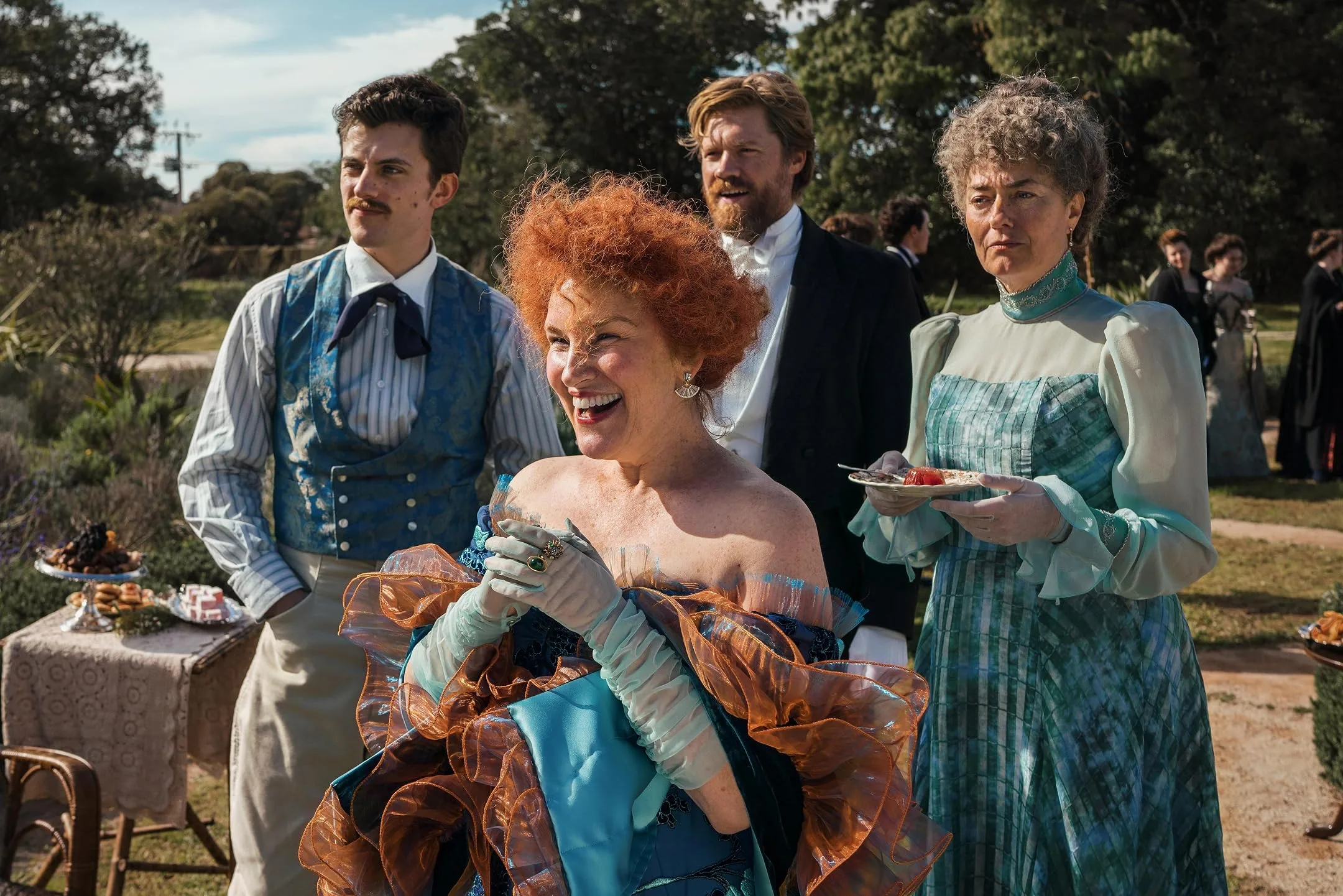
Sybylla’s centrality creates a structural imbalance because the series keeps her major pressures in direct contact. Augusta changes what writing can do. The family’s debt changes what refusal costs. Harry and Frank change the possible shape of her future. Each line pushes another decision into view. The farther a subplot sits from Sybylla, the more often it has to generate momentum on its own.
The later episodes lean harder on sentiment once several supporting stories need emotional space at the same time. That softness suits a series that has earned affection for these people, and its playful tone would be damaged by suddenly treating every social restriction as a grim ledger. The problem is architectural. Emotional warmth cannot perform the same task as causal connection. When several arcs have developed beside one another, a tender return to them can acknowledge their importance without proving that the season ever fused them.
The photo-album-like montage near the end makes the issue visible. It gathers faces and moments the series wants held together in memory, granting the season a shared emotional frame. The sequence is pleasant precisely because so much of the material deserves remembering. It also reveals the difference between having many worthwhile stories in the same series and building six episodes in which those stories have already changed one another before the remembering begins.
My Brilliant Career premiered globally on Netflix on August 13, 2026. You can stream the six-part Australian period drama series exclusively on Netflix. The plot follows Sybylla, a fiercely independent young woman in 1900 Australia who defies societal expectations and her family’s pushes toward marriage to pursue her passionate dream of becoming a writer.
Where to Watch My Brilliant Career Online
Full Credits
Title: My Brilliant Career
Distributor: Netflix, Jungle Entertainment
Release date: August 13, 2026
Rating: TV-MA
Running time: 50–55 minutes
Director: Alyssa McClelland, Anne Renton
Writers: Liz Doran, Sarinah Masukor, Rachael Turk
Producers and Executive Producers: Chloe Rickard, Liz Doran, Alyssa McClelland, Paul Ranford, Courtney Wise, Shari Sebbens
Cast: Philippa Northeast, Christopher Chung, Anna Chancellor, Genevieve O’Reilly, Kate Mulvany, Jake Dunn, Alexander England, Sherry-Lee Watson, Miah Madden
Director of Photography (Cinematographer): Kieran Fowler, Marden Dean
Editors: Gabriel Dowrick
Composer: Caitlin Yeo
The Review
My Brilliant Career
My Brilliant Career has a sturdy engine in Sybylla's fight to turn writing into an economic alternative to marriage. Family debt and the Harry-Frank triangle keep tightening that choice, while the wider ensemble gives Caddagat breadth the six-episode structure cannot always convert into consequence. Its playful energy carries a heavy story load for a long time, yet the late memory montage exposes how many strands have developed beside one another instead of together. The result is warm, smart television with a central story stronger than its surrounding architecture.
PROS
- Writing-versus-marriage story spine
- Debt gives independence real stakes
- Romance stays tied to Sybylla's choices
- Caddagat supports a broad ensemble
- Playful tone carries dense material
CONS
- Supporting arcs often run in parallel
- Six episodes strain the ensemble load
- Late sentiment reduces causal pressure
- Memory montage supplies retrospective unity