






























Remove the recorded vocals in Let’s Sing 2027 and the space they leave becomes yours to fill. A familiar melody can suddenly feel less secure when the voice carrying it disappears. Keeping the original singer audible, using a vocal guide, or choosing an instrumental backing gives players control over that exposure.
These settings accommodate different kinds of pleasure: following a voice you love, finding your footing, or hearing yourself carry the song. There is no reason everyone arriving at the same karaoke session should want the same degree of reassurance.
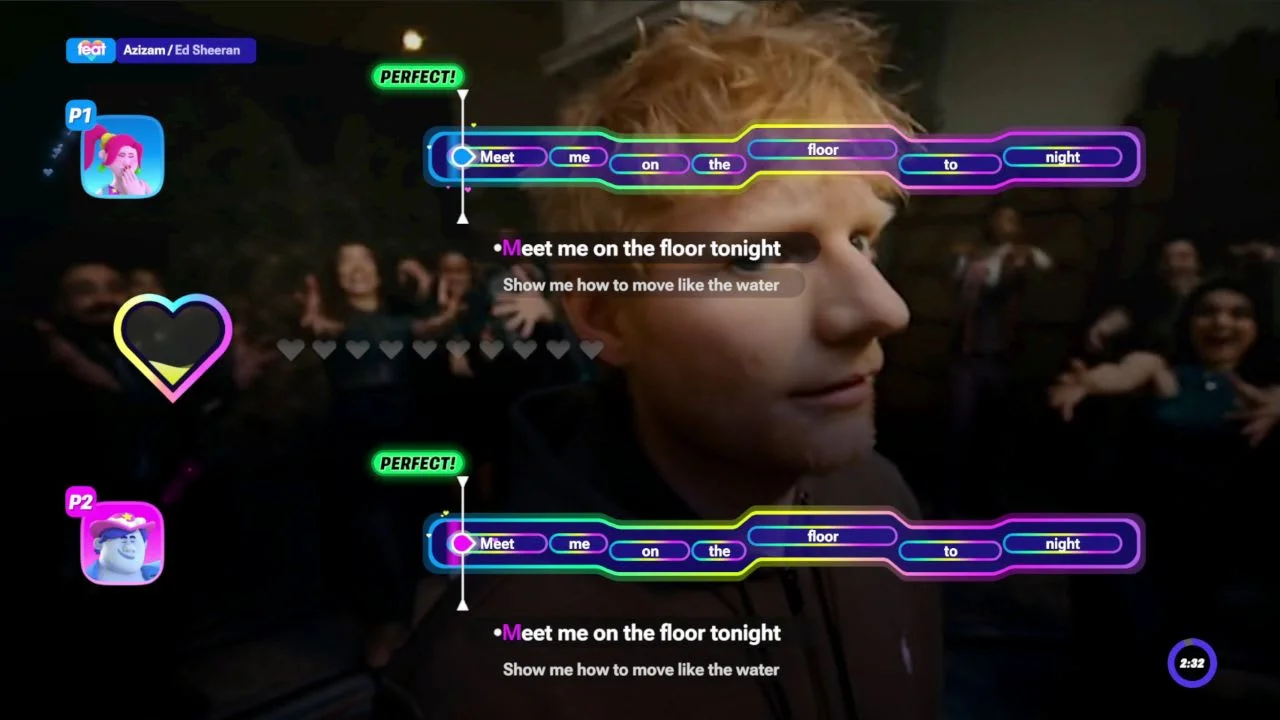
Feat extends that choice into the relationship between singers. Up to four players take different vocal parts, sometimes alternating and sometimes working through harmonies, with hearts providing a shared objective. Attention shifts toward another person’s entrance and the part you contribute alongside it.
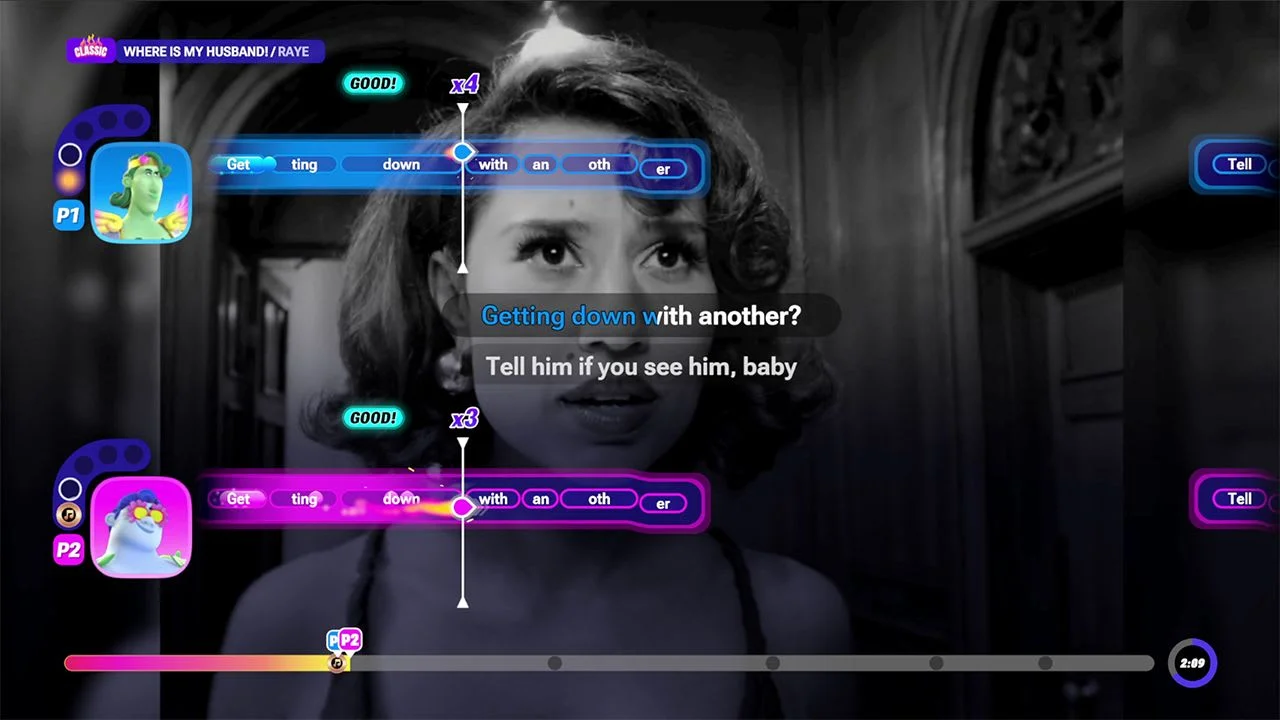
That can make singing together feel supportive, though harmonizing introduces demands of its own. Classic offers the simpler satisfaction of everyone performing the song and competing for individual scores, or singing alone to improve a personal best. Moving between them changes how much another voice feels like company, assistance, or competition.
The free Let’s Sing Companion app makes joining that company easier by allowing phones to serve as microphones. Compatible USB microphones remain an option, but gathering enough dedicated equipment need not become a separate project before anyone sings.
Once connected, players follow the displayed notes and lyrics, with pitch doing the scoring work rather than precise pronunciation. Fast passages can still be demanding without turning every missed syllable into a separate failure. The audio-delay adjustment deserves attention before scores become a source of frustration: feedback needs to align with the performance if players are going to trust what it tells them.
Party mode finds a useful variation on this relationship with assistance. Its Save Soundtown setup asks one or two players to restore music to a town silenced by DJ Hush, linking singing challenges through a light adventure. The interesting part arrives when a challenge takes away visual or audio support for passages.
Knowing a recording and being able to continue without its help become different propositions. A song selected for its familiarity can acquire a little suspense, since recognition alone will not carry you through the missing guidance. The story gives these interruptions a cheerful purpose without needing elaborate dramatic stakes.
There is limited room for that idea to develop. A run comprises six song performances, and the selection permits repeating the same track throughout. A short format suits an occasional diversion, especially between straightforward singing sessions, but the freedom to return to one comfortable choice can narrow the musical experience further.
Soundtown supplies reasons to approach a song differently without building a substantial campaign around them. Its appeal rests on enjoying those small disruptions to the familiar routine; the brief run gives them little time to grow into a sustained sense of progression.
The two-player limit creates a separate problem for shared momentum. Classic and Feat can involve four people, so moving the same group into Party requires rotation or spectators. Taking turns can be perfectly pleasant, but it changes the evening from simultaneous participation into something that needs arranging.
The mode with the most explicit party framing accommodates fewer singers than the straightforward alternatives. Online competition is absent too, restricting the options for friends who cannot gather locally. Leaderboard chasing provides a target for solo improvement, but it cannot supply the exchange of hearing someone else attempt the same passage beside you.
Finding a song everyone wants to attempt matters just as much as the available modes. The 35-song base selection has recognizable contemporary pop anchors, including Sabrina Carpenter’s “Espresso” and Ariana Grande’s “we can’t be friends (wait for your love).” Lorde’s “Royals” and the Goo Goo Dolls’ “Iris” extend its reach beyond recent hits.
These are useful invitations, though the emphasis leaves limited room for rock and country preferences. Thirty-five songs can comfortably support an evening when tastes overlap. The restriction becomes clearer across repeated sessions, or when several people keep searching for a different kind of music. Regional editions also vary, so the local track list deserves checking.
The VIP Pass addresses that search with a subscription library exceeding 150 songs. Cyndi Lauper’s “Girls Just Want to Have Fun,” Tina Turner’s “What’s Love Got to Do with It,” and Smash Mouth’s “All Star” suggest the additional range without reducing musical taste to an age bracket.
What the larger selection buys is another chance to find common ground. Someone unmoved by the base playlist may recognize a favorite there, and a group can move between different musical moods without returning so quickly to the same options. That is a substantial contribution to the social experience, which makes its position behind a recurring payment difficult to treat as a minor extra.
Cosmetic rewards give repeated singing another purpose, with avatar variants, banners, titles, and poses marking time spent performing. They provide a visible record of participation, though a new banner cannot resolve a stalled search for the next song. This leaves the annual package in an awkward position.
The vocal options change how comfortable singing can feel, and Soundtown offers a modest change of pace, while much of the flexibility needed to sustain different groups sits in the subscription catalog. A group that settles on VIP favorites begins building its own repertoire around temporary access. When that access expires, keeping those songs in the next session requires renewing the pass.
The Review
Let's Sing 2027
Let’s Sing 2027 understands the reassurance of having another voice beside yours. Adjustable vocals, phone microphones, and Feat’s shared parts make joining in inviting, while Soundtown briefly tests how confidently you can sing without assistance. Its short runs and two-player limit restrict that diversion, and the pop-heavy base selection puts considerable pressure on the VIP subscription to accommodate different tastes. There is pleasure in finding your voice here, though keeping everyone involved takes some compromises.
PROS
- Flexible vocal support accommodates different confidence levels.
- Phone microphones reduce equipment requirements.
- Feat gives cooperative singing a shared purpose.
- Soundtown’s challenges test familiarity with songs.
CONS
- Soundtown is brief and limited to two players.
- Broader musical variety relies heavily on subscription access.
- No online competitive play.