


















The charm bracelet on Billie Doe’s wrist looks like the sort of family keepsake a mother might insist her daughter never lose. It is also a lock. Alice has used it since Billie’s infancy to suppress the girl’s magical abilities, translating a parent’s desire for safety into a restriction on everything her child might become.
Disney’s Hexed makes the uncomfortable relationship between protection and control unusually literal. For a studio that has spent decades celebrating young women who discover their independence, the bracelet raises a question its fairy tales have seldom examined with much sympathy: what happens to the mothers who are expected to keep those daughters safe?
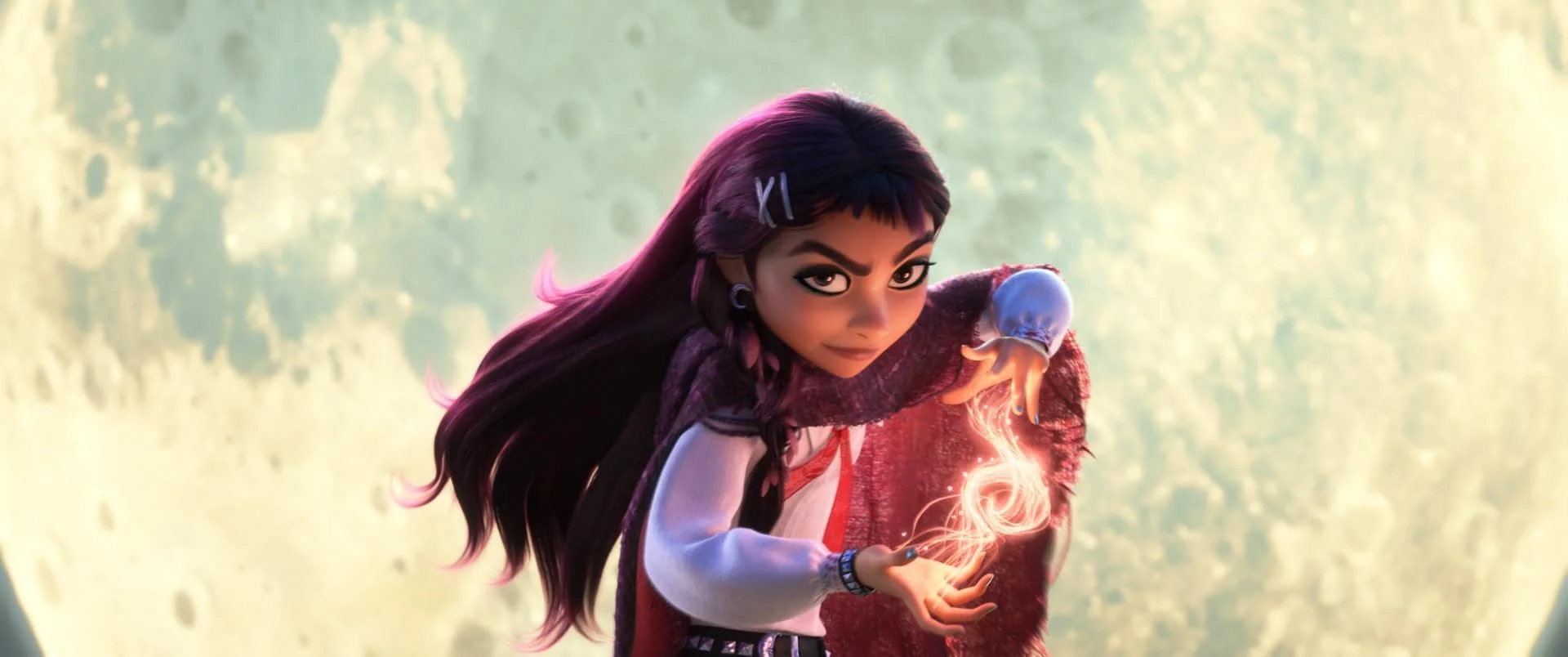
Billie (Hailee Steinfeld) is a rebellious teenager living with her single mother, Alice (Rashida Jones), in suburban Ohio. An attempt to free an owl from her school lands her in trouble, and the accidental removal of her bracelet exposes magical powers she never knew she possessed.
Her discovery leads to Hexe, a hidden realm of witches where the promise of flight offers everything her ordinary life has denied her. Alice follows, desperate to retrieve a daughter who has entered the territory of her estranged mother, Queen Celeste (Jodie Foster). The adolescent fantasy of escaping parental supervision suddenly acquires a troubling family history.
Hexed is an enjoyable, visually imaginative family adventure, and its willingness to treat Alice as a person with her own emotional wounds gives it considerable value. Directors Fawn Veerasunthorn and Jason Hand, however, frequently interrupt moments of emotional intimacy with another chase or comic distraction. The result is a film worth recommending for its warmth and invention, though its treatment of motherhood deserves a richer story than the conventional fantasy surrounding it.
The familiar interpretation of Disney’s rebellious heroines presents independence as an uncomplicated moral good. The parent who imposes restrictions becomes an obstacle, and the daughter’s freedom confirms that her instincts were correct. Alice makes that arrangement considerably less comfortable. Her decision to conceal Billie’s identity is rooted in a childhood shaped by Celeste’s cruelty.
She has attempted to prevent the repetition of her own suffering, yet the methods she chooses reproduce a smaller version of the confinement she escaped. Here, the film touches something recognizable in families where trauma survives through precautions and prohibitions whose origins are never explained to the children expected to obey them.
Jones brings a particular tenderness to this contradiction. Her vocal performance gives Alice the familiar rhythms of an anxious mother whose excessive caution has become habitual. Steinfeld gives Billie a combustible mixture of sarcasm, impatience, and genuine excitement.
Her delight upon discovering she can fly makes her resentment of the bracelet immediately understandable. Against Hexe’s fantastical skies, mother and daughter fly together, turning an ability Alice once concealed into a means of connection. The sequence allows their changing relationship to emerge through movement and shared exhilaration rather than another exchange of accusation and reassurance.
Celeste introduces a darker understanding of maternal authority. Her power depends on extracting magical energy from others, preserving her position as ruler even as her own abilities diminish. The metaphor is unusually pointed for a Disney fantasy. A mother who exploits her offspring to maintain her status becomes a grotesque representation of the expectations that can bind younger women to the emotional needs of their elders. Alice has spent her adult life resisting this inheritance, yet her restrictions on Billie expose the difficulties of escaping it.
The political structure of Hexe sharpens the irony. Its rulers call their domain a Queendom. Yet Celeste’s government maintains an oppressive hierarchy in which extraordinary abilities remain privileges of the powerful. Flight becomes particularly significant because the queen’s exclusive command of it reinforces her claim to supremacy. The approaching Haven Moon ceremony and an ancient prophecy threaten that arrangement, placing Billie within a struggle over who can possess magical power.
Such a setting challenges the comforting assumption that female leadership automatically produces a more equitable world. Celeste’s relationship with Alice suggests that oppression can survive inside the intimate structures of family life. The film gives women across several generations dramatic importance, then makes their conflict satisfy the familiar requirements of a chosen-one prophecy.
Foster gives Celeste an imperious composure that occasionally makes her cruelty especially unpleasant. Her ability to appear benevolent while exercising control suggests a woman who understands the social usefulness of affection. Unfortunately, the screenplay gives her little complexity beyond her desire to remain powerful. A grandmother terrified of losing her importance could have presented a disturbing counterpart to Alice’s fear of losing her daughter. Instead, Celeste increasingly resembles the traditional Disney villain whose wickedness exists to make the heroine’s triumph morally straightforward.
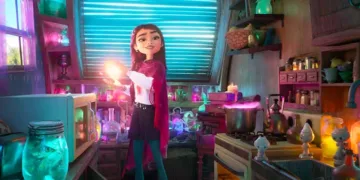
The film is considerably freer in its visual imagination. Hexe expands beyond the rectangular widescreen presentation of the ordinary world, allowing production designer Lorelay Bové’s densely furnished environments to occupy a fuller frame. Twisting landscapes, strange villages, and enchanted interiors give the realm an appealing material richness.
Crystal balls replace contemporary communication devices, and even the smallest spaces seem occupied by creatures with their own ridiculous concerns. A visit to an animal-only establishment produces one of the film’s funniest spectacles, a miniature wrestling match between a cockroach and a spider, complete with a folding chair.
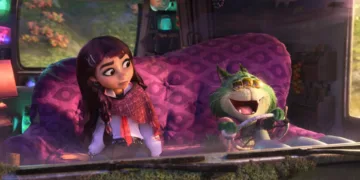
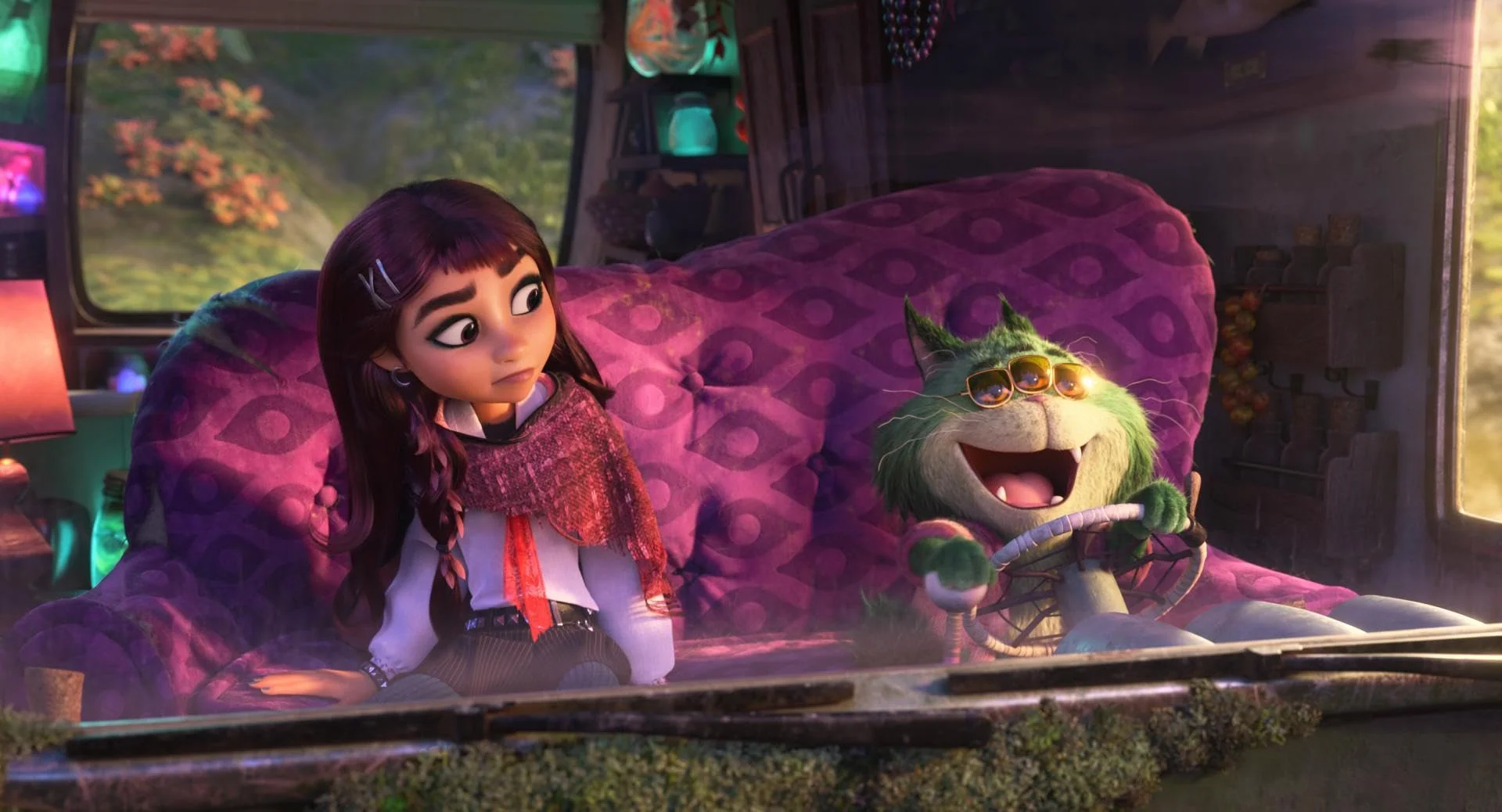
Walton Goggins contributes to that personality as Beef Roger Crummchuk, a cantankerous three-eyed cat who prefers the comforts of his magically enlarged swamp RV. His cynicism provides an amusing counterweight to Billie’s enthusiasm. His gradual willingness to help Alice and Billie gives the comic character an emotional function, too, as his withdrawal from the struggles around him gives way to renewed commitment.
These imaginative details deserve room to flourish. Unfortunately, the camera seldom remains still long enough to appreciate them. Veerasunthorn and Hand send the audience rushing through environments filled with intricate textures and visual jokes, allowing the sheer abundance of invention to become exhausting. A remote lakeside cabin, with its enormous windows, warm lights, comfortable furniture, and crowded shelves, offers a momentary refuge after a dangerous confrontation with Celeste. The setting communicates the promise of domestic peace that Alice has struggled to preserve.
The soundtrack reveals a similar impatience. Kris Bowers provides an expressive orchestral score, but the frequent insertion of recognizable pop songs disrupts the film’s emotional continuity. Dua Lipa’s “Levitating” supplies an obvious association with flight, yet its familiarity draws attention away from the experience the animation is already depicting. These choices suggest a production reluctant to trust its images to generate excitement, even during passages that call for tenderness.
That insistence on movement becomes especially damaging as the prophecy takes precedence. The approaching ceremony, Celeste’s efforts to consolidate her power, and increasingly elaborate magical confrontations crowd the narrative. The climax grows prolonged, with character motivations and the mechanics of certain developments becoming harder to follow. The smaller question of how Alice and Billie might begin to trust one another carries greater emotional significance.
There is a genuinely affecting idea beneath the film’s conventional resolution. Alice has spent years performing the largely invisible work of nurturing and protecting her daughter, accepting sacrifices that Billie could neither recognize nor appreciate. A late revelation invites a reconsideration of the heroic roles assigned to mothers in children’s stories. The sentiment carries force in a genre that has frequently treated parents as obstacles to overcome or figures to remove from the narrative.
Yet the reconciliation arrives through familiar dramatic steps, and the script grants too little space to Alice’s experiences before asking the audience to appreciate their significance. Her damaged relationship with Celeste and her years of raising Billie alone contain enough material for a richer examination of inherited fear. By returning so insistently to the spectacle of Billie’s exceptional destiny, Hexed leaves Alice’s quieter history only partially explored, including the sacrifices that made her daughter’s freedom possible.
Hexed held its premiere at the El Capitan Theatre on November 12, 2026, before opening in United States cinemas on November 25, 2026, via Walt Disney Studios Motion Pictures, followed by its theatrical release in the United Kingdom and Ireland on November 27, 2026, ahead of a future streaming debut on Disney+. Directed by Fawn Veerasunthorn and Jason Hand from Walt Disney Animation Studios, the animated fantasy comedy follows an awkward teenage girl (Hailee Steinfeld) and her cautious mother (Rashida Jones) who discover that her quirks are genuine magical powers, drawing them into a hidden realm of witches.
Where to Watch Hexed (2026) Online
Full Credits
Title: Hexed (Disney’s Hexed)
Distributor: Walt Disney Studios Motion Pictures
Release date: November 12, 2026 (El Capitan Theatre premiere), November 25, 2026 (United States theatrical release), November 27, 2026 (United Kingdom and Ireland theatrical release)
Rating: PG
Running time: 1 hour 43 minutes (103 minutes)
Director: Fawn Veerasunthorn, Jason Hand (co-directed by Josie Trinidad)
Writers: Jared Bush, Dana Ledoux Miller (screenplay), Josie Trinidad, Phil Johnston, Jared Bush (story)
Producers and Executive Producers: Roy Conli, Yvett Merino
Cast: Hailee Steinfeld, Rashida Jones, Jodie Foster, Walton Goggins, Henry Winkler, Dan Stevens, Brett Gelman, Tracey Ullman, Stephen Fry, Randall Park, Kathy Najimy, Abraham Benrubi, Josh Dallas, Jodi Benson
Editors: Jeremy Milton, Clare Knight
Composer: Kris Bowers
The Review
Hexed
Hexed finds its strongest magic in the uneasy relationship between motherhood, protection, and control. Its imaginative fantasy world, affectionate voice performances, and thoughtful treatment of inherited family trauma offer considerable rewards. Yet the familiar chosen-one prophecy, underdeveloped villain, and hurried storytelling prevent its richest ideas from receiving the attention they deserve. Disney delivers an enjoyable family adventure whose quieter moments reveal a considerably stronger film struggling to emerge from beneath the spectacle.
PROS
- Thoughtful exploration of motherhood and inherited trauma
- Imaginative, richly detailed magical world
- Warm voice performances from Steinfeld and Jones
- - Touching moments of mother-daughter connection
CONS
- Underdeveloped central villain
- Predictable chosen-one storyline
- Frantic pacing weakens emotional scenes
- Distracting pop songs and overcrowded climax