






















The old photographs have survived their subject. As the camera moves through a family apartment in Hangzhou, these familiar possessions acquire a disturbing permanence. There are letters, cards, recordings, the accumulated evidence of decades spent among people who loved one another. The objects have suffered no alteration commensurate with the catastrophe that has befallen their owner. They continue to occupy their allotted space. Gu You understands the peculiar anguish of entering a room where everything looks as it should, except that the person who gave the room its meaning will never enter it again.
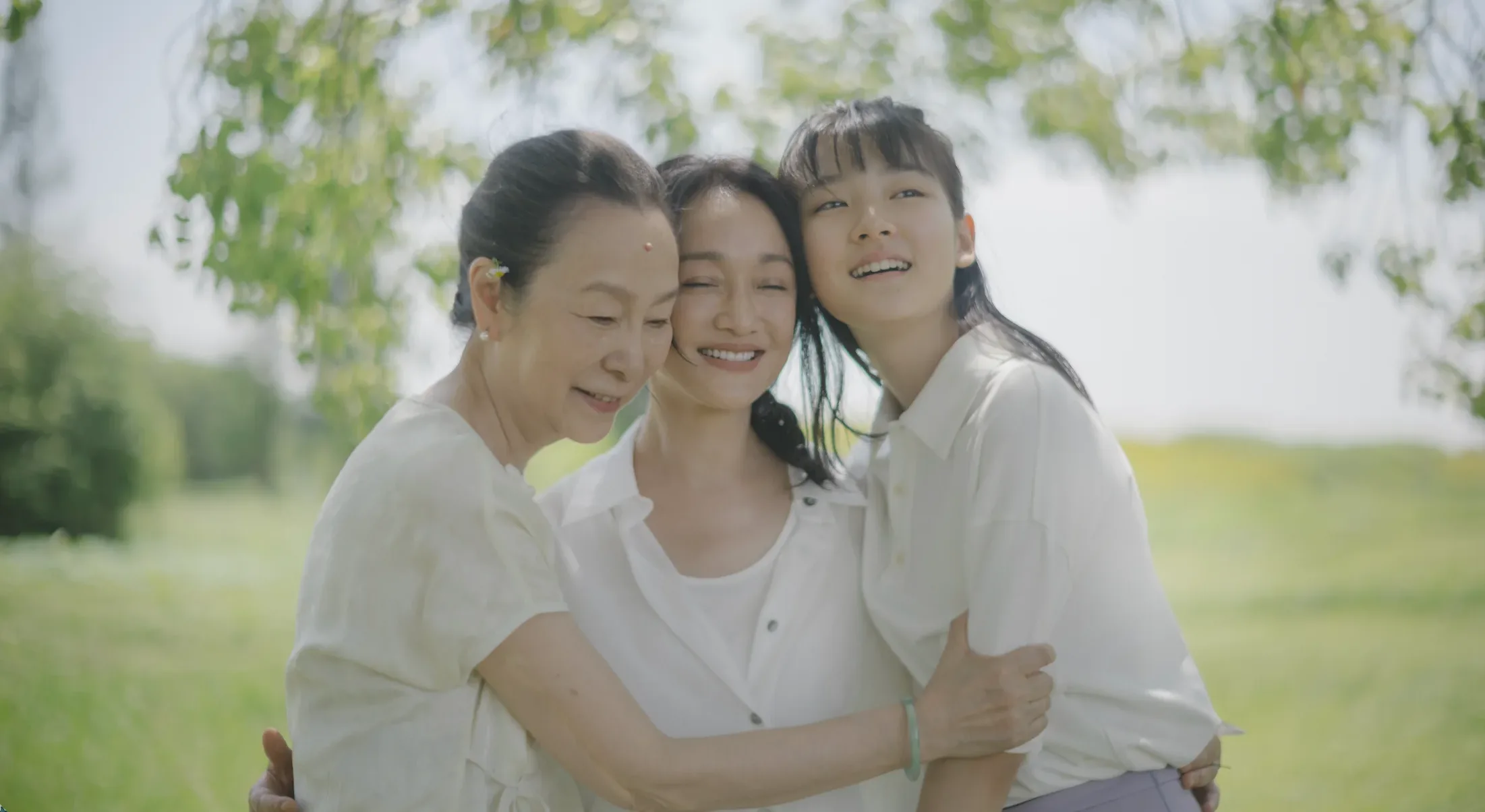
This prolonged observation of domestic space establishes the emotional character of The First Taste of Loneliness, the third film in Gu’s Landscape trilogy. A man dies of pancreatic cancer, leaving behind his wife Luna (Xi Meijuan), daughter Jiang Yue (Zhou Xun), and granddaughter Moon (Wang Shengdi).
The women begin searching their surroundings for evidence of his continuing existence. A butterfly or a bird becomes the possible bearer of a spiritual presence. Their apartment overlooks the Qiantang River, and its position on a high floor in a building without an elevator presents difficulties for the aging Luna. Moving elsewhere would make practical sense. It would also mean relinquishing the rooms in which her marriage retains a physical identity.
Gu has made a beautiful and frequently affecting film about the bewilderment of surviving someone. I would recommend surrendering to its unhurried rhythms, despite a sentimental impulse that occasionally diminishes its emotional discoveries. The early piano accompaniment and Yue’s extensive narration seem anxious to establish the magnitude of a sorrow already evident in the apartment.
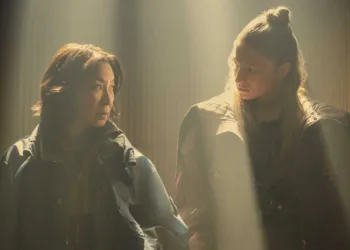
There is a particular tenderness in Gu’s treatment of old age. Luna’s remaining years possess their own emotional possibilities, and Xi Meijuan brings considerable delicacy to the woman’s growing affection for Mr. Xu (Xu Chaoying). Companionship offers relief from the solitude of widowhood, yet accepting it awakens a sense of guilt. Her husband can no longer be hurt by her decisions, but Luna remains accountable to him in the privacy of her emotional life. She must also consider how her daughter and granddaughter might receive this unfamiliar arrangement.
In a park at night, Luna dances with Xu beneath the artificial lights. He moves out of the frame, and she continues dancing. The camera circles her, drawing closer as the waltz awakens something painful in her and tears gather in her eyes. There is music, there are other people nearby, and there is the immense solitude of an elderly woman still capable of taking pleasure in the movement of her body. Xi allows these sensations to exist simultaneously. The scene would lose much of its beauty if we could assign her tears a single cause.
Yue occupies a difficult position between two generations whose needs are changing. Divorced and professionally experienced as a fashion designer, she devotes herself to the care of her mother and daughter, gradually confronting the prospect of an existence in which neither will need her quite so intensely. Zhou Xun gives Yue a gentleness that feels especially convincing in her interactions with Xi. Her acceptance of Luna’s new relationship carries the quiet recognition that a parent’s emotional life remains partly inaccessible to their children.
I wish Gu had shown greater curiosity about the years of Yue’s life spent outside this household. Her divorce suggests an earlier encounter with loneliness, one that might have complicated her understanding of her mother’s desire for companionship. Little emerges about that marriage or the professional identity she has set aside.
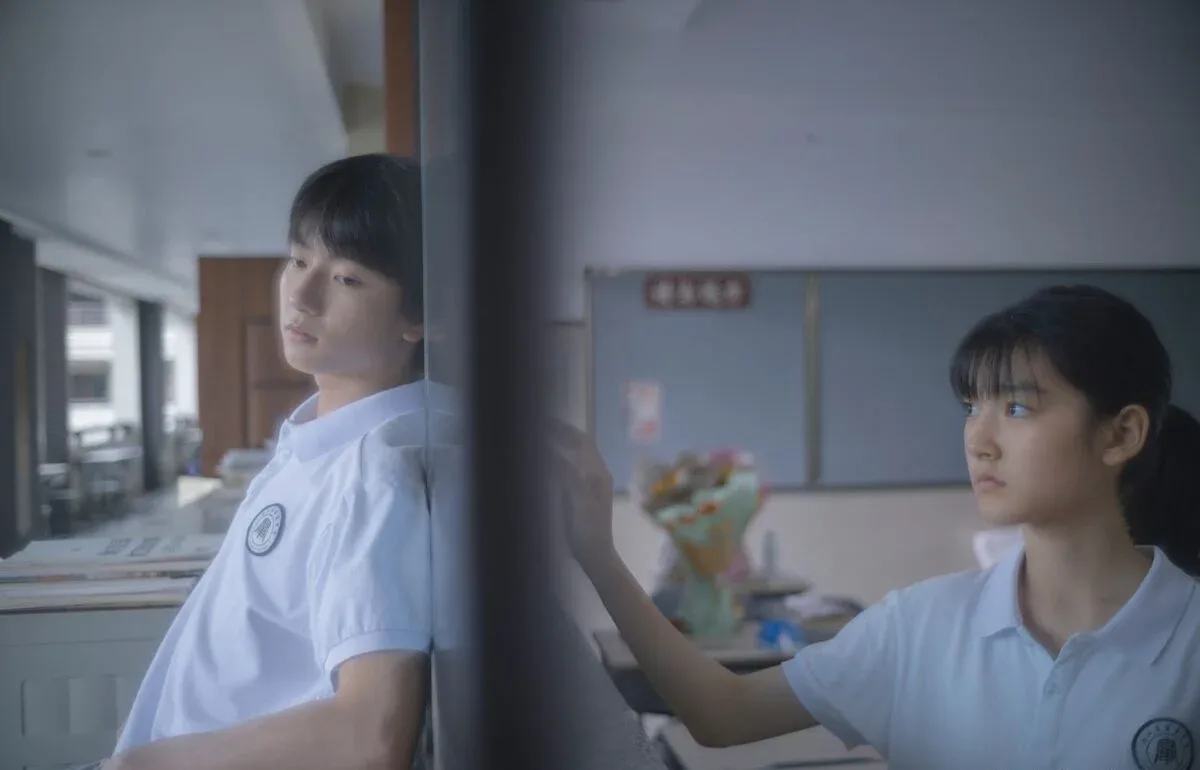
For Moon, the approach of her university entrance examinations brings the dissolution of a familiar world. A football game with school friends acquires unexpected gravity through the possibility that this particular gathering may never occur again. Gu finds an especially evocative image of youth in the nighttime sequence of Moon and a male companion running on an outdoor track amid hundreds of students. Their collective movement belongs to a period of life whose routines will soon become memories. The grandeur of the composition is considerable, although Moon herself remains somewhat elusive within these beautifully arranged impressions of adolescence.
Traditional Chinese landscape painting informs Gu’s cinematic language, as it did in Dwelling in the Fuchun Mountains (2019) and Dwelling by the West Lake (2023). Working with cinematographer Mikiya Takimoto, he favors camera movements from right to left, recalling the gradual opening of a painted scroll. Different locations and periods of time can inhabit a continuous shot, allowing the film to drift between recollection and immediate experience.
The Qiantang River appears beneath the grey light of morning and the steel-blue hues of twilight. Across the water, distant buildings glimmer. The scale of these compositions makes human grief feel terribly intimate, confined to a few rooms among thousands of illuminated windows, each presumably containing its own private anxieties. The river continues flowing through the city. Its indifference is strangely consoling.
Gu conceives certain camera movements as expressions of the grandfather’s lingering spiritual presence. I remain uncertain about the comfort this perspective offers. The sensation of a departed consciousness observing its loved ones is beautiful, particularly within a film so attentive to the physical world. Yet the possibility of his continued presence seems to soften the terror of extinction, the thought that consciousness itself might simply cease.
The treatment of time is particularly accomplished during a restaurant gathering involving Luna, Yue, Xu, and his family. We see Xu washing his hands as the soundtrack carries his introductions elsewhere in the restaurant. Later, we hear him announce that he is going to the restroom. The displacement of sound from its corresponding image creates an experience remarkably close to the workings of recollection, in which details from different moments crowd into the same mental space. Chronology loses its authority.
Li Danfeng’s sound design is sensitive to the fragility of such details. Water laps, rain falls, leaves rustle. Moon records the voices and everyday sounds of her school, gathering acoustic fragments whose significance will become apparent only after she has left. The casual chatter of her classmates may someday be precious to her simply because she can hear them together again.
The emphatic musical accompaniment feels particularly intrusive amid such subtle acoustic work. Several ballads linger past their emotional usefulness, interrupting the contemplative rhythm that Gu and Takimoto establish through their extended takes. There are moments when the film seems unwilling to permit the sadness of a scene to develop at its own pace.
The grandfather’s remembered personality suffers from a similar excess of affection. Apart from some acknowledgment of his drinking, the memories preserved by the family reveal remarkably little that might disturb his benevolent image. Bereavement often leaves people carrying anger they can no longer express to its intended recipient, or seeking forgiveness from someone who cannot grant it. The film largely excludes these painful complexities from its portrait of familial devotion.
Among the father’s unfinished New Year’s resolutions is his intention to perform an act of kindness each day. Yue initially understands this as a call to help others through charitable gestures. Its meaning gradually becomes intimate, concerning the care we sometimes neglect to extend to those whose presence seems assured. The modesty of this aspiration is touching beside the film’s elaborate spiritual imagery.
Gu takes his title from a Teresa Teng song about the understanding of loneliness that comes with age. Heard near the end, it acquires a particular poignancy through Moon, whose recordings preserve a world she has yet to lose. There may come a day when she listens to those familiar voices and discovers, in their ordinary chatter, something she could never have recognized at the time.
The First Taste of Loneliness (Chūcì cháng dào jìmò) had its world premiere in competition at the Busan International Film Festival on October 7, 2026, before screening at the Geneva International Film Festival on November 4, 2026, with international distribution handled by Les Films du Losange and Tandem Films. Directed by Gu You as the closing entry in his Landscape (Shan-Shui) trilogy, the drama follows three generations of women navigating grief, newfound romance, and hidden wishes after the passing of the family patriarch.
Full Credits
Title: The First Taste of Loneliness (初次尝到寂寞 / Chūcì cháng dào jìmò)
Distributor: Tandem Films, Les Films du Losange
Release date: October 7, 2026 (Busan International Film Festival world premiere), November 4, 2026 (Geneva International Film Festival screening)
Running time: 2 hours 15 minutes (135 minutes)
Director: Gu You (Gu Xiaogang)
Writers: Gu You, Yang Yikun
Producers and Executive Producers: Shan Zuolong, Du Kexin, Mathieu Robinet
Cast: Zhou Xun, Xi Meijuan, Wang Shengdi, Zhou Yiwei, Mu Zhicheng, Xu Chaoying
Director of Photography (Cinematographer): Mikiya Takimoto
Editors: Liu Xinzhu
Composer: Sylvian Wang
The Review
The First Taste of Loneliness
The First Taste of Loneliness finds extraordinary beauty in the ordinary remnants of human existence. Gu You's painterly compositions, sensitive sound design, and Xi Meijuan's deeply affecting performance give mortality an intimate presence. The film occasionally compromises its emotional discoveries through insistent music and an idealized portrait of familial affection. Its quieter passages possess considerable philosophical depth, particularly when they confront the painful coexistence of grief and the desire to continue living.
PROS
- Exquisite cinematography inspired by Chinese landscape painting.
- Xi Meijuan's delicate portrayal of grief and renewed affection.
- Thoughtful exploration of mortality and impermanence.
- Immersive environmental sound design.
- Inventive treatment of memory and time.
CONS
- Excessively sentimental musical accompaniment.
- Limited exploration of Yue and Moon's individual lives.
- Idealization of the deceased patriarch diminishes emotional complexity.