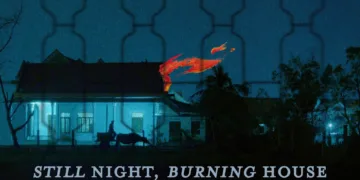



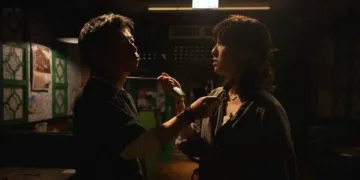























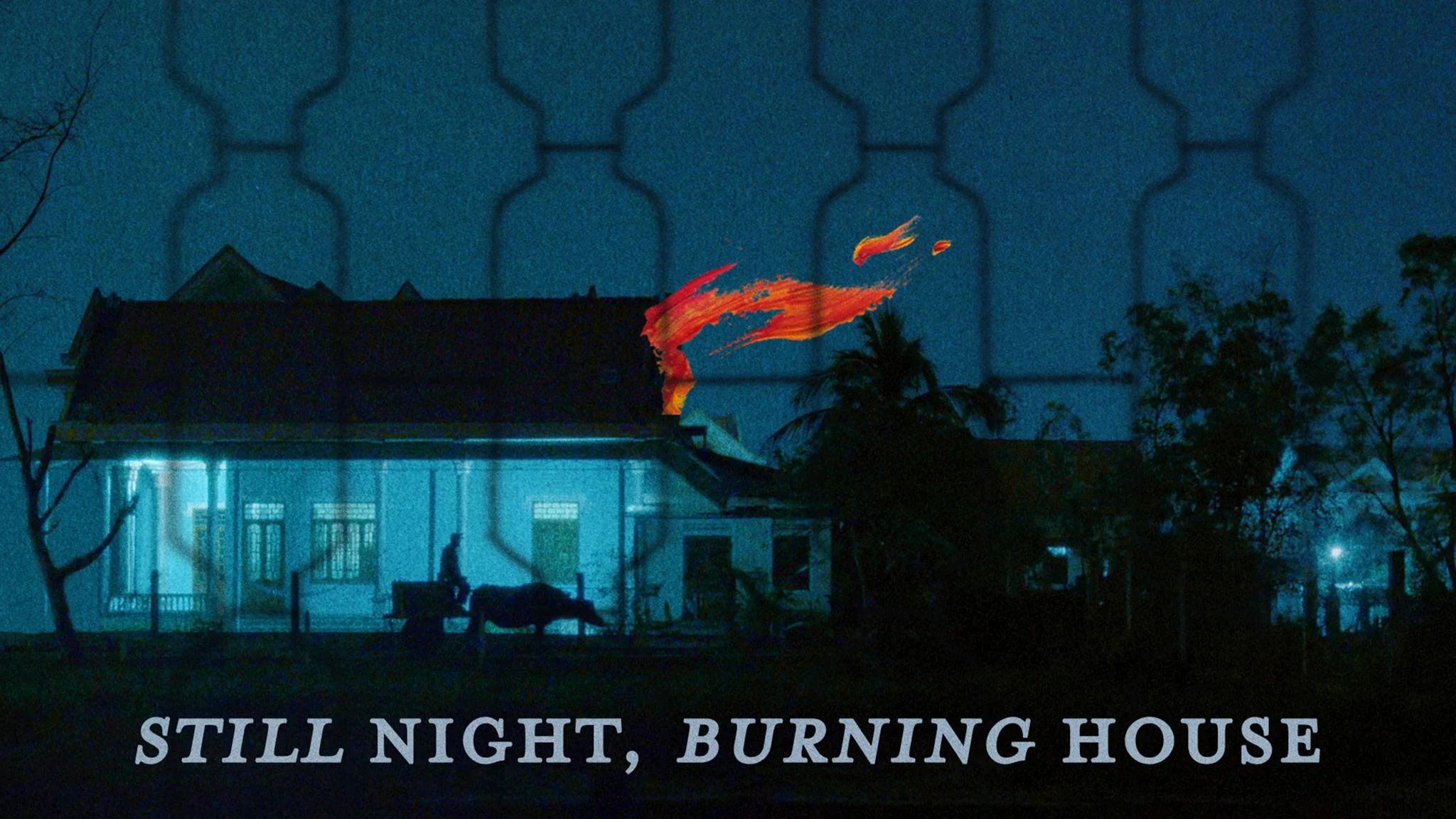

For years after Thach died in 2007, the children in his family were given explanations that kept the fact of his suicide out of reach. He had fallen down the stairs. He had suffered a heart attack. Those stories did not remove the death; they gave it a shape that could be spoken aloud. In Carol Nguyễn’s documentary Still Night, Burning House, the cost of that substitution can be felt in the pauses between relatives who have grown older carrying different versions of the same absence.
Nguyễn explored the family’s reserve in her short film No Crying at the Dinner Table. Her first feature, Still Night, Burning House, is an extraordinarily affecting portrait of the same family facing Thach’s death. At 76 minutes, it is a film I would readily recommend for its patience with pain that cannot be neatly expressed.
Her father, Ngọc, remembers being with Thach shortly before his death. Thach was experiencing a terrifying conviction that his apartment was on fire. Ngọc left him, and soon afterward his brother died. When his daughter asks about the guilt that remains, he admits, “I feel like I still have a lot of fault.” It is a dreadful sentence in its simplicity. Years of memory have narrowed to the interval between leaving someone alive and learning that they are dead. The camera cannot enter that interval. Neither can Ngọc, though he appears to have returned to it countless times.
Nguyễn listens as her father searches for words, letting his silences carry the same gravity as his confession. He cannot finish every thought, and Nguyễn does not hurry him.
The family’s examination of Thach’s medical records appears, at first, to offer a firmer place to stand. Pages documenting hospital visits and a diagnosis of schizophrenia put dates and clinical descriptions around the suffering that relatives once struggled to recognise. His difficulties began amid displacement from Vietnam, before his arrival in Canada in 1983 after time in an Indonesian refugee camp. Limited English comprehension made encounters with medical institutions harder. Ngọc remembers trying to advise his brother, not understanding how his words might be received as confrontation.
In a filmed session, relatives read passages from the records, encountering accounts of arguments and glimpses of Thach’s fondness for the guitar. The voices reading them belong to people who loved him and knew only fragments. That collision is painful to hear. A page can tell them how a hospital described a man on a given day, yet it cannot return the ordinary presence of the person who once picked up an instrument, argued with his brothers, and came home. Even the new knowledge has arrived at an age when nobody can ask Thach what he thought of it.
Some of the film’s most revealing exchanges are awkward, with the participants seeming to test how much of their history the others can bear to hear. Nguyễn, who is both filmmaker and family member, never turns that hesitancy into a spectacle. She has persuaded people to look toward an old wound, but leaves them their own pace.
When the family travels to Vietnam, the past becomes stranger because it has continued existing in their absence. The old family home in Ho Chi Minh City is now a bubble tea shop. An elderly acquaintance still remembers the family and asks about Thach. Suddenly the dead man exists in someone else’s unprompted recollection, outside the documents and the conversations assembled to explain him. For a moment, memory feels less like a burden carried by a few people and closer to something scattered across a city.
Later, Ngọc walks through a street at night. Palm leaves move in the warm air; the city continues in its soft, restless darkness. Nothing in the image asks him to confess or understand anything. It permits him to be somewhere other than the evening his brother died.
The rituals of mourning offer a tangible change. At a market, Phan and the daughters examine joss paper offerings: money, clothes, a guitar, things intended to be consumed by fire and sent toward the dead. In cemeteries, smoke rises among prayers and the sounds of ceremonial instruments. These acts are communal and practical, carried out through materials that have to be bought, prepared, held, and burned. Against years of guarded conversations in Canada, grief here has work for the hands to do.
Ngọc is uncertain about the afterlife, yet he takes part. If a paper guitar is burned for Thach, its destruction cannot prove that anything reached him; it can only establish that someone remembered what he loved. I find the gesture moving partly because it makes no demand on the dead to respond. The film’s fire motif acquires its deepest force here. What had appeared to Thach as an imagined catastrophe on the night of his death becomes, years later, a flame his family can approach together and tend with care.
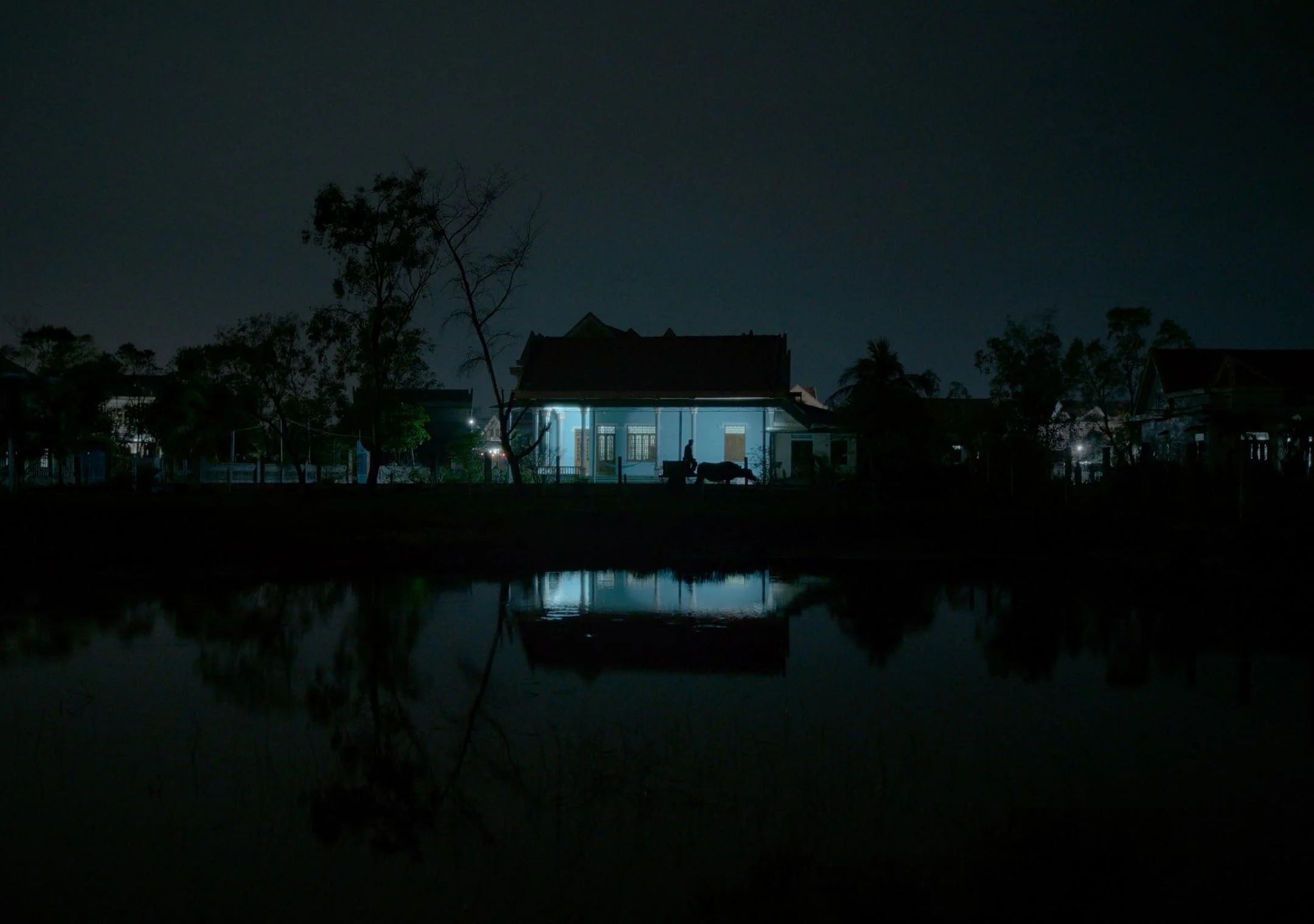
Nguyễn and cinematographer Juliette Lossky allow the film to drift toward a realm of imagined passage. An ox-drawn cart near a lake at twilight appears almost suspended between its dark reflection and the fading light. Later, carts and oxen move in procession, bells sounding against the steady percussion of hooves.
Arie Verheul Van De Ven’s sparse plucked-string music and the heightened sounds of footsteps, nature, and temple chants create an atmosphere in which the visible world seems to contain another, less certain one. Anouk Deschênes’ editing brings these images into contact with testimony and ritual, giving the family’s factual search an unspoken counterpart.
Sometimes that beauty presses too firmly on feelings already conveyed by the relatives themselves. The dreamlike procession risks supplying an image of transcendence where the hesitation in Ngọc’s face offers something harder to dismiss. The film’s concentration is part of its power. Yet the brief runtime leaves certain family histories and aspects of Thach’s medical experience insufficiently explored as the film turns its attention to the mourning rituals in Vietnam.
I cannot tell if the last passage of carts offers a vision of Thach’s onward movement or a vision created by those who must remain behind. The film seems unwilling to guarantee either reading. The bells continue, the animals make their way toward the shore, and the family has a fire to gather around, with offerings chosen for someone who can no longer tell them what he needs.
Still Night, Burning House had its world premiere at the Toronto International Film Festival on September 12, 2026, and screened in competition at IDFA in November 2026 through the National Film Board of Canada. Directed and written by Carol Nguyen, the documentary feature follows her Vietnamese Canadian family as they gather for the first time since her uncle’s death nearly two decades earlier, confronting lingering grief, mental health struggles, and unspoken guilt.
Full Credits
Title: Still Night, Burning House
Distributor: National Film Board of Canada (NFB / ONF), Portage Films, Metafilms
Release date: September 12, 2026 (Toronto International Film Festival world premiere), November 2026 (IDFA international premiere)
Running time: 1 hour 16 minutes (76 minutes)
Director: Carol Nguyen
Writers: Carol Nguyen
Producers and Executive Producers: Audrey-Ann Dupuis-Pierre, Ariel Nasr, Robert Vroom, Sylvain Corbeil, Nathalie Cloutier, Bob Moore, Anh-Duy Vo-Dinh
Cast: Ngoc Nguyen, Jennifer Nguyen, Hoang Nguyen, Jenny Tang, Phan Hue Tang
Director of Photography (Cinematographer): Juliette Lossky
Editors: Anouk Deschênes
Composer: Arie Verheul van de Ven
The Review
Still Night Burning House
In Still Night, Burning House, Carol Nguyễn approaches a family's long-buried grief with extraordinary tenderness. Her father's silences, the painful discoveries in medical records, and the ceremonial flames give shape to an absence that has endured for decades. The dreamlike imagery occasionally insists too heavily on transcendence, and some family histories remain underexplored. Yet the film's quiet beauty lies in its acceptance that understanding a death cannot undo its consequences. There is comfort here, fragile and uncertain, in the simple act of mourning together.
PROS
- Deeply affecting, intimate family conversations
- Beautifully atmospheric cinematography and sound
- Sensitive exploration of guilt, silence, and mortality
- Powerful use of Vietnamese mourning rituals
CONS
- Symbolic imagery occasionally feels overstated
- Some family histories and medical questions receive limited attention