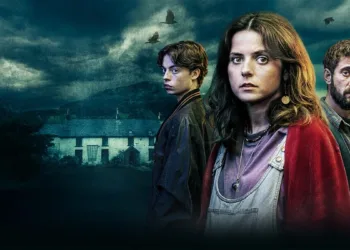








Turning a nine-part paranormal investigation into four episodes of scripted BBC horror is a revealing television decision. The original audio account of the alleged haunting at Heol Fanog could leave listeners arguing about what actually happened. A drama has other obligations, or at least television executives seem to think so: visible ghosts, escalating shocks, and a title sequence that practically promises casualties.
Danny Robins, who investigated the case in his podcast and has made a career of testing supernatural testimony through Uncanny, now writes The Witch Farm as a story in which the audience sees what its characters fear. The change makes for accessible television, but it also strips away one of the material’s most disturbing qualities: uncertainty.
There is still a good deal to admire here. The BBC has made space for a proper haunted-house drama in a schedule where crime stories tend to get the more reliable invitations, and the Welsh setting lends this one a character of its own. Gabrielle Creevy and Michael Socha make the family’s troubles credible long before the apparitions become insistent. The Witch Farm is worth watching for those performances and several genuinely uneasy passages. Its problem is that Robins keeps treating the next supernatural incident as more urgent than the people experiencing it.
The series announces that imbalance early. A prologue set in 1969 brings us to the property and its ominous markings; captions then insist on the story’s roots in firsthand accounts and hint that the house claimed lives. Apparently, the BBC cannot trust a haunted building to make an impression unless the introductory paperwork tells us exactly how alarmed to be. The audience has been instructed to anticipate a disaster before the central family arrives in 1989.
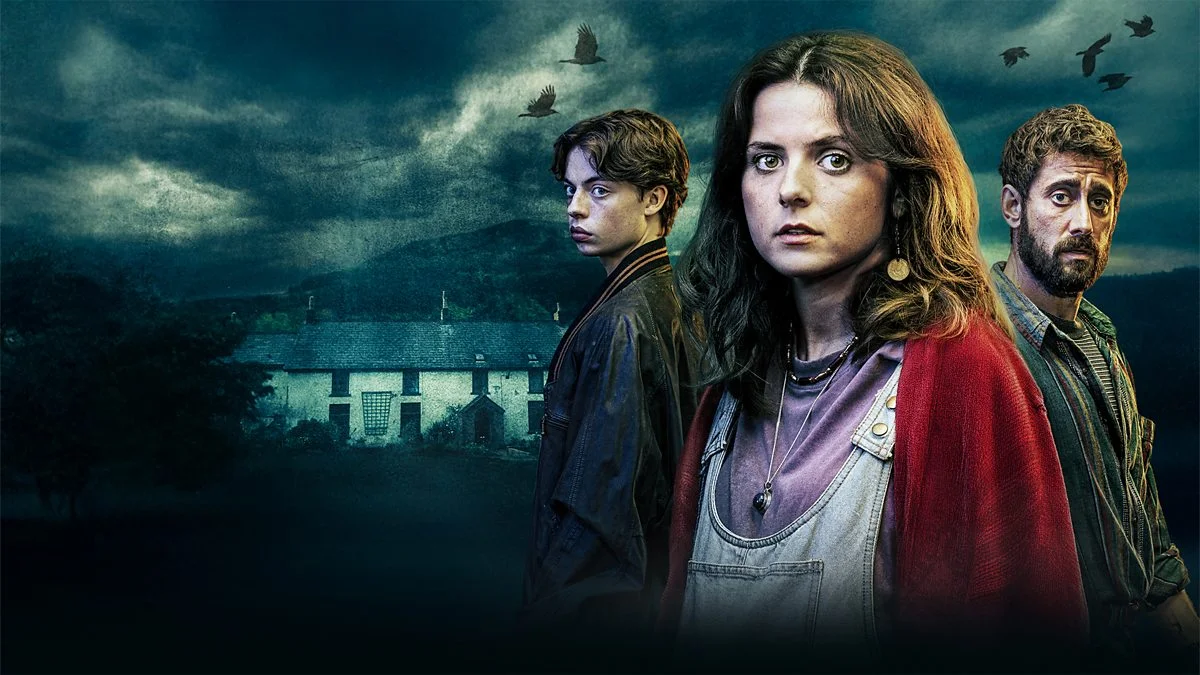
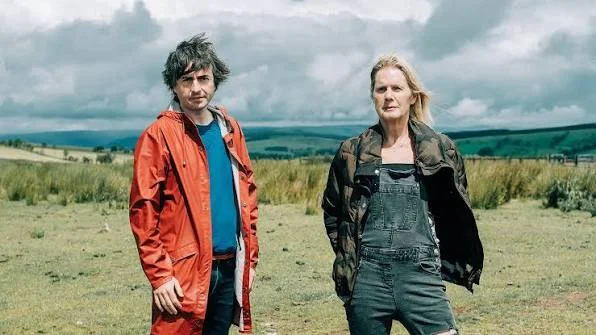
Bill Rich (Socha), his pregnant partner Liz (Creevy), and Bill’s teenage son Jonathan (Lewin Lloyd) have left London for an isolated farmhouse in the Brecon Beacons. Bill calls the absence of neighbours freedom, a persuasive idea for someone hoping distance from his old life will help him manage alcoholism and a stalled artistic career. For the others, his fresh start brings costs that Bill seems slow to recognize.
Jonathan is separated from the city and reduced to his records for entertainment, at a moment when his father’s previous marriage and the expected arrival of another child have already unsettled his place in the family. The farmhouse’s failing plumbing and strange electricity bills hardly suggest a household with the money to solve every problem by moving again.
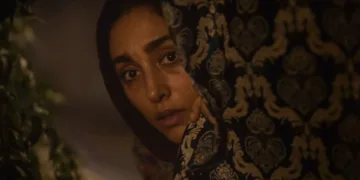
Creevy gives the story its clearest emotional perspective. Liz senses that the house somehow belongs to somebody else, and the remark is unnerving because she is already living inside a future largely arranged around Bill’s needs. When she gives birth there, unable to reach hospital in time, the appearance of an unfamiliar woman turns a moment of physical exposure into supernatural terror.
Later threats involving the baby work for similar reasons. Creevy does not need to persuade us that an apparition is real before she can persuade us that Liz is frightened for her child. Her fear is attached to a specific responsibility, rather than supplied as an interchangeable reaction shot.
Socha is effective at making Bill both likeable and difficult to depend upon. His genial confidence can harden into denial when Liz and Jonathan report strange experiences, and his decision to tell the spirits to leave is almost comically inadequate.
Jonathan, meanwhile, encounters accounts of the Enfield Poltergeist and begins to suspect his own turbulent emotions might be attracting the activity. That suggestion carries a cruel domestic implication: a boy already struggling with a fractured family might now have to consider himself responsible for the terror in his new home.
These tensions ought to give the haunting time to deepen. Instead, footsteps pound through the house, doors slam, household systems misbehave, and the elderly female figure becomes an increasingly familiar visitor. A fleeting glimpse of a spectre retreating from view can be genuinely alarming.
Claustrophobic close-ups and abrupt shifts to shaking handheld footage sometimes reproduce the family’s loss of control. Yet the series reveals its apparitions so readily that the effect becomes inconsistent. Once the ghosts have made themselves available for inspection, another sound in the corridor has a harder job to do. Some of the more emphatic manifestations come perilously close to comedy.
The difficulty is partly one of translation between media. Robins’s earlier audio investigation had room for testimony, competing explanations, and the silence in which a listener supplies a private image of something frightening. Four television episodes have to move through the disturbances and the history behind them at a more frantic pace.
Ironically, the programme’s strongest horror sometimes arrives when it behaves like something people might simply listen to. An electrician’s account, told amid questions about impossibly high power bills, is disturbing because the mind must construct its own version of events. A story of past grief in the second episode finds human pain where another visible apparition would merely increase the number of scares.
The BBC’s decision suggests one possible direction for television: successful audio investigations becoming source material for scripted genre dramas. There is considerable potential in that approach, provided producers recognize that an effective podcast is not automatically a functioning television screenplay.
The production understands the value of a particular place. A derelict stone structure with a flooded cellar sits on the land like a piece of history nobody has successfully buried. Liz’s telling of the Welsh legend of the Gwrach y Rhibyn, a threatening figure associated with the countryside, draws on traditions that rarely receive this much room in mainstream British ghost drama.
Bill’s Englishness contributes to the chill of his encounters with local people, including the frosty neighbouring farmer played by Robert Pugh. Sometimes those neighbours drift toward the stock figures of rural horror. But casting Welsh actress Creevy at the centre allows the setting to register through a character with a stake in it, rather than solely through forbidding hills and curious locals.
There is another question beneath the series’ assurance that it is inspired by real events. The accounts of the Heol Fanog haunting passed through the recollections of the real Liz, a published telling, and Robins’s podcast before reaching this dramatization.
The programme is entitled to invent, compress, and rearrange; the difficulty lies in using the authority of firsthand experience to authenticate scenes whose precise relationship to that testimony remains unknown. Liz’s version of events becomes the foundation for a production written by a man best known for investigating other people’s supernatural experiences. Television should be especially alert to the difference between giving somebody’s testimony a platform and reshaping it into a spectacle of a frightened woman and her baby.
That is one reason the show’s more ordinary barriers to escape deserve attention. In the second episode, the family seek emergency accommodation from the council and get nowhere. The refusal changes the familiar viewer’s demand that haunted-house occupants simply leave: money, housing, and a failing support system help keep these people in place. It is a pointed detail for a production that otherwise too often hurries past the consequences of Bill’s decisions. Even as the series prepares another visit from its supernatural residents, Liz and Jonathan have to return to the building from which they have asked for help escaping.
The Witch Farm premiered on November 22, 2026, on BBC One, BBC One Wales, and BBC iPlayer, where UK audiences can stream the first two episodes ahead of the final two arriving on November 29, 2026. Created and written by Danny Robins based on his hit BBC Radio 4 paranormal podcast and directed by Stacey Gregg, the four-part supernatural thriller follows a couple who leave London for an isolated farmhouse in South Wales in 1989, only to face escalating, terrifying disturbances that force them to confront the property’s dark history.
Full Credits
Title: The Witch Farm
Distributor: BBC One, BBC One Wales, BBC iPlayer, ITV Studios (International Distribution)
Release date: November 22, 2026 (BBC One & BBC iPlayer premiere; Episodes 1–2 streaming November 22 and Episodes 3–4 November 29, 2026)
Running time: 57 minutes per episode (4 episodes, miniseries)
Director: Stacey Gregg
Writers: Danny Robins
Producers and Executive Producers: Megan Ott, James Gandhi, Damien Timmer, Nawfal Faizullah, Rebecca Ferguson, Stacey Gregg, Danny Robins, Nick Andrews
Cast: Gabrielle Creevy, Michael Socha, Lewin Lloyd, Jeremy Swift, Sian Gibson, Roger Evans, Robert Pugh, Edward Holcroft, Kimberley Nixon, Sharon Morgan, Ioan Hefin, Andria Doherty, Steve Meo, Leila Navabi, Karl Johnson, Jake Manwaring, Suzanne Packer, Ieuan Rhys
Editors: Jonathan Stenton, Tom Henson-Webb
Composer: Adam Janota Bzowski
The Review
The Witch Farm
The Witch Farm gives supernatural drama a welcome place on BBC television, strengthened by Gabrielle Creevy's grounded performance, its distinctly Welsh setting, and the family's credible domestic struggles. Yet Danny Robins's adaptation sacrifices much of the uncertainty that made the original investigation disturbing. Repeated apparitions and increasingly explicit scares weaken a story whose most unsettling moments emerge from human vulnerability and stories left to the imagination. The BBC deserves credit for revisiting the haunted-house tradition, even if it seems reluctant to let its ghosts remain mysterious.
PROS
- Gabrielle Creevy's convincing, emotionally grounded performance
- Distinctive Welsh setting and regional folklore
- Believable family tensions and social pressures
- Effective atmosphere during quieter, dialogue-driven scenes
CONS
- Premature supernatural revelations weaken suspense
- Repetitive disturbances deliver diminishing scares
- Compressed adaptation neglects character development
- Real-life testimony becomes difficult to distinguish from invention