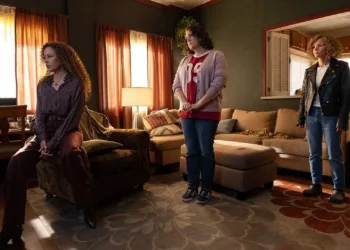

















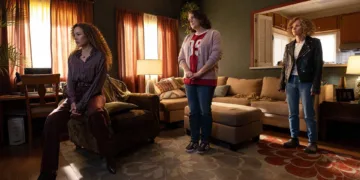










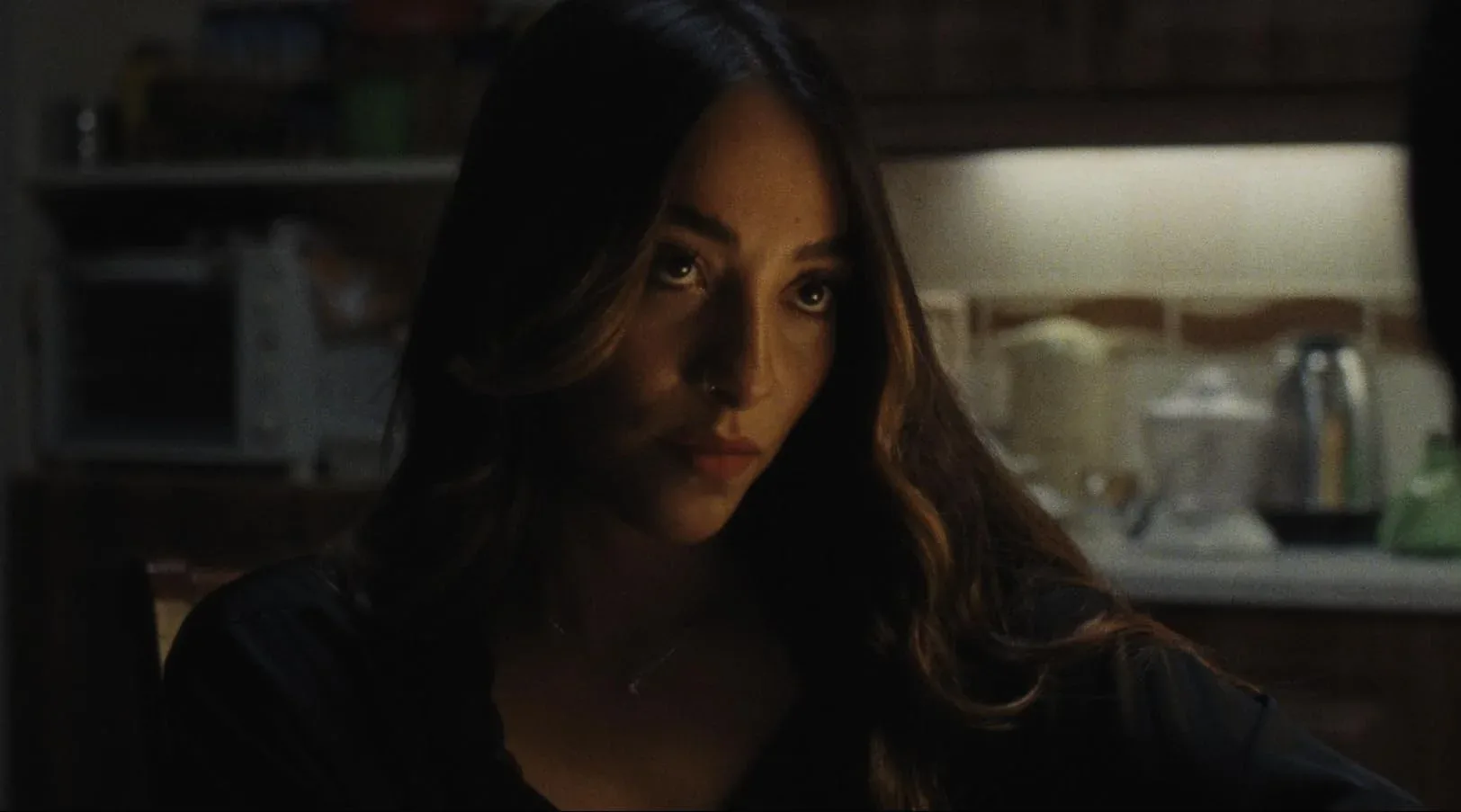

Polygamy is legal in the United Arab Emirates, but legal permission does nothing to settle the question of who controls a family home. That gap is the first dark space in Majid Al Ansari’s The Vile, an Emirati horror film that understands how a room changes when a longtime occupant no longer feels secure there. Cinematographer Benjamin Kirk Nielsen’s dim interiors give this conflict a physical form. Familiar corridors acquire places of concealment, and looking into darkness becomes an exercise in deciding whose fears deserve to be believed.
Amani (Bdoor Mohammed) has spent years building a life with her husband, Khalid (Jasem Alkharraz), and their teenage daughter, Noor (Iman Tarik). Khalid then introduces Zahra (Sarah Taibah), his younger, pregnant second wife, and expects her to move in.
The pregnancy matters to him because Zahra may give him the son Amani never had. His reasoning is delivered with the complacency of a man who has found a legal justification and mistakes it for a moral one. Zahra’s presence changes the household immediately, although Khalid seems inclined to regard the arrangement as an administrative adjustment.
The Vile earns a recommendation through its command of domestic unease, its visual discipline, and Mohammed’s fierce central performance. Its most effective horrors arise from choices people can defend aloud and injuries they refuse to acknowledge. Al Ansari eventually trades some of that precision for conspicuous supernatural effects, but the earlier damage is difficult to shake.
The film begins with Amani and Noor playing hide-and-seek in their home, treating its dark corners as places of shared amusement. That opening establishes a visual vocabulary Al Ansari can later turn against them. Once Zahra arrives, the same kind of obscured domestic space becomes suspect. Nielsen’s moody interior lighting creates a restricted field of vision in which familiarity offers little reassurance.
The moral implication is unusually clear: Amani has not lost the physical house, yet its shadows now belong to possibilities she cannot control. A conventional haunted house announces its hostility through architecture. Here, Benedikt Lange’s lived-in production design gives the darkness ordinary walls, ordinary furniture, and the unpleasant credibility of a place someone still has to clean.
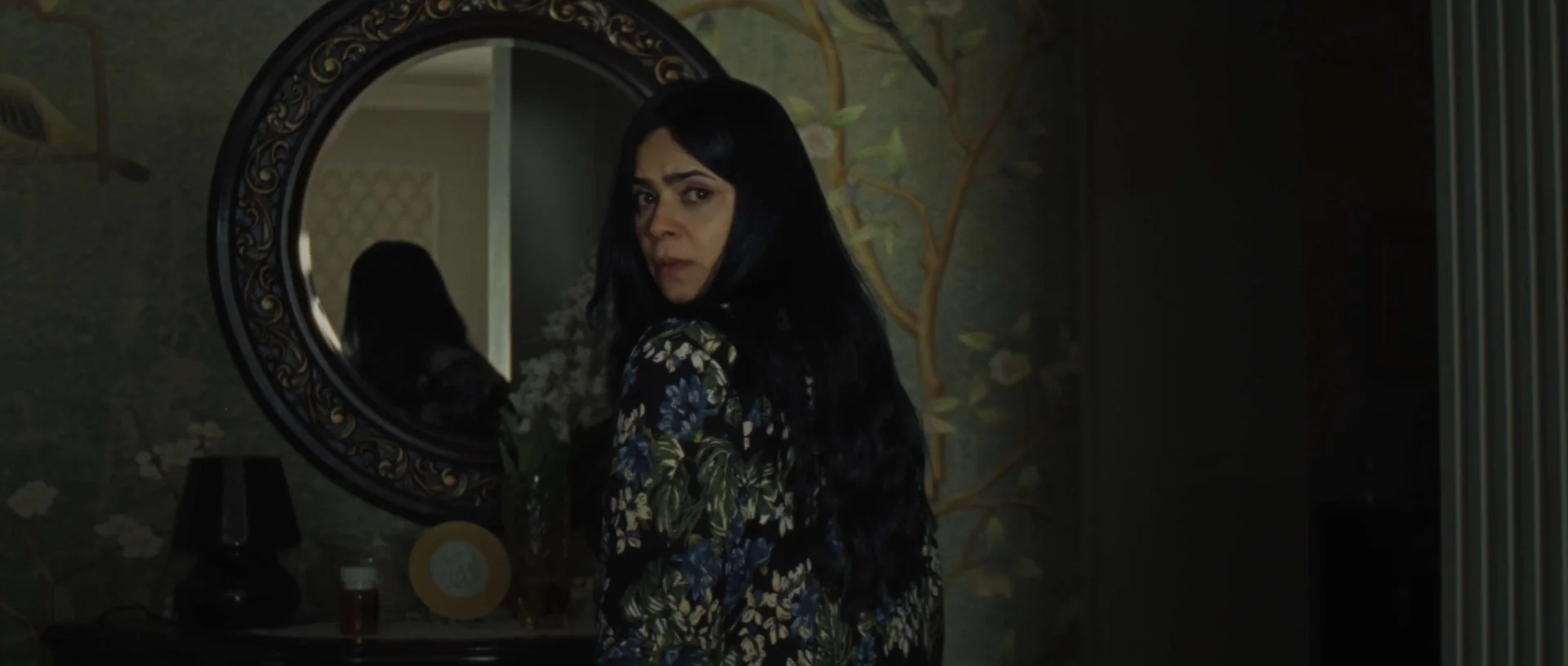
That last obligation matters. The untidy sink and accumulated dishes suggest a household that has already begun to deteriorate before the uncanny intrudes. Amani becomes fiercely protective of the domestic work when Zahra offers to help. By bringing the cluttered kitchen into view, the film makes an ordinary domestic arrangement a measure of contested authority. If Zahra can take over the chores, she can apparently take over the position. Khalid has supplied the premise; the women are left to negotiate its practical meaning among the dishes.
Mohammed makes that struggle painful rather than merely possessive. When Zahra first enters the home, Amani’s anguish spills toward Noor, the person she can still reach emotionally. Her desperation does not cancel her resolve, and her resolve does not prevent the humiliation from showing.
Her sister offers her somewhere else to live, but Amani refuses to abandon a home she has spent years sustaining. That decision is neither easy triumph nor passive submission. It is an insistence that Khalid’s declaration should not erase the history of everyone who lived there before Zahra crossed the threshold.
Khalid’s absences sharpen the cruelty. He leaves Amani to confront a second wife whose manner shifts between kindness and something harder to read. Taibah lets calculation flicker through an otherwise inviting performance. Even Noor begins to warm to Zahra, a plausible response Amani experiences as a further loss of authority. The viewer has no comfortable vantage point from which to settle Zahra’s intentions.
The nocturnal disturbances exploit that uncertainty with greater skill than any explicit apparition. Amani investigates a sound in the house; the darkened corridors force both her and the viewer to contemplate what might occupy the space beyond immediate sight.
The lighting controls access to information, which is also the central ethical problem of the story. Amani can see and suspect, yet she struggles to establish evidence persuasive to those around her. The film borrows something essential from noir: a frightened investigator surrounded by partial clues, uncertain loyalties, and a system in which the truth has little authority until someone powerful agrees to recognize it.
There are other clues. Zahra brings strange, foul-smelling flowers into the house, inexplicable events multiply, and Amani glimpses a djinn-like presence. Her inquiries into Zahra’s background can look like necessary self-defense or the obsessive reasoning of a woman under extraordinary strain. The Vile benefits from keeping those possibilities close together. Its supernatural threat acquires force from the prior, entirely credible violation of trust. Amani has good reason to feel endangered before anyone asks her to believe in a spirit.
Noor’s experiences extend the damage outside the house. Classmates bully her over the change in her family, making Khalid’s supposedly private choice a public burden for his daughter. She must protect herself at school and then return to a home where her mother increasingly fears what no one else can verify. The early hide-and-seek game becomes especially painful in retrospect: mother and daughter once knew how to make fear temporary and pleasurable. Now they disagree about its source, and Amani’s attempts to protect Noor threaten the ease that originally joined them.
The slow development of these fractures is Al Ansari’s greatest structural asset. He allows Zahra’s friendliness to complicate the audience’s suspicions and Amani’s determination to develop into something close to paranoia. That patience places the film in the psychological-horror lineage of Rosemary’s Baby, where pregnancy and domestic disbelief turn intimacy into an arena of investigation. Al Ansari also has a strong instinct for the modest threat. A disturbed night in an ordinary room can unsettle the viewer long after the cause of the noise has ceased to matter.
The later escalation makes that restraint harder to sustain. Jump scares and increasingly surreal occult imagery push the film toward a familiar grammar of supernatural confrontation. The resulting revelations give Zahra a more definite function but a less interesting interior life, reducing the ambiguity Taibah has worked to sustain. The dreamlike climax is especially blunt after a film so attentive to the moral uncertainty of its rooms.
One can admire the technical assurance of the spectacle and still miss the quieter possibility that Amani’s fear might remain impossible to classify. The supernatural explanation gives shape to the malignancy, but narrows Zahra from an unpredictable participant in a household power struggle to the instrument of an occult design.
The Vile had its world premiere at Fantastic Fest in September 2025 and arrived in select U.S. theaters and on digital platforms via Dark Sky Films on November 20, 2026. Directed by Majid Al Ansari, the supernatural horror-thriller follows a devoted wife and mother whose life upends when her husband returns home with a pregnant second wife, unleashing mounting domestic tension and sinister forces inside their home.
Where to Watch The Vile (2025) Online
Full Credits
Title: The Vile (حوبة / Hoba)
Distributor: Dark Sky Films
Release date: September 20, 2025 (Fantastic Fest world premiere), November 20, 2026 (U.S. theatrical and digital release)
Running time: 1 hour 37 minutes (97 minutes)
Director: Majid Al Ansari
Writers: Majid Al Ansari, Johnnie Alward
Producers and Executive Producers: Roy Lee, Steven Schneider, Derek Dauchy, Rami Yasin, Mohamed Hefzy, Yasir Al Yasiri
Cast: Bdoor Mohammad, Sarah Taibah, Iman Tarik, Jasem Alkharraz, Samira Al Wahaibi
Director of Photography (Cinematographer): Benjamin Kirk Nielsen
Editors: Ghalya Lacroix, Hafedh Laridhi
Composer: Jerry Lane, Andrew Lancaster
The Review
The Vile
Al Ansari turns an ordinary family home into a place where every shadow carries a moral accusation. Nielsen’s controlled lighting and Bdoor Mohammed’s fierce performance make Amani’s struggle for dignity genuinely unsettling, while Zahra’s calculated warmth keeps suspicion alive. The film’s patient psychological construction is stronger than its increasingly explicit supernatural horrors. By the time the surreal climax arrives, much of the ambiguity has been sacrificed for familiar occult spectacle. The darkness was considerably more disturbing when its contents remained uncertain.
PROS
- Bdoor Mohammed’s commanding central performance
- Atmospheric lighting and effective domestic production design
- Rich moral ambiguity surrounding authority and trust
- Patient development of psychological tension
CONS
- Heavy-handed supernatural escalation
- Zahra’s characterization weakened by the occult revelations
- Surreal climax undermines earlier psychological restraint