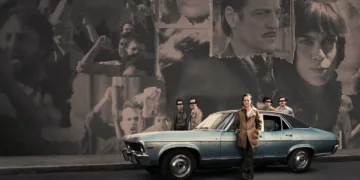



























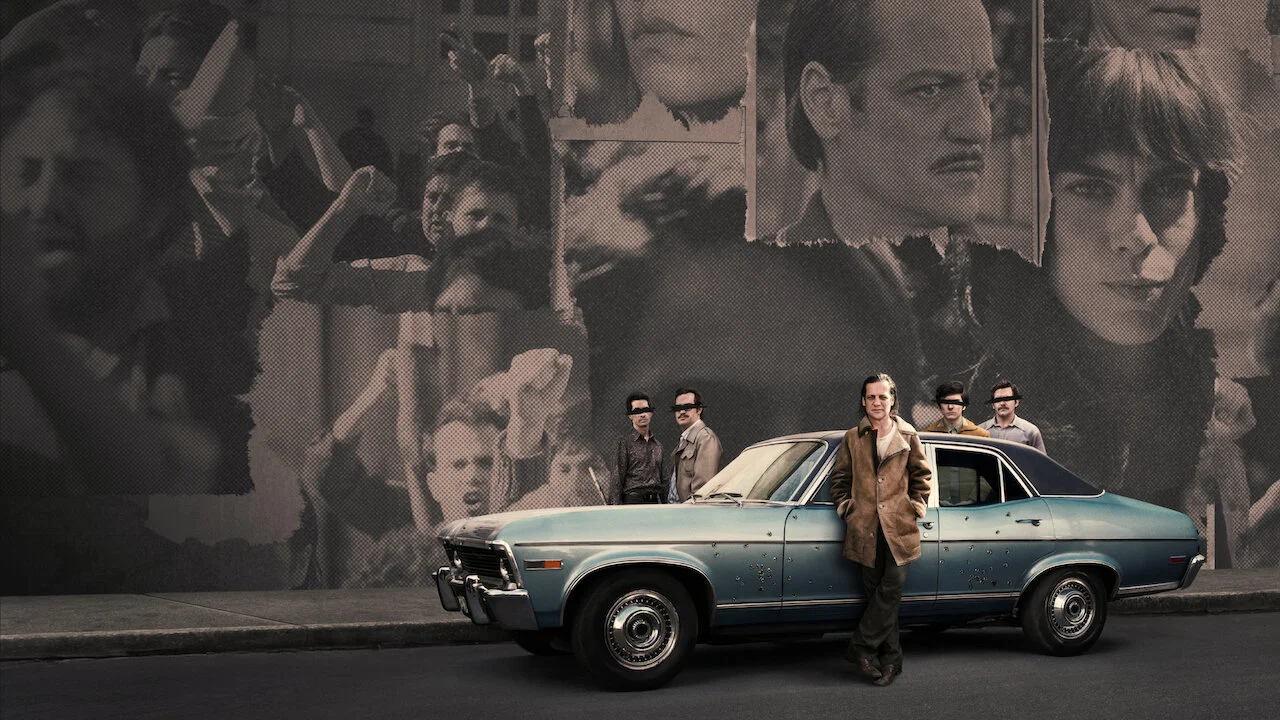

The Argentine flag draped across the shelves of a bank vault is the first episode’s most efficient piece of storytelling. Acosta (Matías Recalt) wants his participation in the robbery to mean something politically. Aníbal Gordon (Rodrigo de la Serna) wants the money, preferably all of it. His response to Acosta’s patriotic gesture is to punch him and leave with the cash. In a few minutes, the series establishes two competing motivations, creates a personal conflict, and sets up the relationship that will eventually expose its central weakness.
That promising foundation supports Pablo Trapero and Pablo Fendrik’s seven-episode Netflix thriller, which follows a real Argentine criminal’s rise through the political violence of the 1970s. Based on work by historian Marcelo Larraquy, Gordon traces how a bank robber with little ideological commitment becomes increasingly valuable to intelligence organizations and right-wing groups.
Its historical premise has considerable dramatic potential, particularly in showing how institutions can transform ordinary criminal ruthlessness into something far more dangerous. The series understands that progression. What it struggles to provide is meaningful development for the people caught inside it.
The result is an ambitious but frequently frustrating crime drama, carried by an excellent central performance and undermined by its own narrative priorities. There are sequences worth watching, particularly during the opening robbery and the oppressive final episodes. Recommending the entire series is harder. Its seven hours contain plenty of changes in Gordon’s circumstances, but remarkably few discoveries about Gordon himself.
The structure initially suggests a carefully organized examination of criminal opportunism. A 1966 prologue depicting the hijacking of an Argentine airliner establishes the political commitment of the militants who will later intersect with Gordon’s activities. The story moves to 1970, when Gordon maintains a respectable family life alongside an increasingly elaborate criminal operation.
The bank robbery brings these worlds into direct conflict, and his betrayal of Acosta leads to retaliation from the young militant’s associates. Their confrontation produces an arrangement that expands Gordon’s opportunities. His expertise becomes useful to politically connected men, and their protection offers him room to operate. The robbery itself features an extended continuous shot that tracks the coordination required to enter and empty the vault. The camera gives the operation a physical clarity that the increasingly complicated political story will struggle to maintain.
The first major structural shift comes when Gordon’s criminal activities intersect with the intelligence apparatus. His imprisonment, dealings with operative Julieta Melo (Camila Peralta), and release through the 1973 amnesty move the story from conventional organized crime into the political institutions of the period.
Gordon subsequently becomes involved with organizations including the CNU and the Triple A, exploiting changing allegiances for his own benefit. These developments are logically connected. A man who has always used violence to obtain money discovers that political authority can make violence considerably easier to practice.
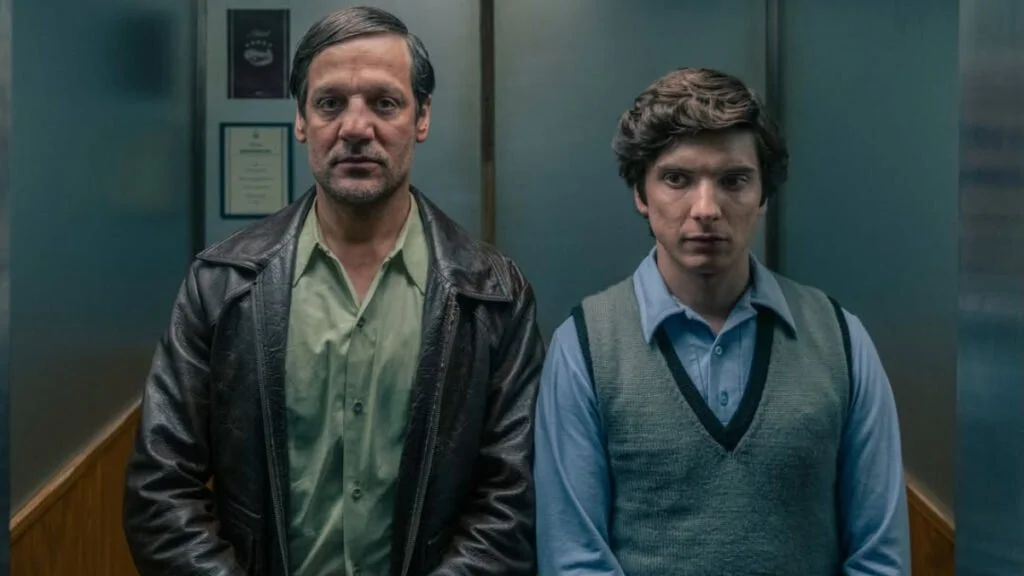
Yet this middle stretch exposes the limitations of the writing. Names, factions, and institutional relationships accumulate through conversations that frequently establish political positions without creating much immediate dramatic tension. Some complexity is unavoidable in a story covering Argentina’s turbulent early 1970s, and the series deserves credit for resisting an artificially simplified political landscape.
But viewers need to understand the practical consequences of these alliances as they emerge. Too often, the script introduces another organization, explains its relationship to Gordon, and moves on. His career progression remains impressively documented. His character development has apparently been assigned to a different department.
Rodrigo de la Serna does much to compensate. His performance finds a disturbing consistency in Gordon’s behavior, particularly the pleasure he takes in situations that would frighten most people. At a fairground shooting game, Gordon’s disappointment in his son’s poor marksmanship reveals a father who measures masculine worth through familiarity with weapons.
Later, inside a haunted attraction, he notices someone following him and responds by drawing his gun with unmistakable excitement. These moments establish a connection between his domestic disappointments and his appetite for danger. De la Serna gives Gordon a recognizable physical personality through his smiles, confident movements, and almost cheerful response to threats.
The actor also handles the character’s increasing brutality without forcing an obvious transformation. Gordon’s cruelty does not suddenly appear once he enters the political machinery. It has been present since the beginning, and his new associations simply remove obstacles to expressing it.
Still, the script offers de la Serna limited opportunities to complicate the behavior he portrays so convincingly. By the later episodes, another grotesque smile tells us little that the first few have not already established. The performance remains unsettling, but its dramatic possibilities become narrower as Gordon grows more powerful.
Matías Recalt’s Acosta provides the missing ingredient. Their relationship develops from mutual hostility into an uneasy partnership, with Acosta initially attracted to Gordon’s competence and apparent authority. Recalt supplies the hesitation and vulnerability that Gordon lacks, making their scenes together particularly useful.
Acosta has political convictions, personal ambitions, and eventually a desire to abandon their violent environment for a quieter existence. Each of these qualities creates a potential conflict with the older man’s expectations. There are even suggestions that Gordon regards Acosta as the capable successor his own son seems unlikely to become.
The series does relatively little with that possibility. Acosta’s changing priorities should fundamentally alter the relationship, forcing Gordon to confront the limits of loyalty and the possibility that someone close to him might choose a life outside his control. Instead, the story advances toward their final rupture without giving sufficient attention to the emotional changes connecting its stages.
Their eventual confrontation carries enormous dramatic consequences, yet the writing barely allows Gordon to process them. Acosta’s departure from his former mentor’s worldview should represent one of the season’s defining character turns. The plot treats it primarily as another event in Gordon’s expanding criminal history.
The same problem affects the supporting women. Julieta’s professional relationship with Gordon offers an opportunity to examine how intelligence officials rationalize employing people they cannot control. Camila Peralta gives her moments of visible discomfort as the consequences of that decision become harder to ignore. The writing, however, rarely develops those reactions into sustained moral conflict. She registers the danger of what she has helped enable, and the narrative promptly finds another crisis demanding her attention.
Gordon’s wife, played by Agustina Muñoz, is even less fortunate. After his release from prison, he embraces his family before almost immediately departing with his associates. Her understanding nod closes a situation that ought to raise several questions about their marriage, their children, and the accommodations required to live alongside such a man. Apparently, domestic consequences can be resolved through a single facial expression. The series repeatedly uses family life to demonstrate Gordon’s ability to compartmentalize his behavior, but gives his family little existence beyond confirming that ability.
Graciela Mancini (Fiorella Bottaioli), a doctor and Montoneros militant, receives a clearer political purpose. Her commitment and personal losses establish the consequences of the violence Gordon helps perpetuate. Yet her scenes are largely organized around resistance and victimization, leaving limited room to understand her life outside the conflict. This becomes noticeable when the final episodes bring her story into direct contact with Gordon and Julieta, a confrontation whose emotional groundwork remains uneven.
The final two episodes represent the series’ sharpest formal change. The early heist thriller and the increasingly convoluted middle give way to the enclosed terror of a clandestine detention facility modeled on Automotores Orletti. Trapero’s return to directing brings a grim concentration to these sequences, where the physical confinement of the setting reflects the power that Gordon and his associates exercise over their captives. The progression makes historical sense. The man who once needed elaborate plans to steal money can now inflict suffering from a position of institutional protection.
There is considerable force in this change of setting, but the series increasingly substitutes escalating brutality for dramatic discovery. Torture, mutilation, beatings, and sexual humiliation repeatedly demonstrate Gordon’s sadism. Some of these scenes communicate the terror of state-backed repression with necessary severity.
Others extend acts of cruelty long after their implications have become clear. The screenplay has already established Gordon’s capacity for appalling violence and struggles to find additional meaning in displaying it again. The repeated use of period music over disturbing sequences develops a similar predictability, turning an initially effective historical counterpoint into an increasingly familiar accompaniment.
This creates a peculiar imbalance in the season’s pacing. The middle episodes devote substantial time to explaining political networks but often rush past decisive personal developments. The final stretch reverses that emphasis, allowing individual acts of violence considerable screen time while leaving the emotional consequences comparatively compressed. Both approaches serve legitimate purposes, yet neither consistently strengthens the relationships established in the first episode.
The decision to stop the story in 1976, rather than depict Gordon’s eventual capture and imprisonment, is among its more defensible choices. It denies the conventional satisfaction of seeing a criminal brought to justice and leaves the machinery of repression as the dominant historical concern.
A closing quotation from Primo Levi reinforces that intention. But the abrupt cutoff also exposes what the intervening episodes have neglected. Gordon’s political rise has been recorded in considerable detail; the personal relationships that might have given that history its strongest dramatic force are left behind, particularly the bond with Acosta that began over a flag in a bank vault.
Gordon premiered on Netflix on November 18, 2026, and is available to stream on the platform. Co-directed by Pablo Trapero and Pablo Fendrik and inspired by Marcelo Larraquy’s books, the Argentine limited series stars Rodrigo de la Serna as Aníbal Gordon, tracing his escalation from a small-time thief into paramilitary violence and state-backed crimes during 1970s Argentina.
Where to Watch Gordon Online


Full Credits
Title: Gordon
Distributor: Netflix
Release date: November 18, 2026
Rating: TV-MA
Running time: ~37–43 minutes per episode (6 episodes, limited series)
Director: Pablo Trapero, Pablo Fendrik
Writers: Pablo Trapero, Marcos Osorio Vidal, Marcelo Larraquy
Producers and Executive Producers: Adrián Suar, Diego Andrasnik
Cast: Rodrigo de la Serna, Matías Recalt, Camila Peralta, Matías Mayer, Fiorella Bottaioli, Agustín Pardella, Fernando Contigiani García, Agustina Muñoz, Toto Rovito
Editors: Gemma Cabello
Composer: Pedro Onetto
The Review
Gordon
Gordon constructs a convincing path from organized crime to institutional terror, but its characters rarely develop alongside the escalating violence. Rodrigo de la Serna delivers a formidable performance, and the opening robbery and oppressive final episodes demonstrate considerable directorial skill. Yet the muddled political exposition, neglected relationships, and repetitive brutality weaken the seven-episode structure. Acosta's underdeveloped arc is particularly damaging, wasting the story's clearest opportunity to challenge its protagonist. The series documents Gordon's rise with admirable determination. Understanding the people around him seems to have been a secondary assignment.
PROS
- Rodrigo de la Serna's commanding performance
- Excellent extended bank-robbery sequence
- Effective progression into political horror
- Disturbing final episodes
CONS
- Underdeveloped character relationships
- Confusing political exposition
- Excessive, repetitive graphic violence
- Uneven pacing and rushed emotional developments