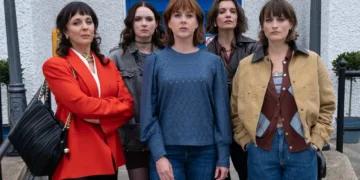


























At their first support meeting, five women take turns denying that they are Alice Bell. The repetition is awkward, but the name they share gives them something their separate protests could not secure: a collective identity. Channel 4’s six-part Hunting Alice Bell follows women targeted by strangers who believe they have located a criminal living under a new name. Before these women can get a hearing, they must organize themselves around the person everyone else wants them to be.
Their subsequent emergence as the Not Alice Bells gives David Baddiel and Peter Bradshaw’s drama its richest subject. Conference invitations and television appearances follow; Cathy Newman interviews them. Their experiences become recognizable as a public issue once they acquire a name suitable for an interview introduction.
Publicity offers practical resistance to harassment, and the series lets that resistance feel exhilarating. Yet their invitation into the conversation rests on a narrow qualification. Each woman must remain an acceptable representative of innocence while speaking about abuse that should require no such audition.
The absent figure organizing their lives is a former nurse who falsified hospital records connected to the crimes of her former partner, serial-killing anaesthetist Jason Nash. Alice served an 18-month sentence and received a new identity. Years later, leisure-centre worker Fran Da Silva appears on local television, and an online personality calling himself True Crime Buster announces that she is Alice. Alexandra Roach plays Fran, whose household includes her husband Nick, their baby and his two teenage children. A fleeting appearance on the news becomes permission for strangers to inspect every part of her life.
The claimed authority is a 74-percent facial match. That number gives an accusation the appearance of a finding, without the programme asking us to accept it as a reliable measurement. Fran’s attempt to show vigilantes her passport and GCSE certificates exposes the competing standards: her accuser can circulate a percentage, while she cannot establish her identity with documents. The scene is distressing because Fran continues trying to satisfy a demand that keeps escaping verification. There is no agreed piece of evidence she can produce to make these people leave her home.
Baddiel and Bradshaw make the accusation’s reach tangible through its movement into institutions and relationships. Colleagues withdraw from Fran, the teenagers suffer attacks, and the baby goes to stay with her grandmother at social services’ insistence. Protecting a child from danger is a different act from threatening a family, but the intervention still makes Fran absorb another loss. Roach keeps this domestic burden present as the plot grows busier. In her efforts to account for herself and preserve her household, Fran remains a person trying to accomplish necessary things, rather than merely the face attached to a topical nightmare.
The collective changes the available action. Fran joins PR worker Vanessa, wealthy Julie, computer specialist Ros and Charlotte, whose addiction leaves her particularly vulnerable. Emily Barber’s Vanessa brings a professional understanding of publicity that is useful precisely because it is uncomfortable. Her observation that online misogyny is fashionable enough to interest the press sounds calculated, as a PR worker’s assessment might. The line also makes the script’s own topical calculations audible. A woman looking for protection has learned to describe that need as an attractive editorial opportunity.

The ensemble’s value lies in giving those women the work of responding, organizing and negotiating their exposure. Nick, played by Rudi Dharmalingam, can offer support without becoming the man who explains the situation and solves it.
The public campaign also means that the women can disagree about tactics rather than existing solely as witnesses to male cruelty. That redistribution of dramatic activity matters most when publicity is treated as work the women undertake. Vanessa’s media fluency and Charlotte’s vulnerability give the shared accusation different stakes, even as the mystery begins putting those differences to another use.
Simon Pegg’s imprisoned Nash attracts male admirers while women associated with his crimes receive sexualized threats. The unequal allocation of fascination and disgust is stark. Fran’s stepdaughter Violet supplies a useful complication by reading Alice’s relationship with Nash through coercion and unequal power. Her interpretation permits discussion of responsibility without assuming that proximity proves equal freedom. It does not settle Alice’s culpability, and its dramatic value comes from introducing another way for the family to understand her conduct.
The series sometimes seems eager to package resistance as efficiently as it packages debate. Shots of the women’s legs emerging from cars lead into a swaggering group walk across a car park. Their collective confidence deserves room, but the ready-made glamour sits uneasily beside the painstaking exposure of Fran’s family.
The sequence supplies a promotional image of empowerment before the women’s security has caught up with it. Real media personalities, including the hosts of The Rest Is Politics, further blur the distance between the publicity circuit and the drama inspecting it. Familiarity can lend authority without requiring much examination of how that authority works.
Then Nash announces from prison that one of the five women is Alice. His claim is an effective intervention because it changes the group’s purpose. Private histories become possible clues; women who needed one another’s protection begin assessing one another’s credibility. The six-part structure gains propulsion from that conversion. There is pleasure in reconsidering details, and the series is good at making the next disclosure seem necessary. The cost is a narrowing of attention: the differences between these women increasingly matter for what they might conceal.
That movement does not automatically cancel the drama’s objections to harassment. An accurate identification would establish a fact, not authorize threats against five households. Nor does serving a sentence erase every legitimate question about past conduct.
The troubling shift occurs inside the support group, where the promise of safety starts depending on access to another woman’s private history. Suspicion now gives the women urgent activity and gives television another reason to keep watching them. Their capacity to protect each other must compete with the possibility that a withheld detail will change whom they feel able to defend.
Hunting Alice Bell premiered on Channel 4 on November 11, 2026. Created by David Baddiel and Peter Bradshaw, the psychological thriller follows a woman whose quiet life implodes when she is wrongfully accused online of being the fugitive ex-lover and accomplice of a notorious serial killer.
Full Credits
Title: Hunting Alice Bell
Distributor: Channel 4, Sphere Abacus
Release date: November 11, 2026
Rating: TV-14
Running time: Approx. 46-60 minutes per episode (6 episodes)
Director: Paul Walker
Writers: David Baddiel, Peter Bradshaw, Polly Buckle, Kate Verghese
Producers and Executive Producers: Tamryn Reinecke, David Baddiel, Mike Benson, Peter Bradshaw, Polly Buckle, Jonathan Ford, Rachel Gesua, Will Stanley
Cast: Alexandra Roach, Amanda Abbington, Emily Barber, Toni O’Rourke, Christina Bennington, Simon Pegg, Rudi Dharmalingam, Ralf Little
Director of Photography (Cinematographer): Giulio Biccari
Editors: Tony Kearns
Composer: Daithí Ó Drónaí
The Review
Hunting Alice Bell
Hunting Alice Bell is sharpest when it shows women learning to make their suffering legible to television. Alexandra Roach gives that argument a human scale, and the collective campaign supplies energy and uncomfortable insight. The mystery generates suspense, though its appetite for secrets gradually crowds out the differences between the women. Glossy empowerment imagery and familiar media faces make the programme’s scrutiny uneven. It understands the price of becoming a public story, while remaining eager to sell one.
PROS
- Roach keeps the family’s losses emotionally tangible.
- Women’s collective resistance drives the drama.
- Concrete consequences expose the reach of public accusation.
- Shifting trust sustains the identity mystery.
CONS
- The mystery increasingly treats personal differences as clues.
- Glossy empowerment imagery jars with the domestic stakes.
- Media cameos lend authority without enough scrutiny.