
























The film opens on the anguish of an adult Lauren Lane, played by Sophie Turner, her face a mask of distress in a gated mansion. This private torment is a stark reversal from her public identity as America’s television sweetheart, the long-running star of the family sitcom Meet the Johnsons. Her carefully constructed, wholesome image has been shattered by a digital violation.
A hacker has leaked her private information, including intimate photos and, most damagingly, an image of a positive pregnancy test. The ensuing media frenzy dissects every detail, turning her life into tabloid fodder. In response to the mounting pressure from the press and her own team, Lauren arranges an escape.
She flees to a luxurious, secluded Airbnb, seeking solace from the public eye. The stage is set for a psychological thriller, positioning a celebrity, besieged by the world, in a location where her isolation becomes her greatest vulnerability.
A Hodgepodge of Threats
Lauren’s search for peace is not merely interrupted; it is obliterated by a script that refuses to commit to a single threat. The initial premise of a woman in hiding quickly splinters into a disorganized array of competing plotlines, each with its own distinct, and often contradictory, tone. The most immediate danger arrives with a trio of criminals planning to rob the house.

Their leader is the blustering ex-con Darren, whose attempts at tough-guy posturing are consistently undone by his own incompetence. He is aided by his twitchy roommate Merg and his nephew Marcus, the Airbnb technician who provides the access. Their home invasion unfolds less like a tense thriller and more like a farcical crime comedy, with their witless banter and poorly executed plans draining the scenario of genuine menace.
Simultaneously, a far more sinister plot is in motion. A cold, efficient hitman is tracking Lauren, hired by her on-screen father, Peter, to permanently silence her and the unborn child that links them. This storyline introduces a chilling, serious threat that is constantly undermined by the buffoonery of the burglars. To further dilute the focus, a third narrative thread follows Lauren’s dog, Georgie, who escapes the chaos.
The dog is found by Loretta, a kind but dawdling animal rescuer whose quirky, gentle side-quest feels imported from an entirely different film. This structural diffusion creates a jarring experience. The film cannot decide what it wants to be, shifting erratically between a life-or-death struggle and the criminals’ aimless, sub-Tarantino dialogue. Trust presents itself not as a cohesive story but as several movies stitched together, a home-invasion flick, a hitman procedural, and a gentle comedy all vying for attention within the same disjointed frame.
A Sidelined Star and Cardboard Foes
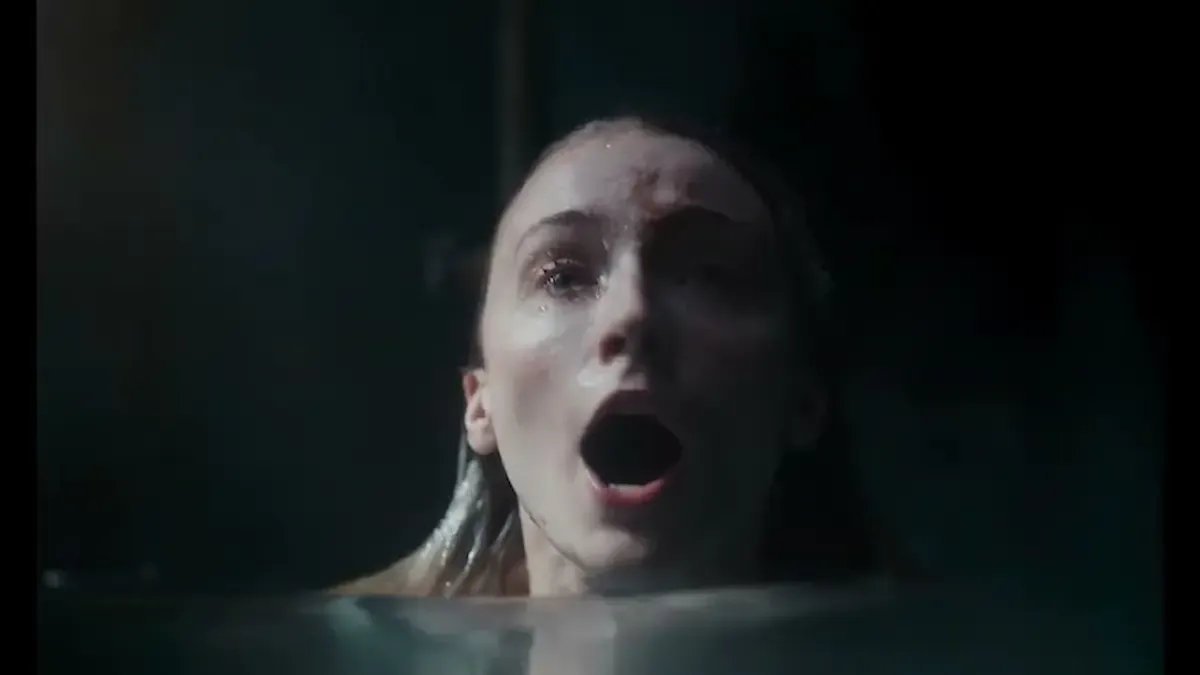
Sophie Turner commits fully to her role, delivering a physically grueling and emotionally raw performance that effectively portrays Lauren’s terror and fierce determination. The film, however, repays her dedication with a baffling structural choice: it removes her from her own story. For a vast portion of the second act, Lauren is trapped and isolated inside a damp, cramped boiler room.
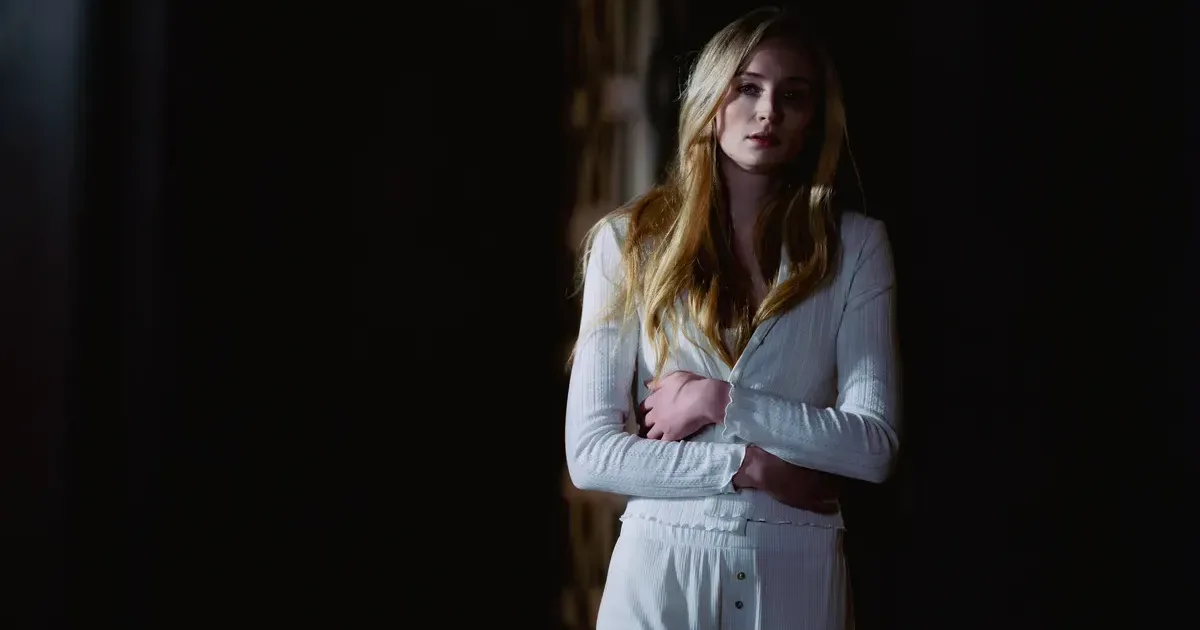
This confinement not only physically immobilizes her but also strips her of all narrative agency. She is transformed from a protagonist into a passive object, a damsel whose primary function is to react to noises outside her stone-and-pipe prison. This decision stalls the movie’s momentum and forces the audience to spend extended time with its far weaker supporting characters, who lack the depth to carry the narrative.
The antagonists are especially underdeveloped. The burglars are a collection of worn-out archetypes, from the loud-mouthed leader who fears returning to prison to the unpredictable tweaker. Their dialogue is a string of clichés, and their actions defy basic logic, making them feel more like narrative obstacles than believable human threats.
The film’s other villain, the predatory TV dad Peter, represents a significant missed opportunity. The concept of a beloved public figure exposed as a groomer is rich with dramatic potential, yet the film never explores the psychological horror of this betrayal. His character is rendered as a flat, one-dimensional figure motivated by a simple, unexamined desire for self-preservation.
Elsewhere, Katey Sagal brings a welcome warmth to the role of Loretta, but her character’s whimsical energy feels entirely out of place amidst the film’s darker ambitions. Her inability to piece together obvious clues is one of many instances where character actions strain credulity, contributing to the film’s shaky foundation of implausibility.
Thematic Ambition Meets Clumsy Execution
Trust gestures toward a serious critique of modern celebrity. The opening act, filled with invasive news clips and the relentless ping of social media notifications, effectively establishes a world where fame is a cage and privacy is a commodity. The film appears ready to examine the public’s voracious appetite for scandal and the dehumanizing effects of media scrutiny.
These potent ideas, however, are treated as little more than an opening act. They are quickly abandoned in favor of the more conventional, yet deeply muddled, thriller plotlines. The narrative’s most significant theme, the insidious power imbalance of Peter’s long-term grooming of Lauren, is handled with similar carelessness.
What should be the emotional and psychological core of the story is instead reduced to a backstory catalyst, a plot point used simply to set the hitman in motion. This superficial treatment does a disservice to the gravity of the subject.
This failure to engage meaningfully with its own ideas is made worse by a screenplay that disregards basic logic. The audience is asked to believe that a star of Lauren’s magnitude could easily evade a swarm of professional paparazzi and travel to a remote location without any form of security. The ordinary boiler room where she is trapped is depicted as an inexplicable, inescapable fortress.
Perhaps most unbelievably, her extensive professional team seems entirely unconcerned by her prolonged, unexplained disappearance. These plot holes are not minor quibbles; they are foundational cracks that shatter the viewer’s immersion and make it impossible to invest in the film’s already underdeveloped themes.
A Film That Fails to Trust Itself
The central deficiency of Trust is betrayed by its own title. Here is a film that does not trust its own best ideas to carry a narrative. It presents a sharp, culturally relevant premise about the perils of fame and hidden abuse, only to retreat into a chaotic jumble of half-baked action and comedy tropes.

It features a strong, dedicated lead actress but then imprisons her in a single room, effectively removing her from the story. Sophie Turner’s performance remains the film’s most commendable element, a raw and believable portrayal of terror existing within a story that frequently borders on the absurd. The initial concept held all the necessary components for a smart, tense, and insightful thriller.
The final product, however, is a deeply frustrating experience. It is a movie sunk by its own indecision, a story built on a foundation of squandered potential, leaving the audience with a chaotic and profoundly unsatisfying cinematic ordeal.
Trust is a survival thriller film directed by Carlson Young and written by Gigi Levangie. It was released in select theaters in the United States on August 22, 2025, and is distributed by Republic Pictures. Produced by Twisted Pictures, Oren Koules Productions, and Republic Pictures, the movie is also available to watch on platforms like Netflix, Amazon Prime Video, and Hulu, as well as for free with ads on The Roku Channel and Pluto TV.
Full Credits
Director: Carlson Young
Writers: Gigi Levangie
Producers and Executive Producers: Oren Koules, Miles Koules, Ketura Kestin, Claire Kupchak, Ksana Golod, Sophie Turner, Carlson Young, Lena Roklin, Daniel Jason Heffner, Ulrich Maier
Cast: Sophie Turner, Rhys Coiro, Billy Campbell, Peter Mensah, Forrest Goodluck, Gianni Paolo, Renata Vaca, Katey Sagal
Director of Photography: Alejandro Martinez
Editors: Louis Cioffi
Composer: Isom Innis
The Review
Trust
Despite a committed and raw performance from Sophie Turner, Trust collapses under the weight of its own indecision. A promising premise about the dark side of celebrity is squandered on an unfocused script that awkwardly blends grim thriller mechanics with inept comedy. Sidelining its star and populated by one-dimensional antagonists, the film is a frustrating, incoherent mess that fails to explore its most potent ideas. It’s a thriller with no tension and a commentary with nothing to say, a profound waste of talent and potential.
PROS
- A strong, dedicated lead performance from Sophie Turner.
- An initially interesting premise tackling themes of celebrity and privacy.
- Katey Sagal provides a memorable supporting performance.
CONS
- An incoherent script that juggles too many conflicting plotlines.
- Jarring and inconsistent tonal shifts from thriller to comedy.
- Underdeveloped, stereotypical antagonists.
- The protagonist is sidelined for a large portion of the film.
- Numerous plot holes and implausible character actions.