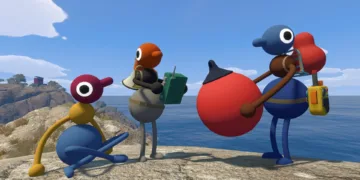





























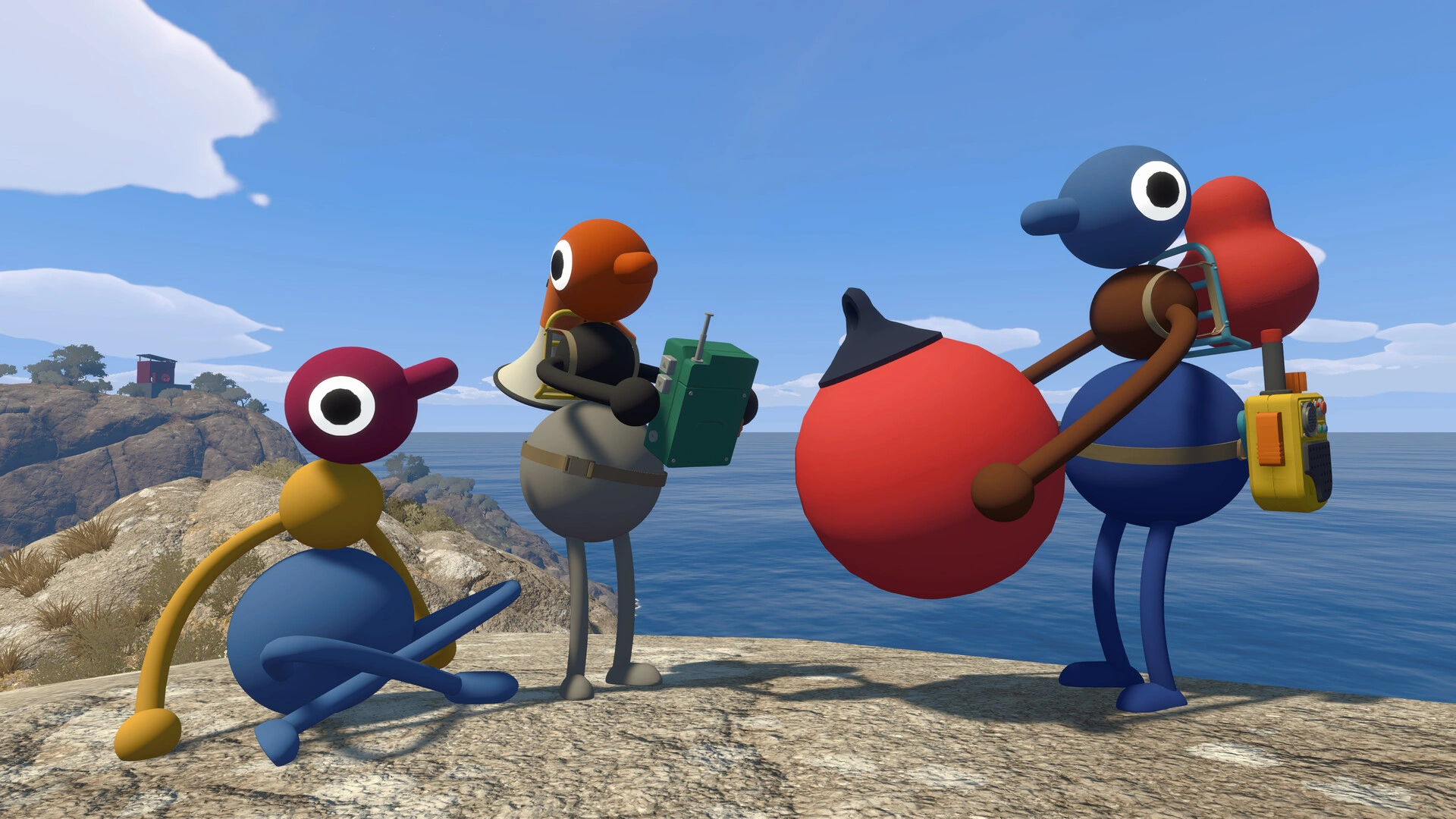

Walk five metres away from a friend and their voice begins to dissolve. A few steps later, they are gone. That shrinking audio radius is the central rule in Big Walk, and House House builds nearly every puzzle, joke, panic, and reunion around it.
The studio’s previous game, Untitled Goose Game, created comedy through authored objectives and one disruptive animal. Big Walk replaces that script with a shared island and gives the troublemaking role to the players. Two to twelve people enter as long-limbed, beak-nosed creatures, then receive one firm instruction: stay off Discord. Party chat would erase the game’s main source of tension, since distance needs to mean something.
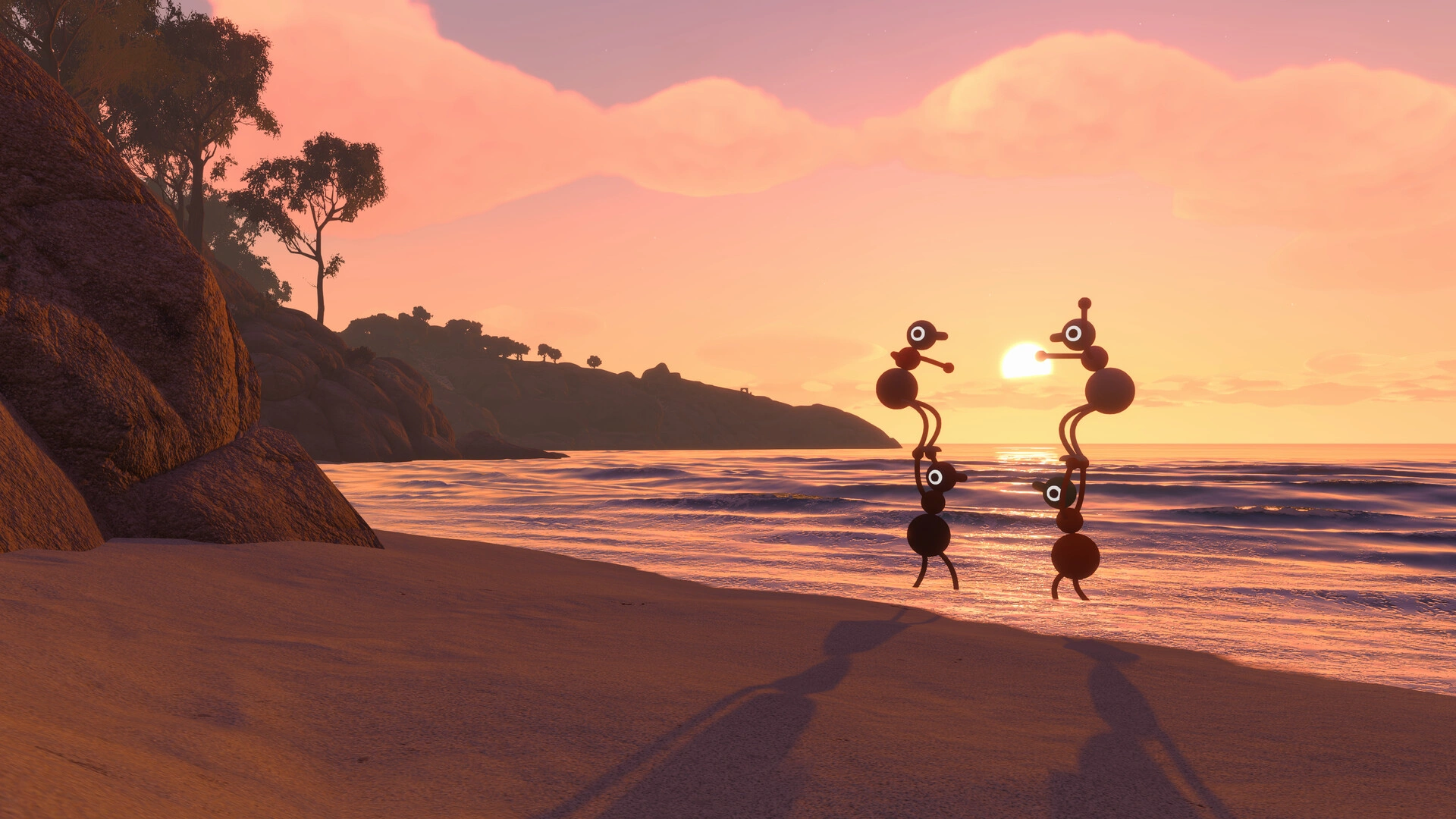
The opening playground teaches movement through pictures rather than text. You learn to pick up objects, clip equipment onto another player’s belt, and stack bodies high enough to reach a crane button. The crane adjusts to the size of the group, a small example of how carefully House House scales its challenges. Once the route leads into the wilderness, explicit instruction disappears. Bright structures sit against gumtrees, granite ridges, and coastal cliffs, giving the group visible goals without turning the landscape into a checklist.
That freedom can look loose from the outside. Underneath it sits a strict loop: choose a landmark, decide what to carry, keep the group within hearing range, solve the local challenge, then transport a smooth red reward back to a tower. Every stage creates room for a human mistake. Someone forgets the lamp. Someone follows the wrong person. Someone places the reward on a slope and watches it roll toward a cliff.
The Island Teaches by Withholding
Most co-op games treat voice communication as an external tool. Big Walk treats it as inventory. Range is limited, walkie-talkies occupy a hand or belt slot, and a backpack changes the group’s planning because one player can finally carry a second object. Communication has a cost, so deciding who gets the radio matters as much as deciding who carries the torch.
Getting separated exposes the system at its best. A friend can vanish behind a rock while you are admiring the sunset, leaving only ambient birds and your unanswered calls. The island offers several recovery tools, yet none behaves like a conventional waypoint. A firework can reveal your position. Lamps placed into circular stands create a trail through the darkness. A whiteboard at the hub lets someone leave a message about their next destination. Each method asks players to think about the missing person rather than follow an icon.
Objects rarely have official labels, which turns naming into another cooperative mechanic. One group may call the curved red prizes gourds, another eggs, another keys. The correct word does not matter. What matters is that everyone understands it when someone yells that the gourd is rolling downhill. Shared vocabulary becomes practical infrastructure.
The same idea shapes non-verbal communication. Each arm can be raised, extended, or pointed independently. Players can jump, sit, spin, shake their heads, wave, or hammer the air in celebration. Those actions look silly until a puzzle seals two partners behind soundproof glass. Then a raised left arm may mean one symbol, a crouch may mean another, and frantic headbanging may mean the answer failed.
There is an unusual intimacy to the equipment system. You do not open a menu and assign your own loadout. A friend physically clips a radio or lamp onto your body. Players can lift one another, carry an absent companion over a shoulder, or build a tower of limbs. These actions support puzzle logic, yet their strongest effect is social. The interface asks people to handle one another with care, right before someone uses that trust to relocate an idle player into a bush.
Puzzles Made of People
The puzzle catalogue keeps returning to incomplete information, then changes the channel through which that information can travel. One room may show a sequence of arbitrary symbols that another player must enter elsewhere. A one-way window can leave one person visible but unable to hear instructions. An intercom may permit speech from only one position. A single lamp can become the group’s entire signaling system.
These setups work because the answer is rarely the hardest part. The real challenge is encoding the answer for someone with a different view. A shape that resembles a bent fork to one player may look like antlers to another. The group has to negotiate a description, test it, and revise the vocabulary when the machine rejects the attempt.
House House gives each submission a small piece of theater. Pressing the button triggers a pause long enough to make everyone doubt the plan. A correct answer releases a party-blower squeak and a burst of confetti. A vice then slowly unthreads, freeing the red prize. The delay adds weight to a simple state change. Solving the logic feels good; surviving the communication feels better.
Outdoor challenges use distance and physics instead of sealed rooms. One player can launch a clockwork explosive while another waits near its predicted landing zone, racing to retrieve it before it bursts. Other tasks ask the group to kick an item through an obstacle course or transport an awkward object across uneven terrain. The island’s steep ridges and narrow valleys become part of the puzzle because carrying capacity, visibility, and voice range all change with position.
The world adjusts some structures for different player counts, so a two-person session does not feel like a reduced version of a four-person game. Smaller groups produce cleaner plans and clearer roles. Larger groups introduce interference: several people offer conflicting descriptions, someone carries the wrong object, and a curious player leaves without announcing it. The design does not suppress that disorder. It converts disorder into content.
Friction Worth Carrying
Movement is the least reliable part of the system. The creatures are meant to feel loose and awkward, but the terrain sometimes adds friction that serves no comic or mechanical purpose. Rocks can trap a player in a shallow gap. Climbable surfaces are inconsistent. Long walks between puzzle sites can become dull after the route has already been understood.
House House partly answers that problem with downhill sliding. Sprinting from a peak, dropping onto your backside, and watching those thin legs flail turns descent into a toy. The same physics make every loose object dangerous. Lamps and red rewards are rounded enough to escape on mild slopes, forcing a panicked chase after one careless placement. The game repeatedly turns inconvenience into slapstick, though the terrain does not always earn the benefit of that excuse.
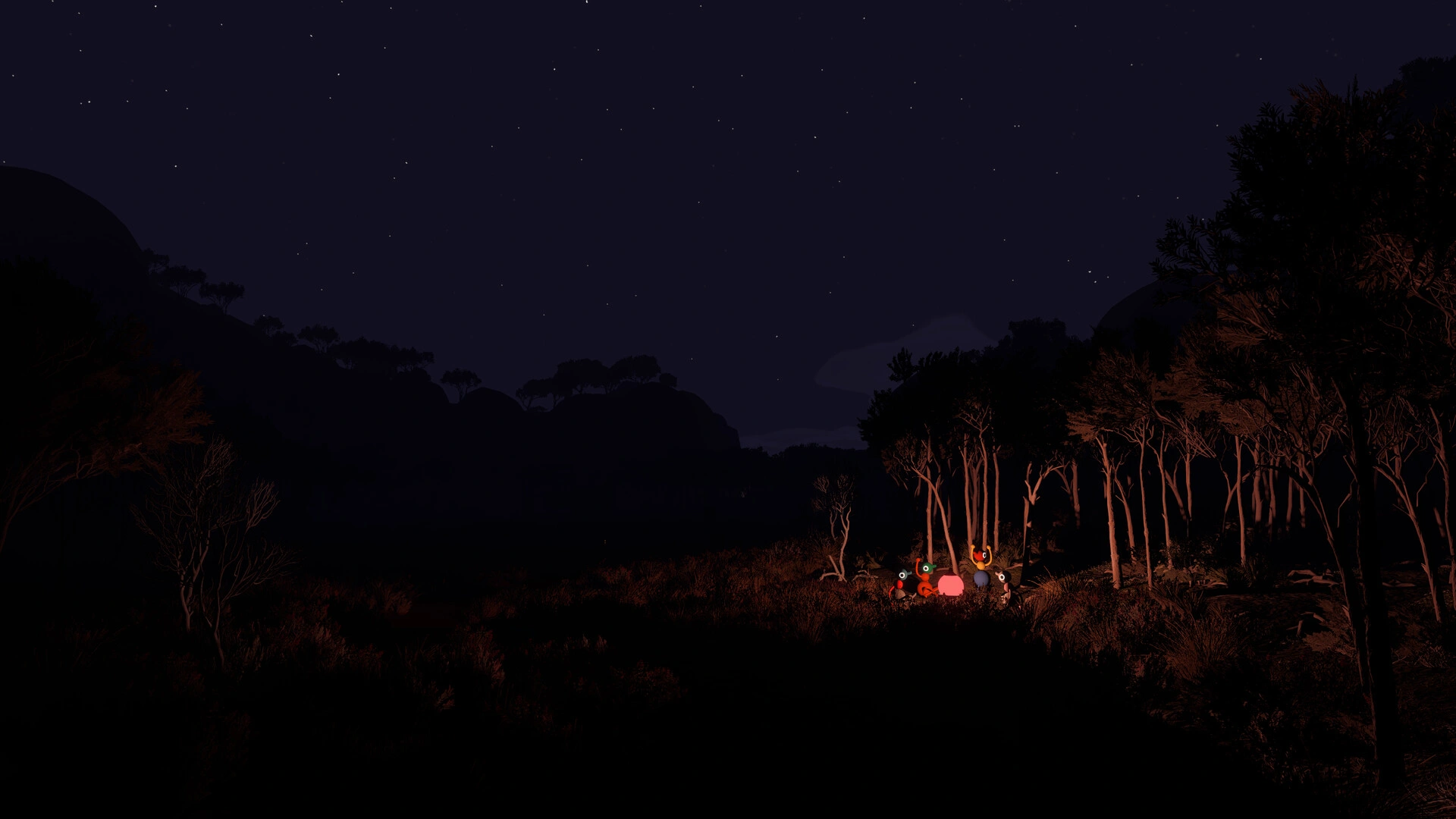
Night creates cleaner pressure. Darkness arrives quickly and becomes severe enough that a torch or lamp changes from decoration to survival equipment. There are no monsters hunting the group. Losing sight of a friend is the threat. A voice cuts out, the nearest landmark disappears, and the same peaceful forest suddenly feels hostile because the social connection has been removed.
Sound carries much of that effect. Australian birds establish place during quiet hikes. A soft bonk marks a long fall. Radio transmitters unlock diegetic music that players can tune into with handheld receivers. Placing a recovered prize into a tower produces a deep reverberation that travels across the island, serving as celebration and location signal at once.
The Switch 2 version introduces problems the systems cannot absorb as elegantly. Pop-in weakens distant navigation, low-resolution shadows flatten the lighting, and frame drops around towers disrupt moments built around scale and visibility. A reported glitch can disable lighting entirely, removing the night cycle’s main constraint. Crossplay softens the platform decision because friends can join from different hardware, but players with another option have a clear reason to use it.
The closing sequence avoids a conventional mechanical exam. It asks the group to use the habits, signals, and trust formed across the island. The game has been recording those skills without a visible progression screen: who notices a missing friend, who remembers the agreed gesture, who can interpret a bad description, who stays calm when the voice disappears. Big Walk turns that social memory into its final resource.
The Review
Big Walk
Big Walk turns communication limits into a remarkably expressive co-op system. Proximity chat, improvised gestures, unnamed objects, and restricted inventories force every group to develop its own language. The island supports that design with readable landmarks, scalable puzzles, and physics that manufacture chaos without scripting it. Awkward traversal and the Switch 2 version’s visual problems create needless friction, yet neither weakens the emotional payoff of learning how your friends think. Few co-op games make misunderstanding this mechanically useful.
PROS
- Exceptional communication mechanics
- Inventive, scalable puzzles
- Organic group storytelling
- Expressive sound design
- Rewarding open exploration
CONS
- Occasionally clumsy traversal
- Some repetitive trekking
- Switch 2 performance issues
- Limited audio settings