





















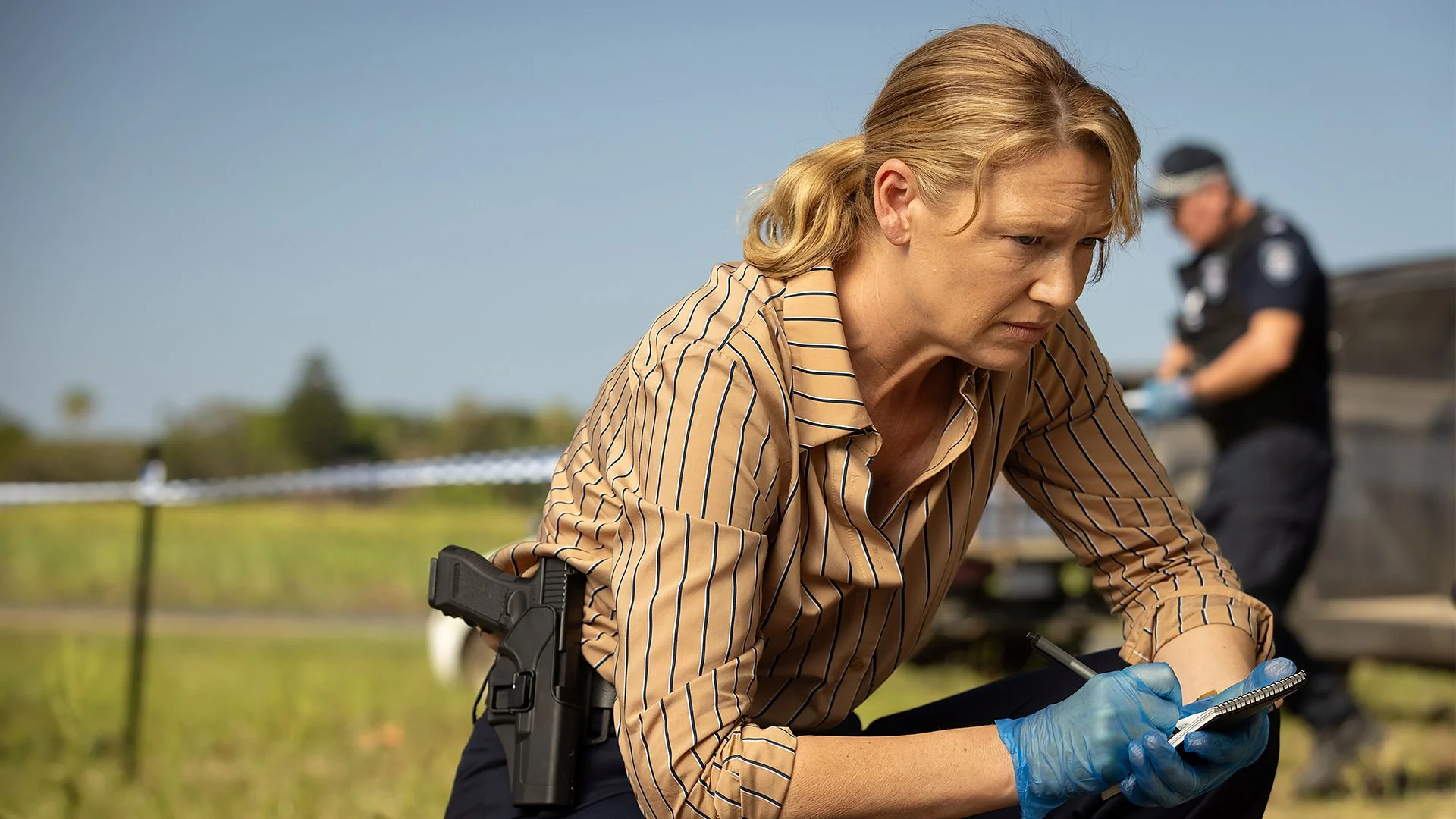

Edie has already made herself clear twice before anyone starts investigating what happened to her. At a bar, the eighteen-year-old tells her friend Finn that friendship is what she wants. He leaves disappointed. When an older man approaches her, she rejects him too, becoming firmer when politeness proves insufficient. Dustfall then cuts to her distressed beside a sugarcane field, with little memory of the intervening events. Those earlier refusals matter. They give the audience access to her expressed wishes before other people begin interpreting her behavior, her injuries, and the gaps in her account.
Director Emma Freeman keeps the assault offscreen and gives dramatic space to the hospital examination, the police interview, and Edie’s interactions with her parents. Omission alone would be a limited ethical achievement; television can withhold an attack and still turn its survivor into an investigative prop.
Here, the aftermath requires attention in its own right. Zoe Phillips carries the difficult position of someone receiving information about an experience she cannot fully recall. Her confusion remains part of the drama while medical and police procedures gather their findings. The production asks viewers to stay with the person who must absorb those findings.
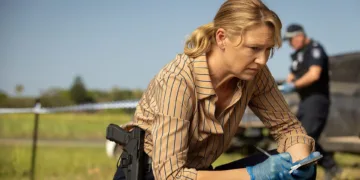
For ABC, this six-part adaptation of Vikki Petraitis’s The Unbelieved is a recognizable proposition: an accomplished detective returns to a small town carrying damage from an earlier case. Anna Torv plays Antigone “Tig” Pollard, newly back in North Gap, Queensland, after a bruising rape trial in Melbourne.
Freeman and writers Beatrix Christian, Dianne Taylor, Belinda Chayko, and Stuart Page retain the appeal of that arrangement. There are suspects, secrets, and investigative reversals. Their consequential choice is where to spend attention between revelations. Edie’s hospital experience and the responses to her account remain substantial dramatic business alongside the pursuit of an offender.
That scrutiny extends into the police station’s everyday thinking. While examining pub footage, an investigator questions what kind of man would order lime and soda. Tig’s partner Remi, played by Bert LaBonté, points out that the drink could supply useful leads.
A small exchange exposes an assumption doing practical damage: the investigator is judging a man against a model of masculinity when he should be considering evidence. Remi’s correction also gives the institution internal differences. Police work contains both the careless habit and the capacity to challenge it, embodied by people sharing the same investigation.
Finn’s response to Edie’s refusal belongs in this inquiry without settling his guilt. His disappointment exposes an expectation attached to their friendship; the older man’s approach presents another demand she must fend off. The series lets these encounters acquire significance as the investigation develops, but the distinction between entitlement and criminal responsibility remains necessary. A widening field of suspicion can reveal how common troubling attitudes are. Treating each attitude as proof of an assault would sacrifice the investigative precision that the lime-and-soda exchange so neatly defends.
The town’s response places another burden on Edie. A nurse, played by Alice Ansara, recalls a previous case involving a beach, suggesting that the community has encountered something like this before. Silence and withheld information hinder Tig, while an early classroom scene signals that Edie’s return to ordinary life will expose her to scrutiny from her peers.
These choices extend the crime’s consequences beyond the question of identification. Familiar surroundings become places where she must manage other people’s knowledge and judgment. The earlier case is especially unsettling because recognition has survived without necessarily producing a better response.
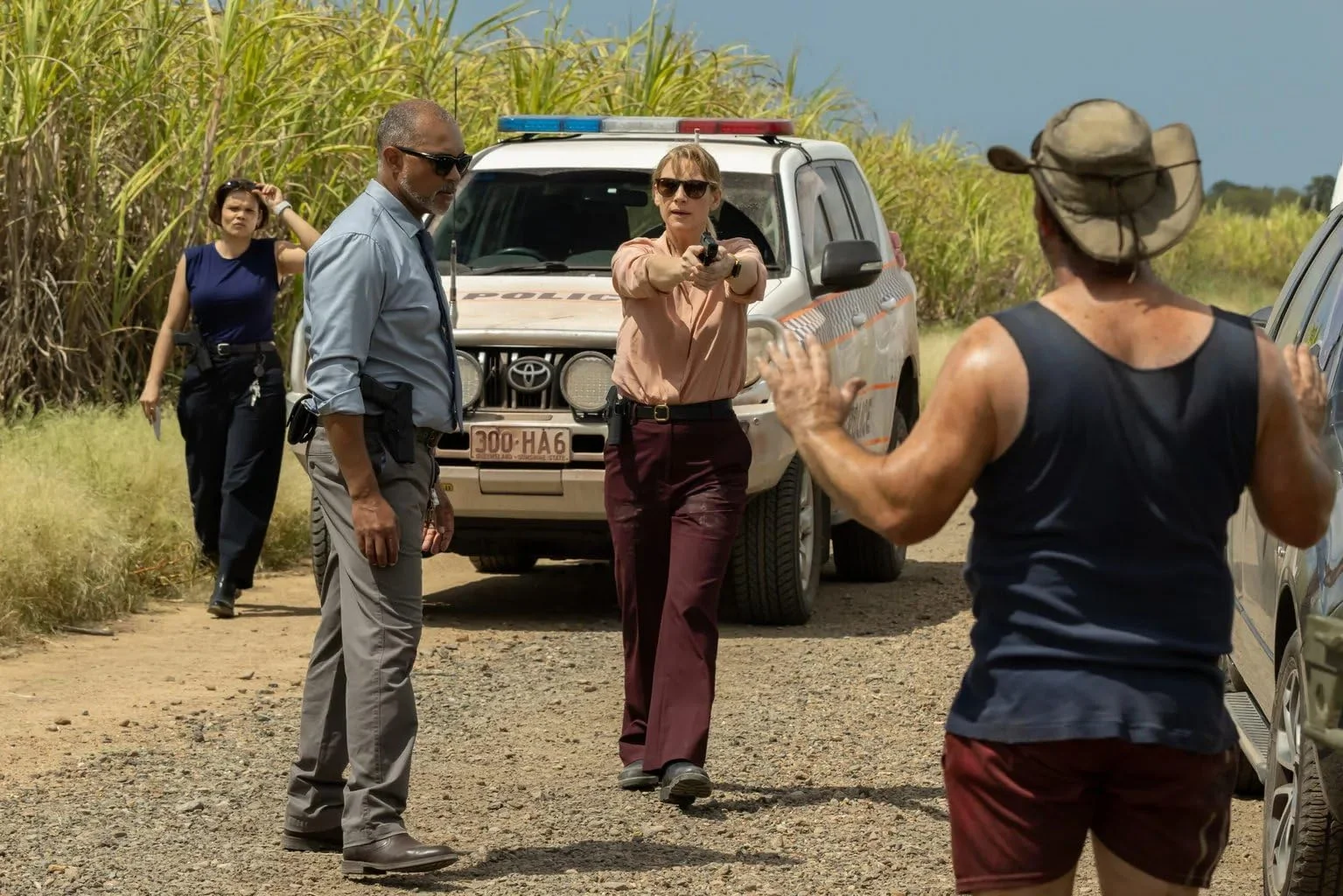
Torv’s Tig makes careful listening credible as part of investigative competence. Her treatment of Edie gives the interviews a human purpose alongside their evidentiary one, while her private life prevents that competence from becoming a complete description of her.
She has moved into her late grandmother’s deteriorating house, where the toilet needs attention and a snake has occupied the bathroom. She begins an affair with the man who removes it. These domestic disruptions give the detective desires and practical problems outside the case, allowing changes of register without making Edie’s distress the occasion for relief.
The house also gives Tig’s conflict with her mother a material point of contention. Olivia, played by Juliet Stevenson, wants it sold; Tig has chosen to inhabit it. Their disagreement sits beside a history in which Olivia failed to protect her daughter.
Property, memory, and parental responsibility become difficult to separate. Olivia’s present demand supplies a concrete action through which that history can exert pressure, rather than leaving the relationship suspended in vague estrangement. Tig’s authority at work offers little help with deciding what to preserve at home or what her mother owes her.
Freeman’s dry landscapes and sugarcane plantations give the thriller an environment of exposed spaces and isolation, with the field where Edie is found connecting atmosphere directly to the case. The recurring python is less persuasive. Its repeated presence around Tig’s home starts to insist on unease that the family conflict and damaged property already establish.
Suspense works better when uncertainty develops through behavior, missing information, and the possibility of another case. The familiar genre machinery remains useful, but its decorative emphasis occasionally presses too hard against a drama whose hospital and interview scenes trust quieter forms of attention.
That trust has a difficult institutional limit in Tig’s earlier Melbourne case. Maya Luu, played by Gemma Chua-Tran, has seen the man she accused acquitted and now faces a defamation action. Placed alongside Tig’s care for Edie, Maya’s predicament complicates the reassurance offered by a capable woman detective.
The production can give a survivor time, credibility, and attentive treatment within its storytelling; the legal process depicted can still expose her to further punishment. Maya must now defend herself against an action brought by the man she accused, carrying the consequences of speaking into another proceeding.
Dustfall premiered on ABC TV and ABC iview on October 11, 2026. Based on Vikki Petraitis’s crime thriller novel The Unbelieved, the six-part Australian drama series follows Detective Tig Pollard as she investigates a string of sexual assaults in a coastal community, uncovering a complex web of cover-ups and dead suspects that forces her to confront painful secrets from her own past.
Full Credits
Title: Dustfall
Distributor: ABC TV, ABC iview, BBC, ZDF
Release date: October 11, 2026
Rating: TV-MA
Running time: 48–55 minutes per episode
Director: Emma Freeman
Writers: Stuart Page, Belinda Chayko, Beatrix Christian, Dianne Taylor
Producers and Executive Producers: Deborah Balderstone, Emma Freeman, Michael Brooks
Cast: Anna Torv, Juliet Stevenson, Lila McGuire, Peter Fenton, Zoe Phillips, Bert LaBonté, Alice Ansara, Gemma Chua-Tran
- Composer: Cornel Wilczek
The Review
Dustfall
Dustfall puts survivor experience at the forefront of a familiar detective format, giving care, credibility, and institutional prejudice real dramatic weight. Anna Torv’s attentive investigator anchors a series whose hospital scenes and everyday police exchanges sharpen its social argument. The recurring python overstates unease, but the stronger storytelling trusts people, procedures, and the consequences of speaking.
PROS
- Sustained attention to Edie’s experience after the assault.
- Torv’s balance of investigative authority and personal complexity.
- Concrete scrutiny of prejudice within police work.
- Suspense grounded in community silence and withheld information.
CONS
- Recurring python symbolism presses its meaning too insistently.







