


























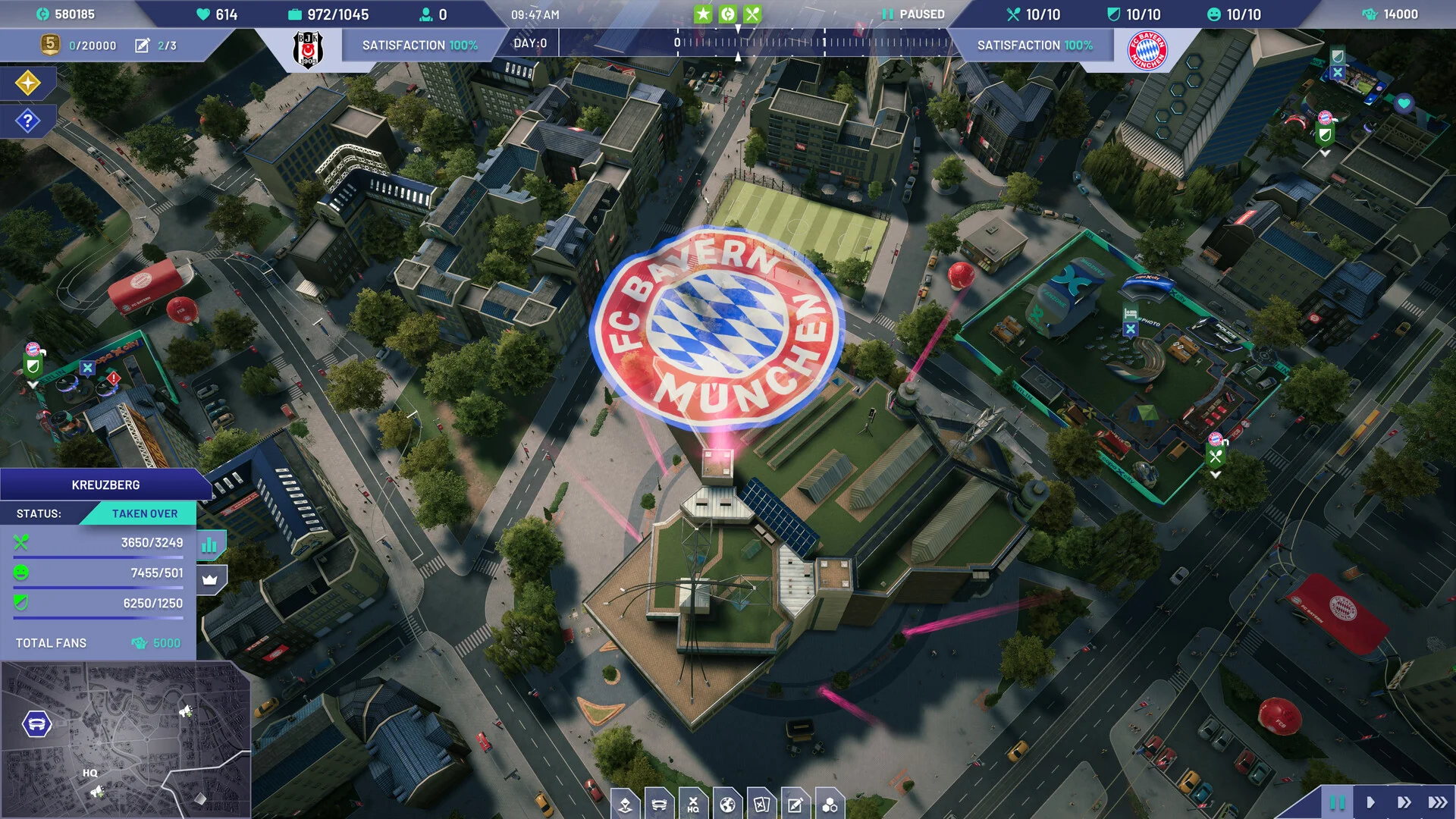
Unlocking a fan zone and leaving it empty can be a sensible use of money in Copa City. Access to further districts depends on connections through already unlocked areas, so a vacant site can buy room to separate rival supporters later. Filling every available space immediately would miss the point of that purchase. Before a food truck or security post arrives, the land already has a job: extending the organizer’s options for handling the crowd.
Those options acquire value through their surroundings. A nearby police station strengthens security facilities, while moving supporters between districts costs resources. Establishing a district as one club’s hub gives fan distribution a purpose beyond keeping satisfaction meters full. Stadium seating then carries the same planning problem indoors, where assigning supporter groups to stands requires attention to security and separation. The city map and stadium screen describe different stages of the same operation. A useful decision outside the ground prepares conditions for what happens inside it.
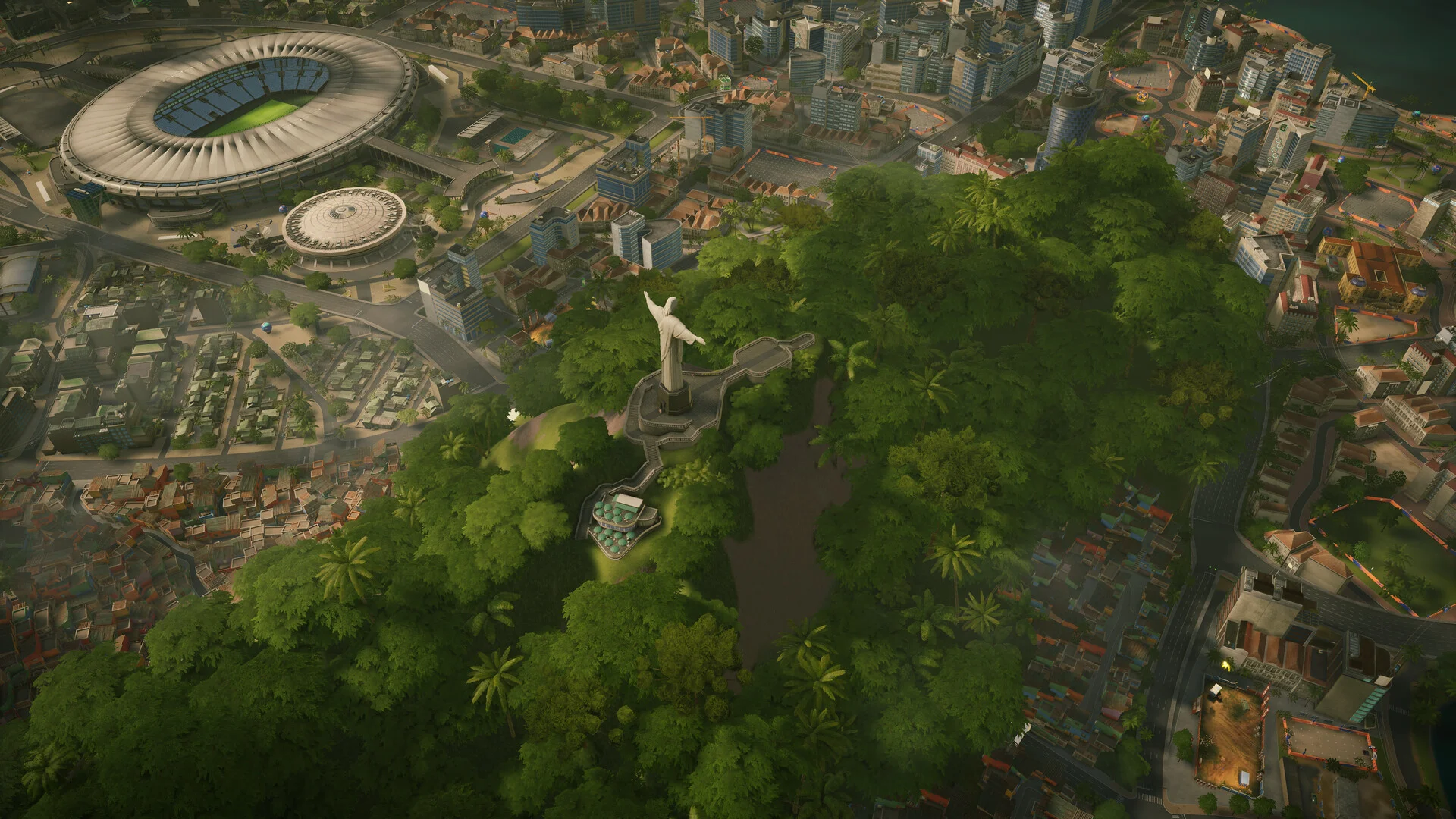
Triple Espresso’s management game builds that operation around existing cities, including Berlin, Warsaw, and Rio de Janeiro, with grounds such as the Maracanã providing its destination. Construction is restricted to designated fan zones rather than unrestricted streets and buildings. That restriction suits the temporary work of hosting a fixture: the city already exists, and the organizer has to fit an event into it. Concentrating facilities in a busy district can worsen traffic and noise, while poorly arranged routes near homes affect residents and fans. Maximizing services in one convenient location carries costs elsewhere.
Advertising makes the economic loop interesting because attracting supporters creates obligations before it delivers a reliable return. Arrivals need food, entertainment, and security; facilities need electricity and staff. Volunteers work outside the stadium, stewards inside it, and specialists support higher-level construction and expansion. Premium modules can address several needs at once, but daily operating costs complicate their apparent efficiency. A purchase has to make sense across space, staffing, and the remaining preparation period. The useful calculation is how much extra demand the operation can support, rather than how quickly another building can be afforded.
The supporter categories give that calculation a readable starting point. Core fans prioritize food, families need entertainment, and ultras place particular demands on security. These are broad abstractions, but they make the relationship between an incoming crowd and its required infrastructure understandable. Match Readiness tiers connect objectives and satisfaction to new funds and facilities, feeding successful preparation back into further development. The weakness is that a large number of requirements does not guarantee difficult choices. Routine need fulfillment can become straightforward once the basics are understood, while tighter scenarios make the same spending decisions carry sharper consequences.
The campaign finds a useful narrative expression of this work in the early Arsenal–Beşiktaş fundraising fixture. When the original sponsor turns out to be fraudulent, choosing between two replacements changes the tasks before match day. The story earns its place by altering the job. It gives financial trouble a practical form instead of leaving it in dialogue between advisers. This is modest branching, with evidence of changed objectives rather than an extensive alternate campaign, but it makes the organizer’s role tangible: preparation includes absorbing commitments that were absent from the original plan.
Unfortunately, Copa City often withholds information needed to manage those commitments. Its tutorial establishes the broad responsibilities better than some of the procedures that decide success. Volunteer recruitment starts automatically, but placing a steward recruitment module in the stadium does not initiate recruitment on its own. An additional action is required, and the difference is poorly explained. A player applying the rule learned outside the stadium can end up with plentiful volunteers and no stewards. The shortage follows an inconsistent lesson before it becomes a staffing problem.
The pitch-side medic requirement exposes a harsher gap between progression and planning. The facility unlocks at Match Readiness tier four. Spending resources on fan satisfaction and other objectives can leave insufficient capacity to reach that tier, even with satisfaction already at 100 percent. In that situation, a mission can fail because a required facility remains inaccessible. Limited resources belong in this kind of game, but an unlock dependency needs to inform spending before those resources are committed. Otherwise, apparent progress can consume the means of meeting the next obligation.

Language and objective feedback make diagnosis harder still. An English instruction asking for a “sign” can refer to an advertising board, requiring the player to decode a label before making the requested purchase. Stadium security objectives can demand compliance without adequately exposing each stand’s requirements. Trial and error then replaces a calculation the interface should support. These faults deserve separate attention from genuine complexity. Positioning facilities to manage rival crowds is a planning task; discovering which item an instruction meant to name is an avoidable interruption.
Technical problems can remove even that uncertain feedback. On PC, disappearing objectives, missing icons that require a reload, and actions failing to register can leave progress dependent on something outside the simulation’s rules. Console selection brings its own friction, particularly when stadium items require repeated switching between standard and precision controls. Small text makes checking requirements less comfortable. PS5 stuttering is another possible interruption, though performance is uneven rather than consistently poor. The significant damage comes when the player cannot establish why an action failed and therefore cannot make a useful correction.
There is a clear payoff when those barriers recede. Supporters populate the city, the stadium fills, and club-specific details such as mascots connect the infrastructure to an identifiable event. The crowds give earlier purchases a visible purpose. They can also disturb a settled plan: a dispute between fan groups increases security demand, and neglected needs can lead to a district being lost, displacing supporters elsewhere. These responses give preparation an ongoing responsibility. Reaching an acceptable meter does not necessarily remove the need to keep resources available for a changing situation.
Campaign scenarios and Single Match score rankings keep that responsibility focused on individual fixtures. With three cities, the appeal rests heavily on rearranging preparations under different conditions, which offers a narrower horizon than maintaining an indefinitely growing settlement. The deadline also changes the meaning of expansion. An empty zone bought for access, a costly supporter transfer, or an upgraded catering module has to justify itself within the event being organized. Once the crowd is arriving, the organizer still has to find staff for the stadium, preserve security capacity, and make the remaining money last until kickoff.
The Review
Copa City
Copa City makes match preparation rewarding when district access, supporter movement, and operating costs produce understandable consequences. Its campaign even lets a sponsor change alter the organizer’s workload. Poorly explained recruitment, hidden unlock requirements, and unreliable objectives weaken that control, sometimes turning an avoidable information gap into mission failure. The management design offers satisfying decisions, but the game too often leaves players guessing how to carry them out.
PROS
- Connected city and stadium planning.
- Useful tradeoffs between expansion, staffing, and costs.
- Sponsor choices change campaign objectives.
- Growing crowds make preparation visibly rewarding.
CONS
- Poorly explained recruitment and progression requirements.
- Objective and interface bugs obstruct informed decisions.
- Awkward console selection and small text.