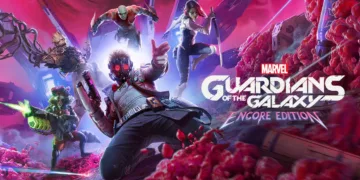




















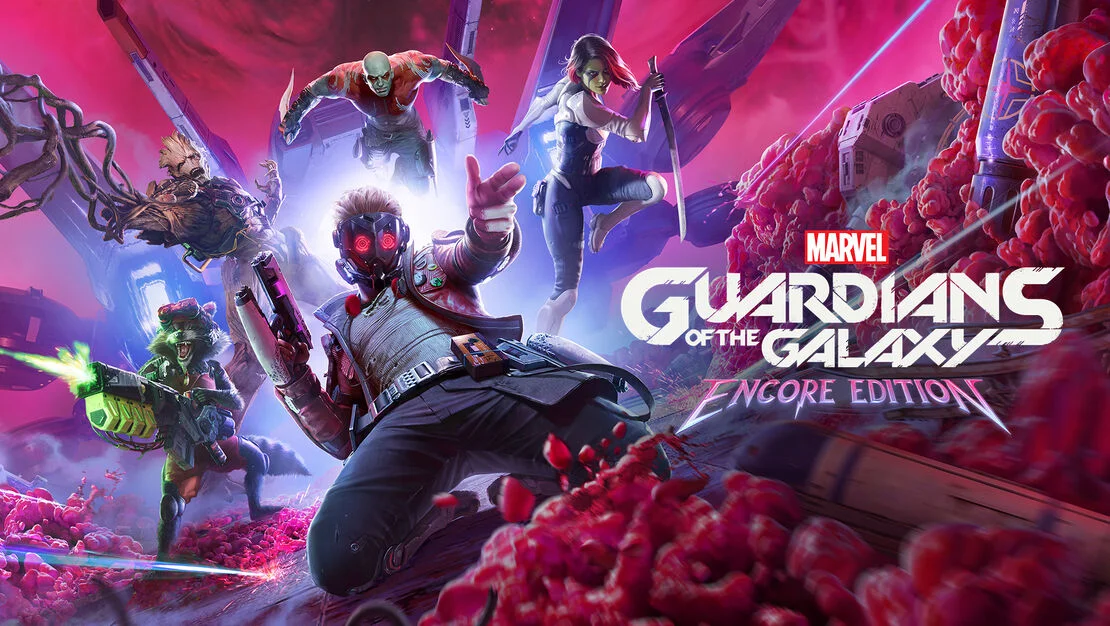

Peter Quill gets a combat bonus even when he gives a bad pep talk. Fill the huddle gauge in Marvel’s Guardians of the Galaxy: Encore Edition, gather the crew, and choose words that suit their mood. Read them correctly and everyone benefits. Misread them and Peter still receives a boost. It is an amusingly generous arrangement for the man giving the speech, and a revealing measure of how gently the game handles his responsibilities.
Those responsibilities become more demanding once the shooting resumes. Only Peter is directly playable, but his teammates supply attacks that change what he can accomplish. Rocket’s gravity bomb pulls enemies together, preparing them for Groot’s ground thorns; Drax can charge into whoever survives. Selecting abilities while keeping Peter moving makes coordination an active task. The others contribute through actions you arrange, giving their presence mechanical weight without requiring you to inhabit every member of the team.
Peter’s own abilities complicate that division of attention. Ice shots immobilize targets, lightning spreads between nearby enemies, and elemental weaknesses encourage changes in ammunition. An unlockable active-reload perk rewards a timed button press with an immediate reload. These are small decisions made alongside larger ones about targets and squad abilities. The pleasure comes from getting several actions to cooperate. The difficulty is keeping track of them while opponents are attacking Peter. Access to useful combinations does not make managing the available options equally intuitive.
The huddle offers relief from that workload, shortening ability timers after a successful response and sending the crew back into combat with licensed music. A playlist containing “The Final Countdown” and “Never Gonna Give You Up” supplies the right register for Peter’s self-belief. The mechanic turns his musical fixation into something the player uses.
Outside combat, listening occupies a substantial part of the roughly 20-hour campaign. These Guardians begin as a recently assembled mercenary outfit struggling to pay their debts. A monster-hunting expedition into a Nova Corps quarantine zone starts a chain of trouble, while encounters with Centurion Ko-Rel and her daughter Nikki introduce personal obligations for Peter. The group already has relationships he cannot simply command into harmony. Rocket and Groot share an attachment that predates his involvement; Drax distrusts Gamora because of her connection to Thanos, who killed his family.
Dialogue choices let the player take a position among these tensions. During travel, Peter can answer questions, intervene in arguments, or remain silent. This gives conversation a useful distinction from issuing combat orders: having the controls does not mean having everyone’s agreement.
Choices involving outside characters, including Lady Hellbender, can affect local progression, but the campaign retains its central direction. The agency is strongest as participation in Peter’s conduct. It should not be mistaken for extensive control over the plot. The Universal Church of Truth and its Promise give questions of faith and manipulation a larger role without requiring the story to branch around every reply.
The environmental obstacles continue the dependence established in combat. Groot builds bridges, Rocket enters small spaces, and Drax moves heavy objects. These actions keep individual abilities relevant during travel, but their simplicity limits how much problem-solving they offer.
Asking the appropriate Guardian to remove an obstacle can become an administrative step between conversations. The visor’s hints help keep movement clear, yet clarity alone cannot make repeated corridors and arena arrivals interesting. The team can have something worth saying while the route beneath them offers little worth deciding.
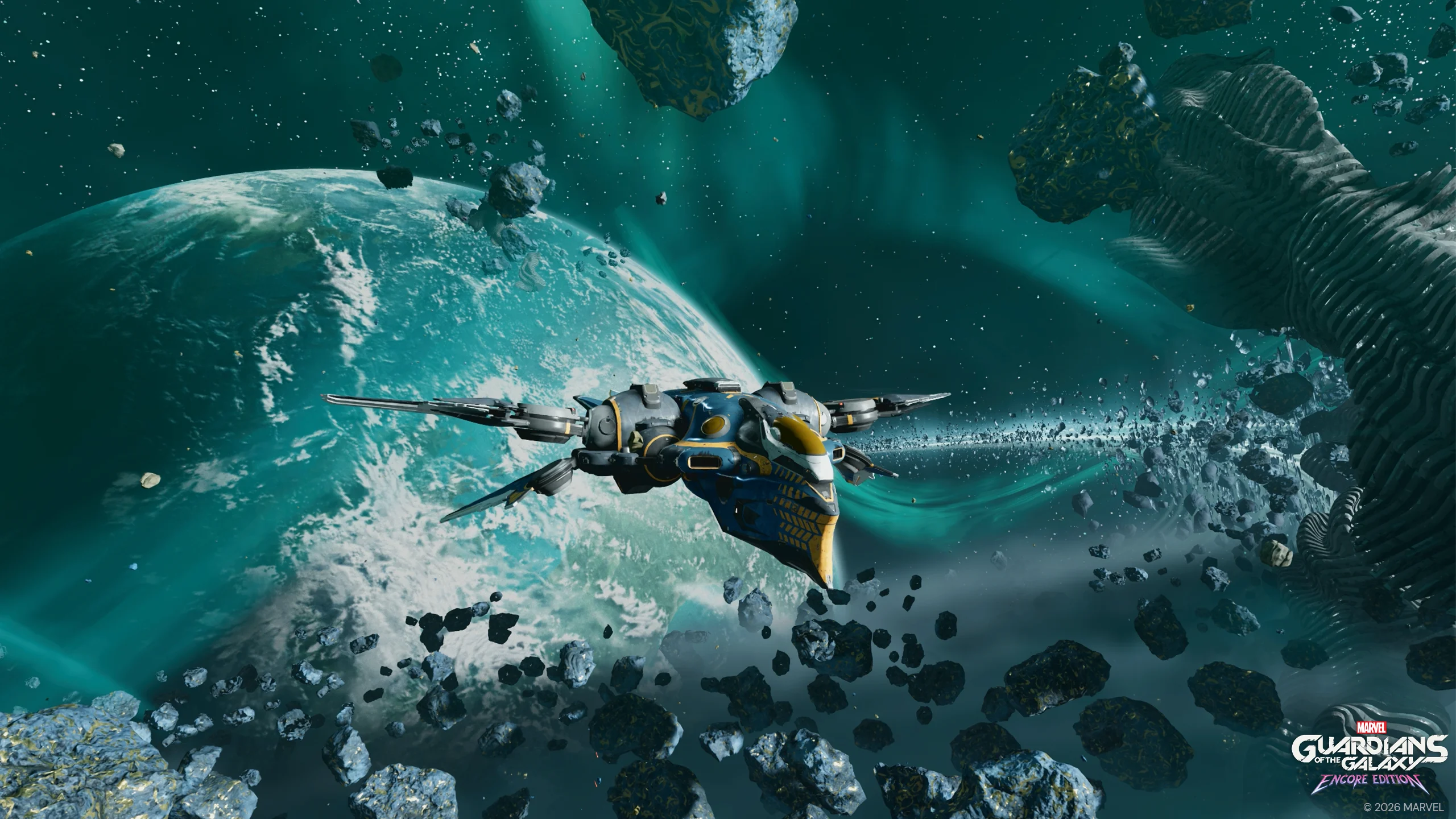
Short detours have firmer incentives. Cosmetic outfits reward curiosity, while components feed Peter’s workbench upgrades; squad techniques use points earned through combat. Searching therefore serves different kinds of progress, though it cannot disguise a predictable route indefinitely. Geometric plants, gelatinous enemies, and strange planetary environments give the eye welcome variety. The distinction matters: the adventure can keep producing unfamiliar sights while repeating familiar demands on the player. Banter makes those walks sociable, but it cannot carry every stretch between fights.
Encore’s principal contribution is changing where this campaign can be played. The original Switch release depended on cloud streaming; the Switch 2 version runs natively, removing the need for a constant streaming connection. There are no new campaign chapters or missions.
Mouse mode puts movement on the left Joy-Con 2 and camera control on the right, resting on a surface. That is a useful alternative at a table, with different practical requirements from ordinary handheld play. Motion controls cover Milano steering and selected sliding or jet-boot sequences, and can be disabled. They should not be confused with dedicated gyro aiming.
The visual compromises are easier to accept than interruptions to play. Reduced hair detail, changes to facial lighting, and pop-in leave the imaginative environments recognizable, but technical ambition needs to be judged separately from that art direction. Reported frame-rate targets are 30 fps for docked quality mode, 40 fps for docked performance mode, and 30 fps in handheld play. Those figures describe targets rather than dependable delivery. Stutters and cinematic drops remain concerns, with uneven accounts of stability making a blanket promise of smooth play difficult to support.
Crashes require a different calculation from frame-rate dips. A hitch disrupts an action; a software error can require reopening the game and retracing progress. Frequent autosaves can reduce that repetition. There is also an isolated report of a save becoming unloadable following an update, requiring a retreat by an entire chapter. Its cause and frequency are unestablished, so it cannot fairly describe every player’s likely experience. It does establish why autosaving and reliable recovery should be assessed separately.
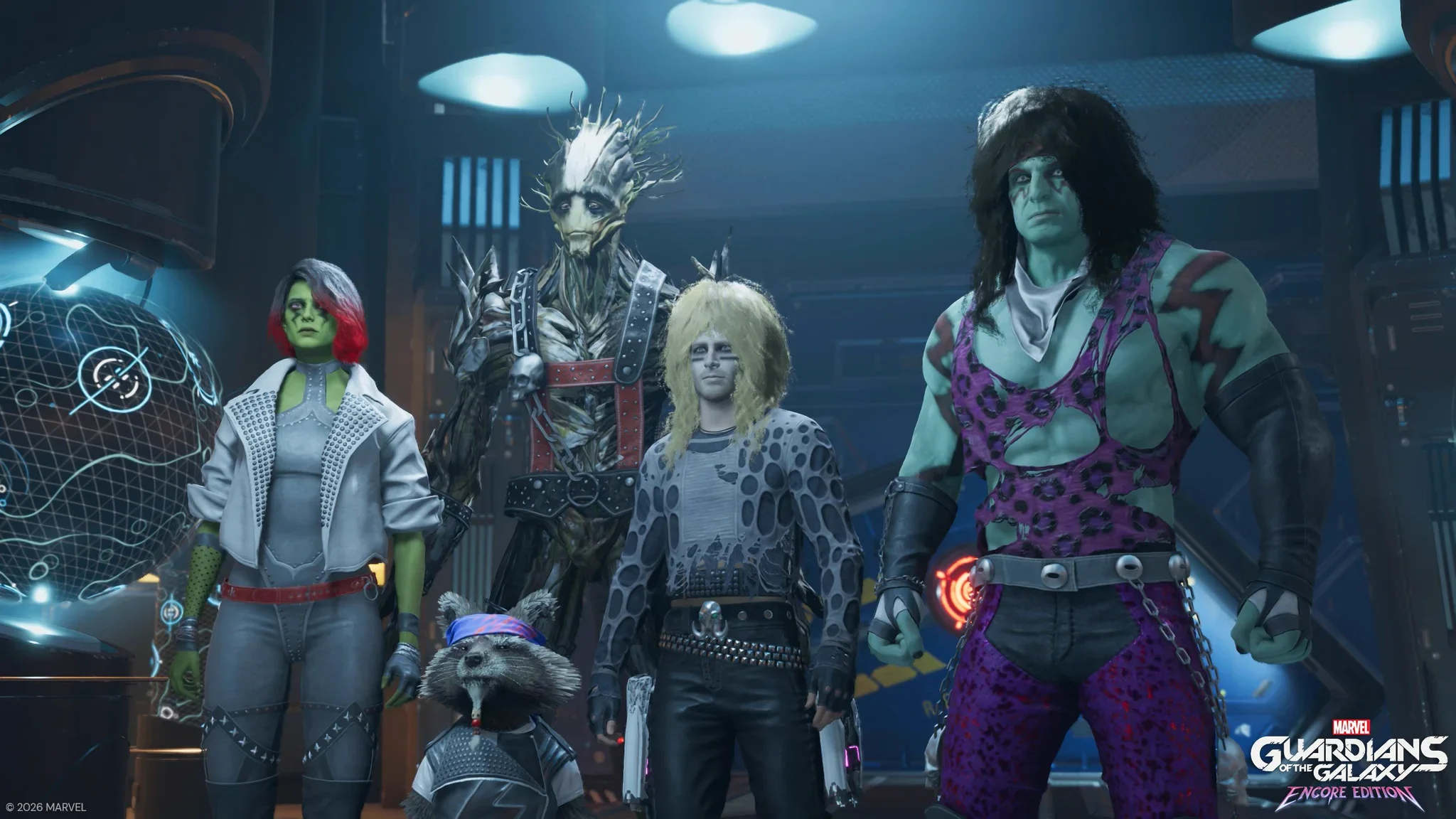
Outfit switching is the more repeatedly identified crash trigger, which places an awkward restriction on Encore’s additions. The five exclusive glam-rock costumes fit Peter’s musical tastes, but an optional cosmetic feature should be an easy place to experiment. When changing clothes risks a trip back to the console menu, the player has reason to postpone it until a convenient stopping point. An autosave may shorten the recovery, while leaving that hesitation intact the next time the outfit menu opens.
The Review
Marvel's Guardians of the Galaxy: Encore Edition
Guardians of the Galaxy makes leadership tangible through linked attacks, conversational choices, and musical huddles. Its strongest systems give the crew a purpose beyond accompanying Peter, though crowded combat demands and routine traversal weaken the rhythm. Encore’s native portable play is a substantial gain; its new controls and costumes are smaller incentives. Uneven performance and crashes, especially around outfit switching, make this a cautious recommendation for players who value portability enough to accept the interruptions.
PROS
- Squad abilities combine into satisfying tactical sequences.
- Dialogue choices make Peter’s leadership participatory.
- Musical huddles connect character identity to combat.
- Native portable play removes cloud-streaming dependence.
CONS
- Combat coordination can overload the player’s attention.
- Repeated corridors and simple obstacles weaken exploration.
- Stutters and cinematic frame-rate drops disrupt presentation.
- Outfit switching is repeatedly associated with crashes.