


























The vintage engagement ring in Focker In-Law carries an unfortunate burden of family sentiment. Passed from grandfather to grandson, it becomes an instrument of parental interference when Greg Focker steals it to prevent his son from proposing. The object belongs to a familiar tradition in which marriage represents the continuity of a family, yet its disappearance exposes the conditions that some parents attach to that continuity. They want their children to establish independent lives, provided those lives remain conveniently within reach.
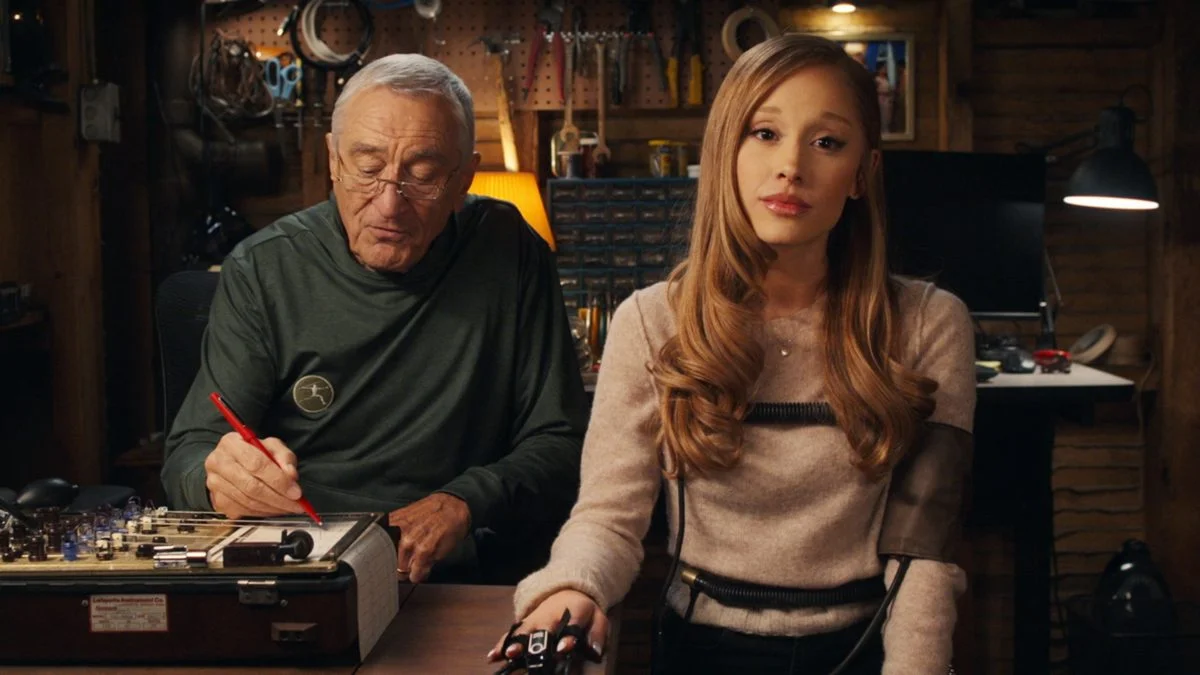
Twenty-six years after Meet the Parents, Greg (Ben Stiller) discovers that he is older than his intimidating father-in-law, Jack Byrnes (Robert De Niro), was when they first met. John Hamburg, who has contributed to the writing of every installment and now assumes directorial duties, builds the fourth film around this generational reversal. Jack’s 80th birthday celebration brings together Greg’s family, including his son Henry (Skyler Gisondo) and Henry’s girlfriend Olivia (Ariana Grande), a woman whose considerable professional accomplishments make Greg’s insecurities particularly conspicuous.
The familiar faces and affectionate reunions promise a comforting comedy about the difficulties of watching children grow up. That interpretation gives Greg’s behavior far too generous a reading. His deliberate attempts to sabotage his son’s relationship make Focker In-Law an unpleasant experience for substantial stretches, and Hamburg’s exhausted repertoire of slapstick offers insufficient compensation. Grande supplies a welcome burst of comic intelligence, but even her considerable charm cannot make this a reunion worth attending.
Greg’s anxiety has a recognizable domestic foundation. Henry’s professional future could take him to San Diego, Olivia’s hometown, instead of keeping him close to his father in Chicago. The prospect of geographical separation becomes entangled with Greg’s assessment of Olivia’s suitability. There is fertile material here about the emotional investments parents make in their children’s futures, particularly when a child’s independence threatens an established family routine. Hamburg gives that anxiety remarkably little room to develop before converting it into another elaborate deception.
Olivia complicates matters simply by being good at things. A former FBI hostage negotiator who now works as an executive leadership coach, she possesses the professional discipline that Jack, himself a former CIA operative, instinctively respects. Grande plays these encounters with a delightful composure. A measured pause or a slight alteration in her expression can puncture Greg’s mounting agitation. Stiller visibly strains beneath the effort of maintaining his dignity, and Grande barely needs to disturb her own expression to get a laugh.
The ease with which Olivia earns Jack’s admiration reveals something interesting about the family’s supposedly changing values. Jack recognizes in her the qualities he prizes in himself. The patriarch’s approval, once so difficult for Greg to obtain, remains a reward for demonstrating the appropriate temperament and credentials. A woman has entered this fiercely competitive domestic environment and excelled according to its existing standards. Her success leaves the standards themselves largely intact.

Grande deserves a richer character than the screenplay provides. Olivia’s professional history explains her confidence, and her evident affection for Henry establishes her good intentions, yet the relationship between these two young people receives frustratingly little attention. Henry’s attraction to this formidable woman could have furnished an amusing portrait of a couple with complementary temperaments. Instead, Gisondo spends much of his screen time reacting to his father’s interference.
The film’s opening comic encounter between Greg and Olivia establishes its problems with characterization. A trip from economy to the first-class bathroom somehow produces an incident involving Olivia’s handbag and missing contraceptive pills. Neither knows the other’s identity at this point. The sequence is constructed to produce maximum embarrassment upon their formal introduction, but the convoluted behavior required to arrive there makes the embarrassment feel manufactured. Olivia has perfectly legitimate grounds for finding Greg objectionable.
The original Meet the Parents understood the peculiar vulnerability of a guest entering somebody else’s household. Stiller’s desperate politeness and De Niro’s formidable silences gave ordinary domestic interactions an atmosphere of peril. The guest could scarcely relax over dinner. Focker In-Law retains the humiliation long after Greg has acquired the privileges of an established family member, and some of the comedy loses its emotional generosity in the process.
Hamburg resorts to increasingly frantic physical activity. A competitive cooking session between Greg and Olivia, prompted by Jack’s newfound commitment to veganism, ends with a burned face. The engagement ring deception sends Greg fleeing from Jack’s German shepherd, Lorenzo, with the taxidermied remains of the beloved Mr. Jinx eventually falling victim to the dog’s teeth. There is something dispiriting about watching a film expend such energy on physical chaos when the emotional conflict that supposedly fuels it remains so poorly examined.
A misplaced rendition of John Legend’s “All of Me” fares considerably better. Greg sings the intensely romantic ballad to Jack in an effort to conceal his deception, and De Niro’s discomfort becomes a source of genuine amusement. The song’s declarations of unconditional devotion are deliciously inappropriate for a relationship that has spent decades operating through suspicion and conditional acceptance. Stiller’s commitment to the mortifying performance briefly restores the peculiar intimacy between these two men.
That intimacy has come at the expense of nearly everybody else. Beanie Feldstein plays Henry’s twin sister Samantha, whose experience as the daughter of an excessively protective father would have provided a valuable perspective on Greg’s behavior. Her boyfriend Eduardo (Eduardo Franco) receives some amusing material through his eagerness to enter Jack’s notorious Circle of Trust.
Even the younger generation has been encouraged to covet membership in a club established by an aging patriarch. Teri Polo’s Pam, meanwhile, is largely relegated to exasperation at her husband’s antics. As the woman whose choice of partner once generated the family’s central conflict, she has an especially relevant history that the screenplay scarcely exploits.
There is genuine pleasure in seeing characters age across a series of films. De Niro in tight exercise clothes, enthusiastically discussing vegan food and Jamba Juice, offers an amusing glimpse of a man whose retirement has taken an unexpected direction. Yet the affection generated by such details sits uneasily beside the conspicuous collection of familiar props, from the polygraph machine to the preserved cat. Hamburg treats recognition as a reliable source of amusement when several of these objects have exhausted their comic usefulness.
The curious thing about the franchise’s return after sixteen years is how little curiosity it displays about the adults Henry and Samantha have become. Their personalities, ambitions and romantic attachments should give the family an entirely different texture. Olivia briefly supplies that possibility, particularly when Grande allows a little amusement to creep into her otherwise impeccable composure.
Even the prospect of meeting Olivia’s own parents, raised late in the film, carries the suggestion that her family will furnish another setting for Greg’s anxieties. It would be considerably richer to discover what kind of household Olivia comes from, what she values about it and what she wishes to leave behind when she establishes a household of her own.
Focker In-Law held its New York City premiere on November 11, 2026, before opening in theaters on November 25, 2026, distributed by Universal Pictures in the United States and Canada and by Paramount Pictures internationally. Directed by John Hamburg, the fourth Meet the Parents installment centers on Greg and Pam Focker’s grown son, Henry, as he prepares to propose to a strong-willed woman whom Greg considers a complete mismatch.
Where to Watch Focker In-Law (2026) Online
Full Credits
Title: Focker In-Law (Focker-in-Law)
Distributor: Universal Pictures (US and Canada), Paramount Pictures (International)
Release date: November 11, 2026 (New York City premiere), November 25, 2026 (US, Canada, and international theatrical release)
Rating: PG-13 (US), 12A (UK)
Running time: 1 hour 45 minutes (105 minutes)
Director: John Hamburg
Writers: John Hamburg (screenplay), John Hamburg, Ilana Glazer, Austen Earl (story), Greg Glienna, Mary Ruth Clarke (characters)
Producers and Executive Producers: Jane Rosenthal, Robert De Niro, Jay Roach, Ben Stiller, John Lesher, John Hamburg
Cast: Robert De Niro, Ben Stiller, Owen Wilson, Teri Polo, Blythe Danner, Ariana Grande, Skyler Gisondo, Beanie Feldstein, Eduardo Franco, Cole Escola
Director of Photography (Cinematographer): Barry Peterson
Composer: Theodore Shapiro
The Review
Focker In-Law
Focker In-Law mistakes the persistence of familiar family rituals for their enduring comic appeal. Its generational reversal offers fertile material about parental possessiveness, yet the screenplay treats Greg's deliberate interference with misplaced affection. Ariana Grande brings intelligence and precision to a comedy otherwise exhausted by its dependence on humiliation and nostalgia. The younger characters deserve richer personalities, and the established performers deserve fresher material. For a film ostensibly concerned with accepting change, its creative reluctance to embrace it is particularly disappointing.
PROS
- Ariana Grande's composed, intelligent comic performance.
- An occasionally amusing dynamic between Stiller and De Niro.
- A promising premise exploring parental authority.
- The delightfully uncomfortable musical serenade.
CONS
- Contrived slapstick and recycled franchise jokes.
- Greg's increasingly unsympathetic behavior.
- Superficial treatment of parental possessiveness.
- Underdeveloped younger characters.
- Excessive dependence on nostalgic recognition.