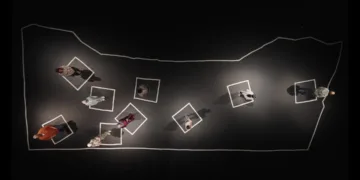























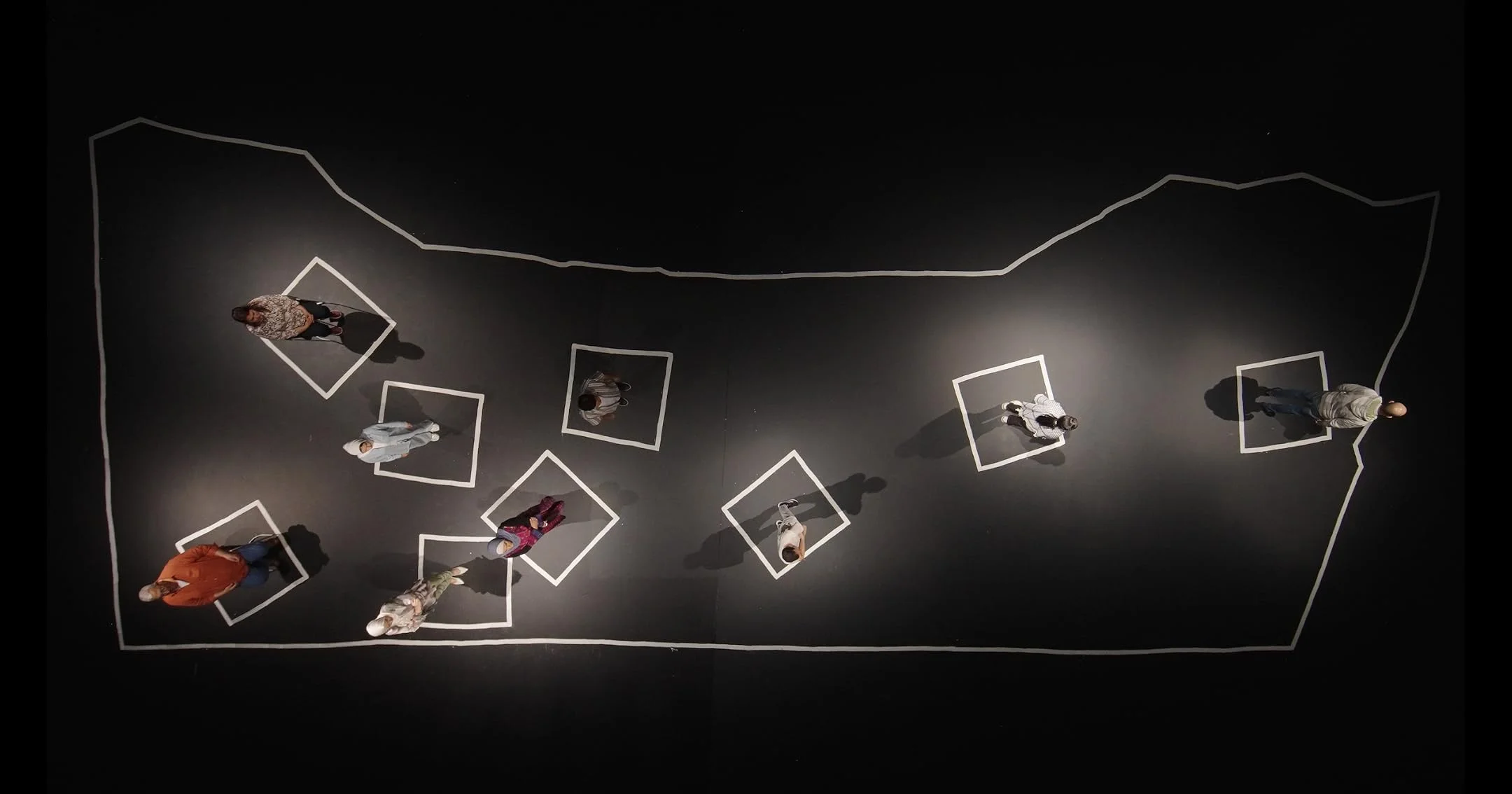

Visa restrictions prevented a group of Palestinian refugees from traveling to Switzerland to participate in a documentary, so filmmaker Nicolas Wadimoff moved his production to a studio in South Africa. What fascinates me about this decision is how Wadimoff uses the unfamiliar setting to develop a cinematic language for displacement. He strips the studio of recognizable scenery and gives his participants the means to reconstruct their own geography. A black floor, marked with white lines, becomes the Gaza Strip. People who can no longer visit their homes can at least establish where those homes once stood.
Wadimoff previously explored life in Gaza in his 2010 documentary Aisheen (Still Alive in Gaza). With Who Is Still Alive, he gathers Palestinians who escaped the Israeli bombardment following the events of October 7, 2023. They come from different generations and professional backgrounds, bringing memories of family life, artistic ambitions, careers and the places that accommodated them. Visual artist Adel Altaweel helps create the map on the studio floor, where each participant can locate their former neighborhood.
This is an exceptional piece of documentary filmmaking that I would readily recommend, particularly for its understanding of how physical space can communicate personal history. Wadimoff has such a good visual concept that I wish he had developed it further across the film. His eventual reliance on conventional interviews sacrifices some of the expressive possibilities established in these early sequences.
One of my favorite aspects of the studio arrangement is its use of blocking. This is a filmmaking term for the positioning and movement of people within a scene, usually planned to help communicate relationships or direct our attention. Here, the participants occupy marked areas of the floor corresponding to their former residences. As they describe being forced to evacuate, they move between locations. Some experienced this process as many as twenty times. An account of repeated evacuation acquires a physical dimension through the simple act of someone crossing a studio floor. You begin to understand how exhausting it must have been to keep searching for somewhere to stay.
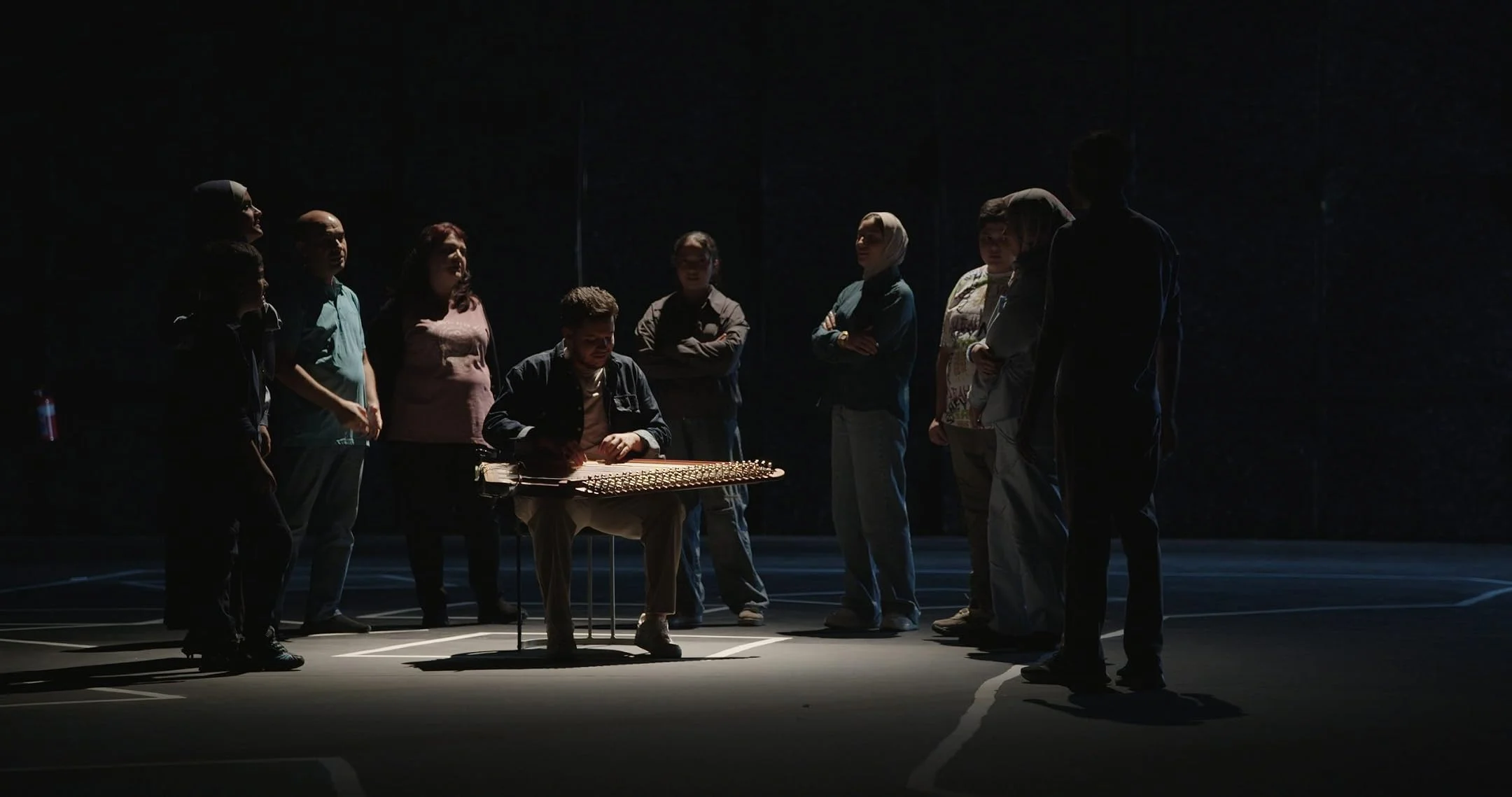
The camera movements are beautifully judged. Wadimoff tracks and pans around the standing participants, whose figures are picked out by theatrical lighting. These sequences give us time to absorb the relationship between the speaker and the surrounding space. The homes exist in considerable detail in their memories, and we learn about them through descriptions of neighborhoods, familiar surroundings and the efforts that went into building family residences. The production design leaves the imaginative work to the audience.
There is something particularly effective about learning these details before hearing the accounts of destruction. We have some understanding of what these people valued in their everyday lives, and each subsequent testimony carries that knowledge.
The documentary becomes more familiar in its presentation as Wadimoff settles into individual interviews. Haneen Harara, a journalist who reported on Israeli attacks before going into exile, speaks about the deaths of thirteen members of her family in an airstrike. Her professional background gives her testimony an additional significance. Someone whose work involved communicating the experiences of others now has to articulate an immense personal loss.
Businessman Jawdat Khoudary speaks about the destruction of Al Mat’haf, his museum and a repository for the region’s antiquities. His account expands our understanding of what has disappeared from Gaza. The objects he collected documented aspects of its history, and the destruction of the museum deprives future generations of access to that material.
I found myself missing the spatial inventiveness of the earlier passages during some of these extended interviews. The camera and the carefully constructed set had established a terrific relationship between spoken recollection and physical movement. With so many successive testimonies presented in a familiar documentary format, that relationship receives considerably less attention. The experimental and conventional elements of Wadimoff’s filmmaking could have been integrated with greater consistency.
There are instances, though, where the simplest presentation is exactly what the material requires. Altaweel lost nearly his entire family when their house was bombed, surviving the destruction himself. His difficulty speaking during the introductions carries particular weight given his involvement in drawing the map. Wadimoff allows space for such moments, recognizing that the participants’ ability to communicate through words varies considerably.
The film gains fresh energy midway through when Harara and Khoudary enter into a disagreement about returning to Gaza. Harara believes strongly in the necessity of rebuilding and challenges Khoudary over his reluctance to participate. It’s a fascinating change in the documentary’s approach because the two are now addressing each other. Their responses emerge from an exchange rather than a recollection, and the audience encounters aspects of their personalities that would be difficult to capture through individual interviews.
Harara’s determination is enormously affecting, particularly given the magnitude of her losses. Khoudary’s hesitation deserves attention too. Having heard his account of the museum, we have some appreciation of the years of personal investment that disappeared with its destruction. Returning would mean confronting the physical evidence of everything he has lost. Wadimoff is wise to give this disagreement room in the film.
These participants represent a particular cross-section of Palestinian society. Several had established careers and possessed the means or opportunity to escape Gaza. Millions of individual experiences cannot be contained within a production of this scale, and the documentary works best as a collection of personal histories. In a media environment where distant audiences frequently encounter Gaza through figures and images of destruction, hearing someone describe the home their family spent years building offers a valuable change in perspective.
The sound design becomes especially interesting through Feras Elsharafi, a young musician who plays the qanun, a traditional Middle Eastern stringed instrument. He recalls playing a piece of music in Gaza when an explosion showered him with broken glass. He can identify the exact point in the composition at which it happened. I found this detail particularly moving because it demonstrates how memory can become attached to something as specific as a musical passage. Playing that same instrument remains part of his life, and it was the possession he chose to take when his family received an evacuation order.
Wadimoff makes another lovely filmmaking choice toward the end by taking his participants outside. After spending so much time in a darkened studio, the change in the acoustic environment is striking. We can hear the wind and the sounds of children playing. Elsharafi’s music helps give these closing passages a warmth that feels entirely earned. We’ve spent considerable time learning what these people used to do, and listening to a young musician continue practicing his art offers a welcome opportunity to appreciate something he can still do today.
Who Is Still Alive (Qui vit encore) had its world premiere at the Venice International Film Festival on September 3, 2025, followed by theatrical runs in Switzerland on January 29, 2026, and France on October 14, 2026, ahead of arriving in UK and Irish cinemas on November 27, 2026. Written and directed by Nicolas Wadimoff, the documentary film gathers nine Palestinians from Gaza within outlines of a hand-drawn map on the floor as they share memories, grief, and stories of survival amid the war.
Full Credits
Title: Who Is Still Alive (Qui vit encore)
Distributor: First Hand Films (Switzerland), Una Mattina Films (France), Watermelon Pictures (US), Front Row Filmed Entertainment (MENA), Akka Films (World Sales)
Release date: September 3, 2025 (Venice International Film Festival world premiere), January 29, 2026 (Switzerland theatrical release), October 14, 2026 (France theatrical release), November 27, 2026 (UK and Ireland theatrical release)
Running time: 1 hour 53 minutes (113 minutes)
Director: Nicolas Wadimoff
Writers: Nicolas Wadimoff
Producers and Executive Producers: Ketsia Stocker, Nicolas Wadimoff, Philippe Coeytaux, Nadia Turincev, Omar El Kadi, Ossama Bawardi, May Jabareen
Cast: Jawdat Khoudary, Mahmoud Jouda, Adel Al Taweel, Haneen Harara, Malak Khadra, Hanaa Eleiwa, Firaz Elshrafi, Eman Shannan, Ghada Alabadla
Director of Photography (Cinematographer): Leandro Monti, Camille Cottagnoud
Editors: Jean Reusser
Composer: Dom La Nena
The Review
Who Is Still Alive
Who Is Still Alive demonstrates how a remarkably simple visual idea can communicate the complex experience of displacement. Nicolas Wadimoff's use of physical space, personal testimony, and environmental sound gives individual memories extraordinary clarity. Although the extended interviews occasionally diminish the film's visual inventiveness, the participants' contrasting perspectives on exile and returning home sustain its emotional power. The closing musical passages are particularly affecting, allowing us to appreciate the survivors as people whose artistic identities and personal ambitions endure.
PROS
- Inventive spatial reconstruction of Gaza through minimalist production design.
- Sensitive handling of personal testimony and traumatic memories.
- Thoughtful camera movement and theatrical lighting.
- Meaningful exchanges between participants with contrasting perspectives.
- Beautiful integration of qanun music and environmental sound.
CONS
- Extended interview sequences occasionally become visually repetitive.
- The inventive spatial storytelling feels underdeveloped beyond the opening passages.