





























Why does a ten-episode workplace comedy from Amy Poehler and Michael Schur need a stolen statue to keep its audience watching? That question hangs over Dig, Peacock’s adaptation of Kate Myers’ novel Excavations, which arranges the creators’ familiar interest in workplace relationships around a season-long archaeological mystery. The format makes a convenient promise to streaming television: funny people worth spending time with, plus an unanswered question to carry viewers into the next episode. It also asks the comedy to compete for room in its own show.
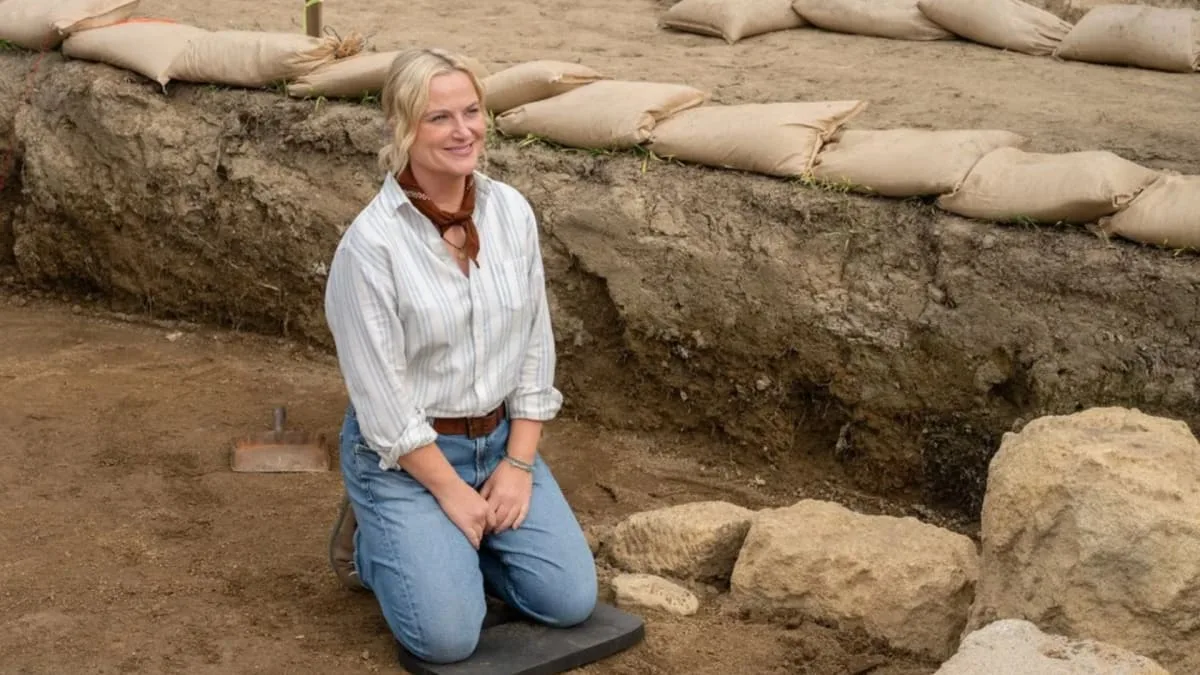
The workplace is an excavation site in Greece, where Elise (Poehler) has spent roughly fifteen summers doing the essential labor under Neville Wycombe (Hugh Laurie), a celebrated professor who repeatedly announces that retirement is imminent and then stays put. Elise knows the work, supervises the students, and wants the authority she has earned. Neville gets the public affection and the final say. When she discovers an ancient statue of Hera, the possibility of claiming credit herself becomes tempting enough to make secrecy seem sensible. That decision gives the mystery its premise, but the imbalance between Elise’s responsibilities and her professional standing is the sharper story.
Dig is pleasant, intermittently funny, and worth watching for the relationships its four central women eventually build. It is also frustratingly cautious with its best ideas. Its early episodes struggle to establish distinct personalities, and its later mystery spends energy manufacturing suspense that the series seldom sustains. The recommendation comes with reservations, particularly for viewers expecting the consistent comic invention associated with its creators.
Elise’s situation offers the series a credible institutional target. She is indispensable to an organization that keeps promising to recognize her, a predicament television workplaces have portrayed for decades but that remains painfully current. Neville even tells her to temper her tough-love approach and show the undergraduates some grace. The advice is reasonable: Elise can be forbidding, and her difficulty connecting with people is a genuine professional limitation.
Yet Neville’s ability to appoint himself the judge of her leadership, after repeatedly withholding the job, represents a privilege the script rarely examines seriously. Instead, he frequently becomes an endearing nuisance. Laurie can make his vanity amusing, but the character’s movement between supportive mentor and obstructive boss leaves the workplace critique uncertain about the authority it wants to challenge.
The most persuasive response to this hierarchy comes from the women working around it. Dylan (Geraldine Viswanathan), Elise’s former protégé, returns five years after abruptly abandoning the dig and their plans to work together. At 29, she has plenty of impulses and little direction. Clare (Antonia Thomas), nearing 40, seems to have assembled the respectable adult life Dylan lacks. She is wealthy, controlled, and engaged to Dylan’s ex-boyfriend Gary (Jon Pointing). Their history practically arrives gift-wrapped as a romantic feud. Instead, the series gives them room to understand each other, including Clare’s dependence on the security her privilege supplies and Dylan’s inability to settle old disappointments. Their developing friendship challenges television’s familiar habit of making women compete for male attention.
The generational design is almost suspiciously tidy: a woman approaching 50 wants recognition, another approaching 40 questions her independence, a 29-year-old resists adulthood, and a 19-year-old is discovering life beyond home. Clare sometimes gets reduced to being rich, just as Dylan’s supposed chaos rarely causes enough disruption to earn the label. There are still pleasures in watching Thomas meet Viswanathan’s impulsive delivery with immaculate composure, particularly as their shared history with Gary stops defining every interaction.
Patty (Fina Strazza), Neville’s sheltered young assistant, is where the series’ interest in personal growth becomes most rewarding. Her obsession with Greek mythology, awkward attempts at conversation, and habit of speaking to animals initially make her the designated eccentric. Some jokes land at the expense of a girl who has barely experienced life outside rural Maine; Strazza’s exaggerated vocal delivery can push the characterization toward caricature.
But Patty’s gradual acceptance into the secret excavation gives her a reason to risk embarrassment, speak for herself, and trust other people. Her desire for friends carries emotional weight because the earlier episodes establish how little practice she has at being included. Strazza becomes increasingly effective as Patty gains confidence among the other women.
That generosity is less evident in the show’s use of Greece. An archaeological story about who gets to claim a discovery carries questions about cultural stewardship before anyone steals anything. The women conceal the Hera statue partly to keep Neville from taking professional credit, yet their plan also evades the authorities responsible for the artifact. The series acknowledges the illegality and introduces an antiquities black market, but devotes far greater interest to the visitors’ personal breakthroughs than to the country whose history supplies their opportunity.
The Greek setting is largely presented through the needs of an American and British-centered ensemble. There are characters from the surrounding community, notably Stavros, the mayor played by Kayvan Novak, and a suspected local looter played by Jason Mantzoukas. Novak gives Stavros an unexpectedly appealing connection with Elise, and their flirtation brings out a less guarded side of Poehler’s performance. Still, prominent local roles are associated with romance, comic exaggeration, or suspicion. Scenic beaches and whitewashed villages supply atmosphere, yet the excavation trenches often look artificial. With Italian locations and Hollywood studio production standing in for parts of Greece, the physical setting sometimes feels detached from the archaeological work defining these characters’ lives. The imbalance is especially noticeable in a story that repeatedly asks its audience to care about the rightful ownership of a Greek artifact.
The ten half-hour episodes create their own division of labor. The early installments introduce the site, its students, estranged colleagues, and romantic complications with clumsy directness. Once the women commit to extracting the statue they nickname “Pretty Woman,” the series begins to find a shared comic rhythm. Its disappearance then triggers spying, suspected looters, disguises, and an investigation involving the antiquities trade. These incidents provide momentum through late revelations, but the suspense remains slight, and several conflicts evaporate before they can seriously affect a relationship. Apparently, even a sitcom from the creators of Parks and Recreation must produce a cliffhanger to prove it belongs on a streaming service.
Some of the funniest material is simpler. A bingo card mocking Neville’s habitual behavior works because the students have spent enough time with him to recognize the pattern, and Laurie knows how to make his wounded self-importance amusing. Dylan and Patty trying to move sheep off a road draws comedy from two people reacting differently to the same absurd task. Both examples depend on character and place rather than the next mystery revelation. The occasional cheap joke about bodies or social awkwardness is especially disappointing in a series that otherwise wants its characters treated with patience.
Peacock has assembled formidable comic talent, including guest appearances from Max Greenfield and Brennan Lee Mulligan, but recognizable performers cannot always compensate for underdeveloped material. Greenfield’s involvement in the art-dealing side of the mystery, for instance, offers another colorful presence in a storyline that struggles to make its supporting players consequential.
The format points toward a particular tendency in contemporary streaming comedy: episodes short enough to retain the accessibility of the sitcom, connected by a mystery that encourages continuous viewing. Dig suggests the limitations of that arrangement whenever it interrupts the developing friendships to introduce another suspect or complication. Its strongest emotional progress occurs as Patty finds acceptance and Elise begins to trust the women around her, even as the investigation keeps demanding their attention.
Dig is a comedy television series created by Michael Schur and Amy Poehler, based on Kate Myers’ novel Excavations, scheduled to premiere on Peacock on November 23, 2026. The series follows archaeologists working at an excavation site in Greece who uncover a secret that draws them into an international conspiracy. All ten episodes of the first season will be available to stream on Peacock in the U.S. starting November 23, 2026, and will air on Showcase and StackTV in Canada.
Where to Watch Dig Online
Full Credits
Title: Dig
Distributor: Peacock
Release date: November 23, 2026
Rating: TV-MA
Running time: 30 minutes per episode
Director: Michael Schur, Amy Poehler
Writers: Michael Schur, Amy Poehler, J. J. Philbin, Kassia Miller, Matteo Borghese, Rob Turbovsky, McKenna Thurber, Berkley Johnson, Karen Chee, Ama Anane, Amina Munir, Dani Shank, Kate Myers
Producers and Executive Producers: Michael Schur, Amy Poehler, J. J. Philbin, Kate Myers, Morgan Sackett, Dave Becky, David Miner, Sharon Jackson, Kate Arend, Jordan Grief
Cast: Amy Poehler, Hugh Laurie, Geraldine Viswanathan, Antonia Thomas, Fina Strazza, Jason Mantzoukas, Noma Dumezweni, Brennan Lee Mulligan, Kayvan Novak, Jon Pointing, Bonita Friedericy, Max Greenfield, Dan Bucatinsky
The Review
Dig
Dig finds its greatest strength in the friendships between four women confronting different forms of professional and personal uncertainty. Fina Strazza's affecting performance and the ensemble's comic chemistry make Peacock's archaeological comedy worth watching. Yet the uneven mystery, inconsistent characterization, and superficial treatment of Greece weaken its ambitions. Amy Poehler and Michael Schur have assembled a talented cast around a promising workplace premise, only to let streaming television's appetite for constant suspense interrupt the relationships that deserve our attention.
PROS
- Strong chemistry among the four female leads
- Fina Strazza's rewarding character development
- Thoughtful portrayal of female friendship and professional inequality
- Amusing workplace comedy and supporting performances
CONS
- Underdeveloped mystery and uneven pacing
- Inconsistent characterization, particularly Neville
- Superficial representation of Greece and its cultural heritage
- Some cheap jokes undermine the sympathetic writing