




























Grandma Yuma can bake again once Neha starts bringing milk to the neighborhood. Her reopened pie shop gives Milki Delivery’s small business a purpose that a rising bank balance could never supply: an ingredient returns, and an interrupted social habit resumes. Neha has arrived seeking a companion for her cow, Milki, only to discover that the region’s other cows have vanished. Selling the milk of the remaining animal gradually draws her into the lives of people whose routines have contracted around that absence.
French developers Blibloop and Doot place this modest revival in a countryside with Japanese names, forest temples, and vending machines. Nodoka Fields gives way to Hiroo Forest and Toyo Coast, taking the bicycle route from farmland toward wooded slopes and fishing settlements.
Milk tea belongs comfortably beside Yuma’s baking. Calling the setting simply Japanese would flatten its mixture of associations; treating its dairy economy as inherently French would be equally careless. The interesting cultural exchange happens through the ease with which these practices share a fictional neighborhood, where belonging can begin with supplying something another person has missed.
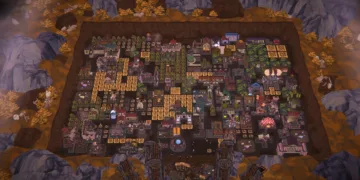
The hand-drawn landscape makes that invitation attractive. Soft colors give farms and wooded paths a welcoming continuity, while sunset and nighttime lighting alter the same roads without requiring a new destination. The resemblance to Studio Ghibli lies in the attention given to ordinary activity within a living landscape: a bicycle stopping, animals passing, work proceeding at a human scale. Zakku’s piano-led music and light electronic textures sit alongside cicadas, birds, and coastal waves. Those sounds give the scenery an existence beyond Neha’s errands, making a pause feel like time spent somewhere.
Participation begins with a straightforward routine. Feed Milki, collect milk, choose a route, make deliveries, and gather materials for improvements. You select destinations and Neha pedals automatically, so the useful decisions concern where to go and what to spend energy doing. Deliveries earn money and trust; foraging provides fruit, wood, and scrap. A bench offers rest, and consumables can stretch a day’s activity. The arrangement gives each departure a small practical question without burdening it with an elaborate simulation of rural labor.
The requests give these choices a social shape. Selling ten bottles in one day earns a farmer’s trust, while gathering wood repairs a bridge and opens movement through the region. Restocking vending machines extends the delivery business beyond face-to-face transactions.

These are simple objectives, yet they make local renewal tangible. Tavi, the forgetful postman, resumes circulating and talking to residents after observing Neha’s efforts. Alongside Yuma’s return to baking, his renewed activity makes the community feel responsive through changed habits. The conversations can remain slight because some of the characterization happens through what people start doing again.
This is an unusually forgiving version of mutual dependence. Requests can wait for days without punishment, milk does not spoil, and fainting after staying out too late sends Neha safely home. The clock organizes activity without threatening the relationships that justify it.
There is still preparation to consider, particularly for a mountain trip that calls for an early departure and adequate supplies. Such tasks show how the game can ask for attention while allowing an unsuccessful day to remain an ordinary day. Its neighbors do not withdraw their goodwill because a route was poorly planned.
Bicycle improvements initially develop that balance well. Better tires permit rougher terrain, and a more comfortable seat expands Neha’s energy reserve. The reward is visible in the map and in the amount a day can accommodate.
Later options let her cross several nodes and eventually use fast travel, reducing the cost of familiar circuits. These improvements have a welcome physical logic: a young rider becomes better equipped to reach the people around her. Their value is clearest when a new purchase makes a previously awkward trip manageable.
The repeated rides themselves are less consistently rewarding. Automatic cycling leaves long stretches in which the route has been chosen and little remains to decide. Clicking a passing bird or rabbit supplies a coin, but these brief interactions do little to change a familiar crossing.
Fast-forward helps, yet repeated harvesting animations and delivery dialogue add further pauses around actions already understood. Watching the evening light change can be pleasurable; having to watch another trip before performing the same few clicks can exhaust that pleasure. The distinction matters in a game whose most attractive scenery is encountered through compulsory repetition.
Later abundance weakens the connection between the business and its daily demands. As energy, money, and milk become plentiful, deliveries lose some of their role in preparing the next improvement. Production continues after selling has become less useful. A campaign of roughly three to six hours limits the strain, but its compactness cannot entirely conceal this thinning purpose. The community still welcomes Neha’s visits while the economy gives the player fewer reasons to plan them carefully.
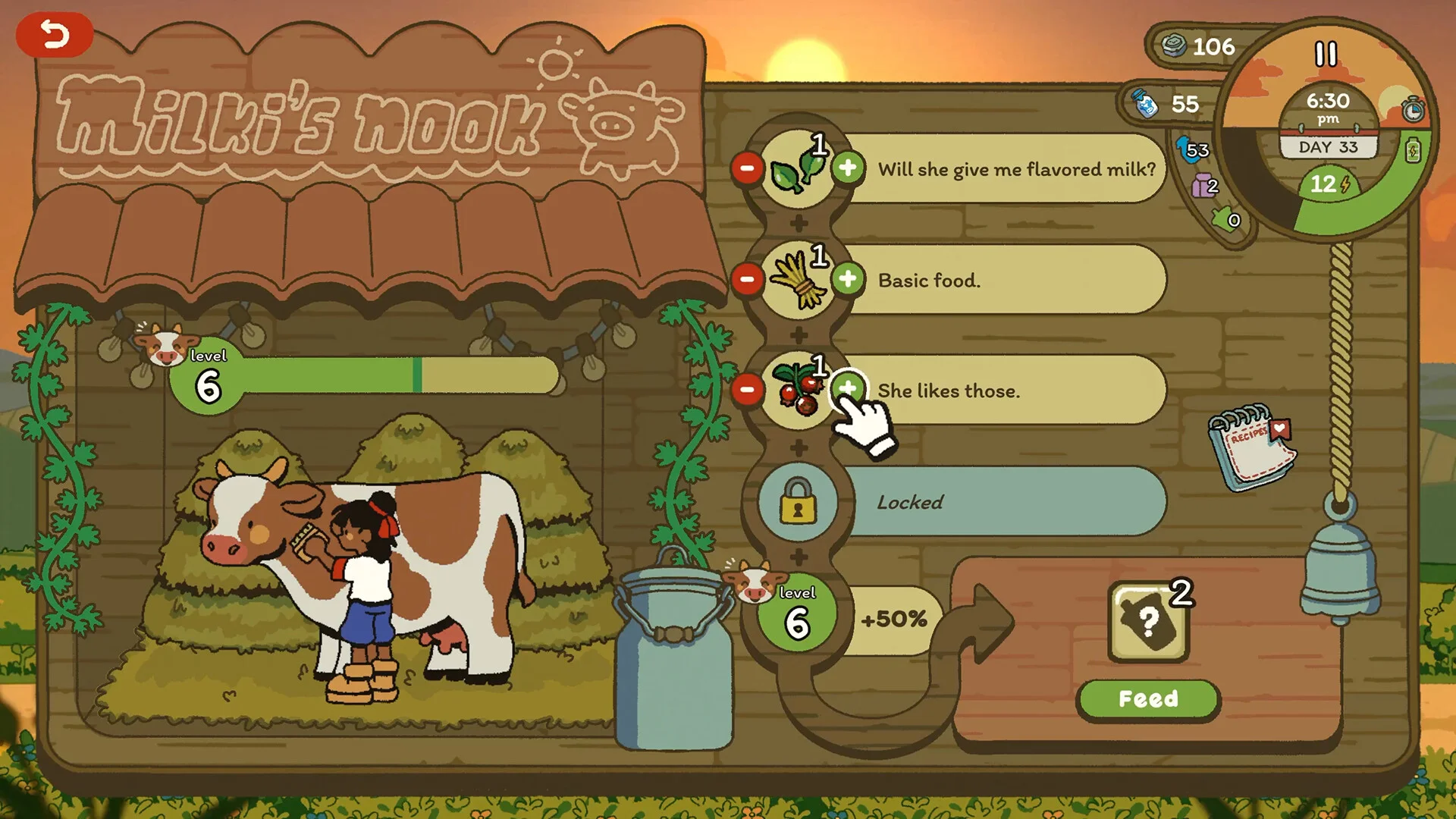
That surplus complicates the game’s concern with animal care. Milki needs companionship, and the vanished cows place the region’s failed dairy industry under a shadow of damaged trust. Neha’s operation proposes an intimate scale of repair: feed this animal, attend to her happiness, bring her milk to familiar people. The fantasy rests on relationships that industrial production has failed to protect. Returning dairy to the neighborhood becomes acceptable through the attention paid to the creature supplying it.
Yet affection remains tied to output. Fruit and care increase Milki’s happiness and yield, while strawberry milk and milk tea extend the product range. The game leaves this connection intact, giving kindness both an emotional purpose and a commercial reward. Once the bottles accumulate beyond any pressing need to sell them, those purposes begin to separate. Feeding Milki can continue as a daily act of care, with the next morning’s milk waiting for a delivery schedule that no longer requires all of it.
The Review
Milki Delivery
Milki Delivery turns its French-made, Japanese-inflected countryside into a place where small acts of service restore everyday social life. Yuma's reopened shop gives deliveries a human purpose, supported by inviting landscapes and forgiving daily planning. Automatic rides and repeated interactions wear thin, while late abundance leaves the business short of practical incentives. Its most thoughtful tension survives that slowdown: caring for Milki remains meaningful even when her milk exceeds the neighborhood's gameplay demands.
PROS
- Deliveries produce tangible changes in residents' routines.
- Hand-drawn scenery and sound give familiar routes atmosphere.
- Early bicycle upgrades meaningfully expand access and daily capacity.
- Forgiving rules allow planning without punitive pressure.
CONS
- Automatic rides offer little changing activity.
- Repeated dialogue and harvesting animations slow familiar tasks.
- Late abundance weakens the incentive to keep delivering.