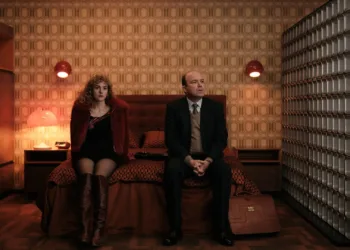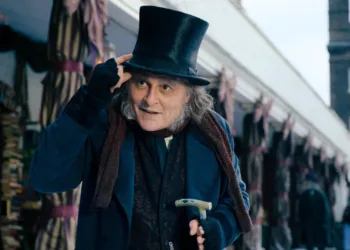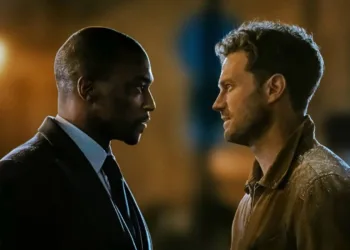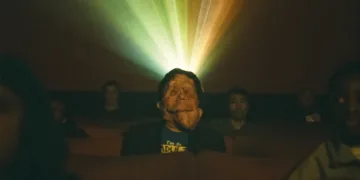









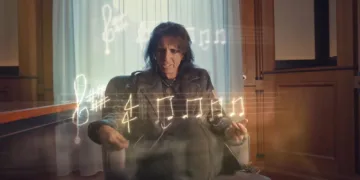












For a school talent show, the young Adam Pearson dresses as Avril Lavigne and sings “Complicated.” A boy from Croydon takes possession of a North American pop persona, finding a public role through the pleasurable business of playing someone else. The performance carries an ordinary adolescent wish: to command the attention of a room on your own chosen terms. Preserved in Edward Lovelace’s documentary Zero Intention of Living Quietly, it gives Pearson a history of creative appetite before the film asks us to consider the responsibilities attached to his visibility.
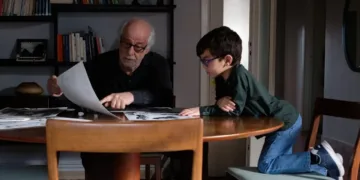
His bullies’ use of The Elephant Man makes that freedom of identification brutally conditional. Pearson has neurofibromatosis type 1, or NF1, which causes noncancerous tumors to grow across his face. Other people seize on a screen image to decide what they see when they look at him. Lovelace places these recollections within a life recorded through family photographs and childhood films, restoring the domestic history that an insult erases. The cultural exchange here is painfully unequal. Pearson can find possibilities in entertainment arriving in his corner of Britain, yet he cannot control how his peers use the same shared stock of images.
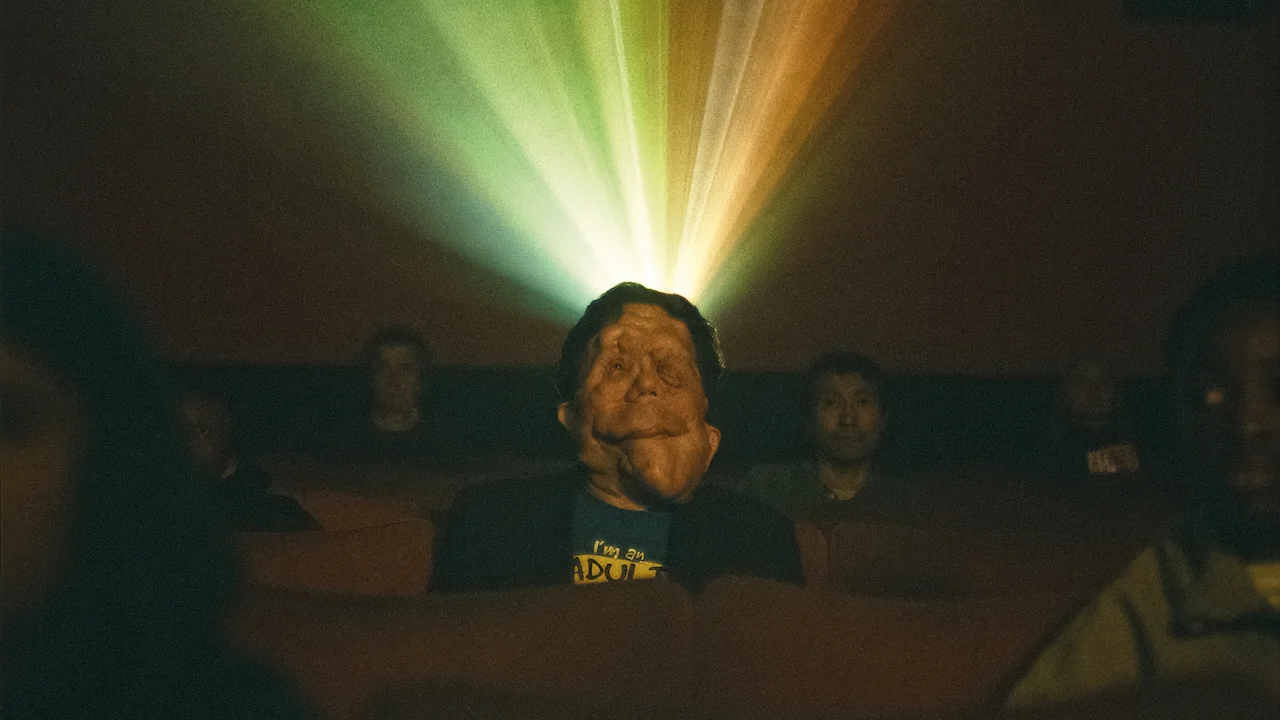
Speaking from an empty cinema, Pearson describes recognizing himself in Buzz Lightyear, Forrest Gump, and Elle Woods. These are identifications made through feelings, ambitions, and disappointments rather than physical resemblance. Lovelace’s use of familiar clips lets us follow the associations without requiring us to share them. American popular cinema becomes a vocabulary with which a British viewer describes himself, and Pearson proves an inventive reader. The breadth of his attachments matters: he finds room for himself across different stories, while the bullies insist on reducing him to one.
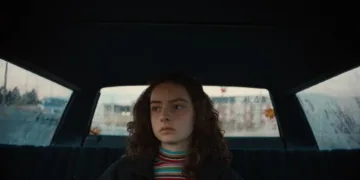
That movement between screen and everyday life gains a different direction when Ellie Jim’s mother contacts Pearson following his appearance in Under the Skin. Ellie also has NF1 and wants to perform. Her mother hopes he can offer understanding grounded in experience, and their conversations give that hope practical substance. Pearson has to consider what he can honestly promise someone younger whose fears he recognizes. His efforts to comfort her are affecting partly because reassurance requires care with the truth. Having endured something does not automatically supply the words that will make it bearable for another person.
Ellie’s trust also exposes a contradiction in Pearson’s own choices. A nightclub assault and the strain of public scrutiny have helped drive him away from performing; he initially avoids even reading the script for A Different Man. Encouraging Ellie to pursue her ambitions makes his retreat harder to accept. Lovelace finds a persuasive motive for his return to acting in this discomfort. Pearson wants his advice to carry the authority of something he is prepared to attempt himself. The relationship allows responsibility to coexist with fear, giving his renewed ambition an emotional basis beyond the familiar documentary reward of professional recognition.
The move from Croydon to work in New York expands his audience without resolving the situation that brought them together. Behind-the-scenes footage of A Different Man places Pearson alongside Sebastian Stan and Renate Reinsve, participating in the production of images that will travel internationally. Meanwhile, Ellie’s difficulties at school and with her health continue. His success cannot be transferred to her through proximity or goodwill. The film is most searching when it holds those unequal circumstances together, allowing the excitement of his work to sit beside the continuing need for a call home. Their friendship operates at a scale that publicity cannot replace.
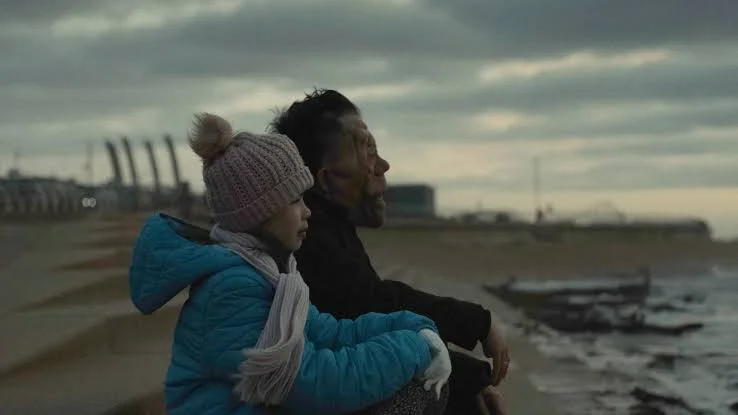
Ruben Woodin Dechamps’s cinematography gives that connection a precise visual expression. A wide shot of Pearson waiting at a bus stop finds an echo in Ellie’s isolation in a playground. The pairing links two people who inhabit different stages of life while remaining exposed to the ways a public space can exclude. It is an economical use of the film’s polished imagery, making a relationship legible without requiring either person to explain it. Their calls then provide what the matched compositions cannot: the hesitations involved in responding to the particular person at the other end.
Elsewhere, Lovelace seems less confident that the experience will communicate without heavy emphasis. Close-ups of Pearson deleting casting emails turn his reluctance into a conspicuous dramatic obstacle. When the sound fades during the Berlin press conference, anxiety arrives already translated into a familiar cinematic signal. These choices make his discomfort easy to read, but leave little interpretive space around it. Stephen Rennicks and Hugh Drumm’s wistful piano scoring applies a similar pressure, repeatedly steering the portrait toward poignancy. The borrowed language of popular cinema, so flexible in Pearson’s own hands, becomes restrictive when the documentary uses it to settle how we should feel.
Pearson’s candid admissions suggest a less settled film within this one. He speaks about loneliness, anger, and fear of his condition’s progression; he acknowledges verbally bullying others himself. That last admission interrupts the comfortable division between a cruel world and an innocent subject, revealing how injury can become a justification for inflicting injury. Lovelace permits the complication, then gives it little room to alter the movement toward restored confidence. Across the brief running time, returns to encouragement begin to repeat an established point. Pearson’s renewed willingness to perform can bear greater uncertainty than the film allows it.
Ellie’s school performance brings this limitation into especially sharp focus. Before she takes the stage, she and Pearson enjoy High School Musical together, turning a widely exported piece of American entertainment into a shared source of nerve and pleasure. Yet her final performance is presented without our hearing her sing.
After so much access to familiar screen voices, the absence of hers feels consequential. The documentary has helped us understand why she wants an audience, then limits our ability to become one. We can recognize the achievement of her appearance while being denied the encounter with her performance that might make the occasion distinctly hers.
Zero Intention of Living Quietly premiered at the Telluride Film Festival in September 2026 before screening at the BFI London Film Festival. Directed by Edward Lovelace, the documentary follows actor and disability advocate Adam Pearson as he navigates public life, overcomes isolation, and forms an inspiring bond with a young girl who shares his genetic condition.
Full Credits
Title: Zero Intention of Living Quietly
Distributor: Ventureland, Cinetic Media
Release date: September 4, 2026 (Telluride Film Festival)
Running time: 1 hour 27 minutes (87 minutes)
Director: Edward Lovelace
Producers and Executive Producers: John Battsek, Sarah Thomson, Fleur Nieddu, Edward Lovelace, Howard T. Owens, Ben Silverman, Lottie Allen, James Packer, Kerstin Emhoff, Ali Brown, Tim Murray, Drew Buckley, Isabel San Vargas, Taylor Levin
Cast: Adam Pearson, Ellie Jim
Director of Photography (Cinematographer): Ruben Woodin Dechamps
Editors: Julian Hart, Nic Zimmermann, David Charap
Composer: Stephen Rennicks, Hugh Drumm
The Review
Zero Intention of Living Quietly
Hollywood’s familiar characters acquire personal meanings in Adam Pearson’s Croydon upbringing, while his friendship with Ellie turns screen visibility into a responsibility toward someone he knows. Edward Lovelace captures that exchange with warmth and genuine insight. His emphatic music and dramatic cues too often prescribe our response, however, and the repeated encouragement gives Pearson’s anger and uncertainty insufficient room. Ellie’s unheard performance makes the limits of this generous portrait especially apparent: the film values her ambition while restricting our encounter with its expression.
PROS
- Reciprocal mentorship gives Pearson’s return to acting personal stakes.
- Film references reveal how screen identities change through everyday use.
- Matched compositions connect Pearson and Ellie without erasing their differences.
CONS
- Emphatic scoring and dramatic cues overdirect the emotional response.
- Repeated encouragement limits the exploration of anger and uncertainty.
- Ellie’s unheard singing restricts access to her own performance.