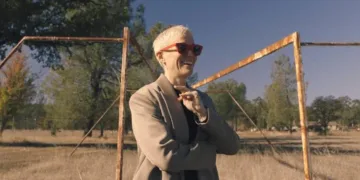











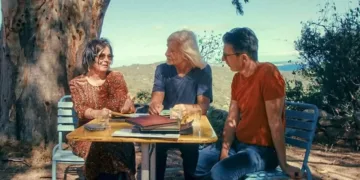












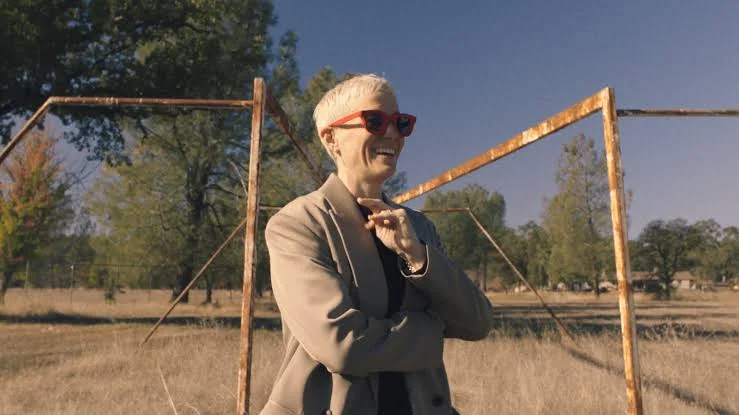

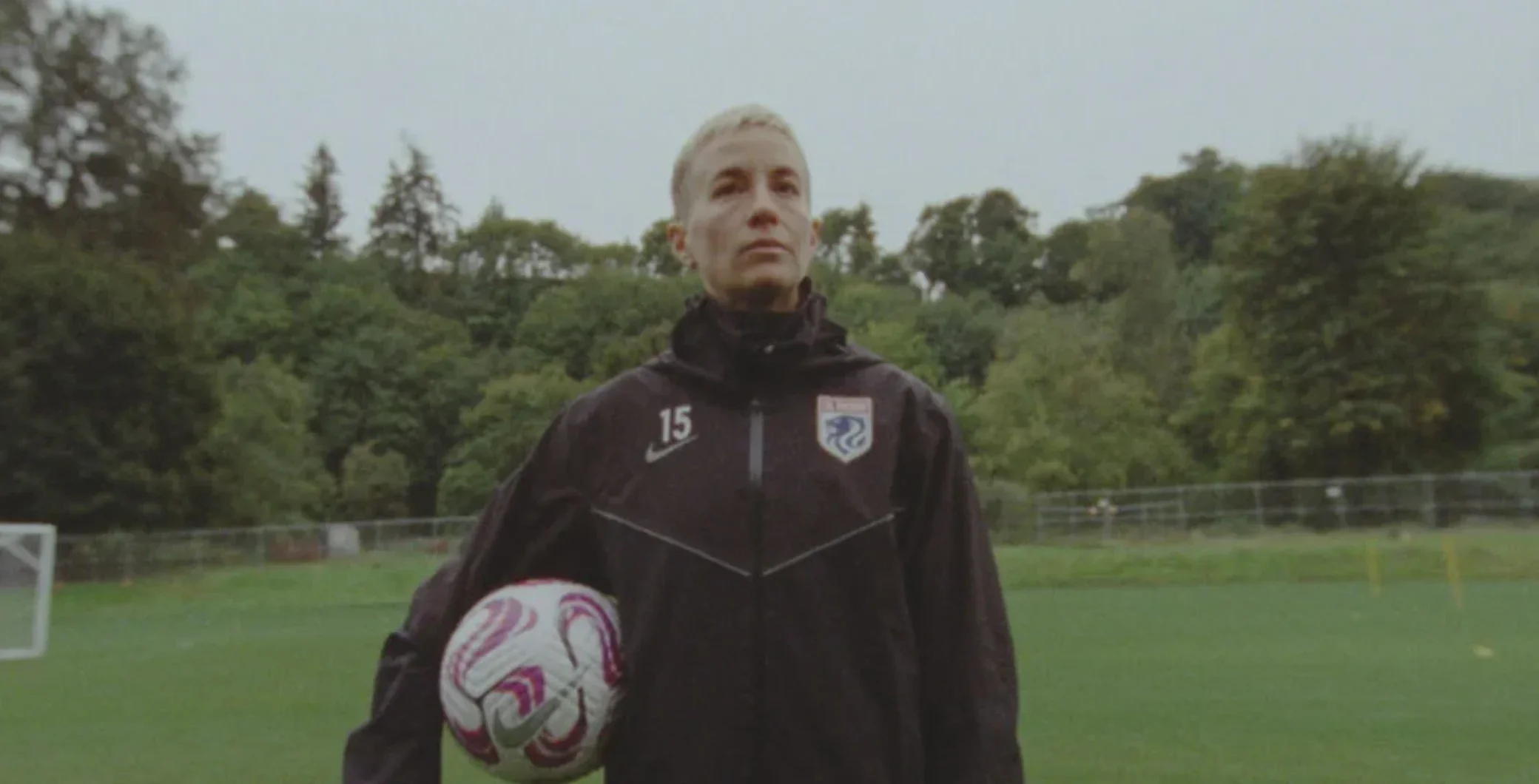
Megan Rapinoe has skincare to get through while she thinks about what might be her last match. The routine continues alongside the reflection, giving a huge career threshold the slightly distracted intimacy of a conversation before bed. Rebeca Huntt lets these activities share the scene in her documentary Rapinoe. There is time to consider leaving professional soccer and time to attend to a face that, for years, has been photographed celebrating, protesting, and absorbing the response to both.
Being this close to Rapinoe gradually changes how it feels to watch her. During an intense physical-therapy session, the camera stays near her face, bringing bodily effort into a portrait easily dominated by accomplishments. Elsewhere, Huntt persuades her to stretch out on a sofa as though settling into a therapy appointment.
Rapinoe plays along, briefly. The setup gets its warmth from her willingness to entertain the director’s idea without becoming obedient to it. Much of the new footage’s 16mm grain supports this relaxed familiarity, sitting alongside digital images and archives in a film that invites us into Rapinoe’s company before asking how well we know her.
Huntt’s split screens make that invitation especially rewarding. An interviewee can appear beside the person being discussed, leaving two faces available while one account occupies our attention. We can look away from the speaker without leaving the relationship.
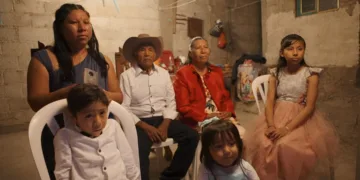
This gives family recollections an emotional activity that a succession of isolated interviews would struggle to reproduce. The person telling the story no longer controls every part of our encounter with it. Affection and discomfort have room to coexist in the frame, without the film needing to announce a revelation each time someone remembers something difficult.
The coming-out accounts give that approach substance. Rapinoe and her twin sister grew up together in a working-class family in Redding, California, sharing soccer and a religious mother whose difficulty accepting Megan’s sexuality complicated life at home. Yet the sisters’ readiness to speak about their sexuality did not run on the same schedule.
Old prom photographs of them with male dates sit within a history that public confidence can make easy to flatten. The film lets us feel the awkwardness of discovering yourself while someone close to you has already found words for her experience. Megan’s openness belongs to a particular person; it cannot resolve the timing of everyone around her.
Her memories of older brother Brian carry a different ache. He helped inspire her love of soccer, and his addiction and repeated encounters with detention and incarceration altered what she understood about the institutions governing people’s lives. Her emotion preserves the relationship beneath the later political significance. Brian remains someone she looked up to before he becomes part of an explanation of her activism. That order matters to our attachment: we understand the loss involved in watching a loved person struggle before considering how those experiences informed her willingness to challenge authority.
The sporting footage supplies a welcome release from these difficult recollections. Rapinoe’s goal-celebration pose still delivers a rush, and Huntt understands the pleasure of letting that confidence fill the screen. The supporters chanting for equal pay give the excitement a collective direction. Winning has brought everyone together, and their voices demand something the victory itself has failed to secure. Against that sound, the pay dispute’s appeal to male players’ supposed physical advantages feels especially remote from the women whose work has produced the celebration. The archive earns its place through what the crowd wants next.
Kneeling in support of Colin Kaepernick’s protest against racial injustice produces a different sensation of being watched. Without teammates joining her, Rapinoe’s visibility becomes exposing. Booing and hostile commentary make the distance between agreement and public solidarity painfully tangible. Huntt places the media uproar, including Donald Trump’s attacks, against Rapinoe’s plain explanations of her convictions. We can understand her reasoning quickly; the aggression keeps coming. This is where the film makes the cost of holding a position felt through repetition and scale, while allowing the position itself to remain straightforward.
Rapinoe’s account of emotional detachment complicates the confidence that has carried us through those sequences. She describes a way of coping that helped her perform and withstand scrutiny, then talks about therapy making that familiar protection harder to maintain. It is an absorbing admission because it changes the emotional significance of composure.
The film becomes less satisfying when it suggests a connection between increased self-reflection and her missed penalty at the 2023 World Cup. A single sporting error bears too much explanatory weight there. We have heard enough to appreciate her uncertainty, but too little to accept this particular account of how it affected her play.
The self-recorded footage near the end communicates that uncertainty with greater force. What starts as Rapinoe showing clothes shifts as she texts Sue Bird and becomes visibly emotional. The passage allows our expectations to change while we watch: the playful presentation continues into territory that feels harder for its maker to manage. Because Rapinoe records the scene herself, the scene also loosens the comforting distinction between a public image and a private person waiting to be discovered behind it. She can choose to record herself and still encounter feelings that disrupt the presentation. Huntt gives that change room without turning it into an explanation of the relationship.
Retirement leaves the film facing a similar difficulty of following through. Rapinoe can identify that an old way of living has stopped working, while the new one remains uncertain. Her subsequent activism, podcasting, and commentary receive a closing caption, leaving little sense of how those pursuits feel as daily life. The final Mary Oliver reading, asking what someone plans to do with their life, directs the film’s encouragement toward us. It is a generous invitation after so much hostility and effort. Yet our imagination has to supply much of Rapinoe’s next phase, just when the film has made us interested in spending uncelebrated time with her.
Rapinoe had its world premiere at the Toronto International Film Festival on September 10, 2026, before being acquired by HBO Documentary Films. Directed by Rebeca Huntt, the documentary explores the extraordinary life, career, and cultural impact of iconic soccer star and activist Megan Rapinoe.
Full Credits
Title: Rapinoe
Distributor: HBO Documentary Films
Release date: September 10, 2026 (Toronto International Film Festival)
Running time: 1 hour 32 minutes (92 minutes)
Director: Rebeca Huntt
Producers and Executive Producers: Rebeca Huntt, Dan Cogan, Zoe Potkin, Kate Barry
Cast: Megan Rapinoe
Director of Photography (Cinematographer): Derek Howard, Alejandro Mejia Gavino, Sophia Stieglitz, Sean Mattison, Tony Hardmon
Editors: Gabriel Rhodes, Isabel Freeman
Composer: Chanell Crichlow, T. Griffin
The Review
Rapinoe
Huntt makes Rapinoe’s confidence feel costly without draining its joy. Family split screens and unguarded self-recording bring us close enough to share the exhilaration of her victories and the strain of being so visible. The suggested link between therapy and a missed penalty stretches the film’s insight, while retirement receives too little lived detail. Still, the affection feels earned: this is a portrait that makes ordinary time with its subject worth watching.
PROS
- Family split screens give personal history emotional complexity.
- Everyday routines reveal humor and physical effort.
- Sporting celebrations connect exhilaration to collective demands.
- Self-recorded footage captures vulnerability without relationship speculation.
CONS
- The therapy–penalty connection carries insufficient psychological support.
- Life after soccer receives limited development beyond a closing caption.