





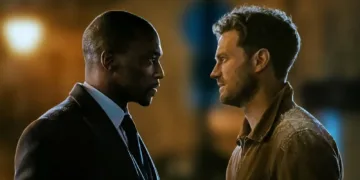









Before Jacob Marley becomes a warning, he is someone who can share Scrooge’s pleasure in being unkind. The two men’s Christmas Eve contempt has the ease of an old understanding, a small companionship sustained by shutting everybody else out. Ti West gives them this interval together in Ebenezer, then lets Marley die in front of his distressed partner, with a kettle’s whistle lending the scene its domestic unease. An ordinary room becomes a place in which something irreversible has happened. Scrooge’s cruelty survives the interruption. The person who understood it does not.
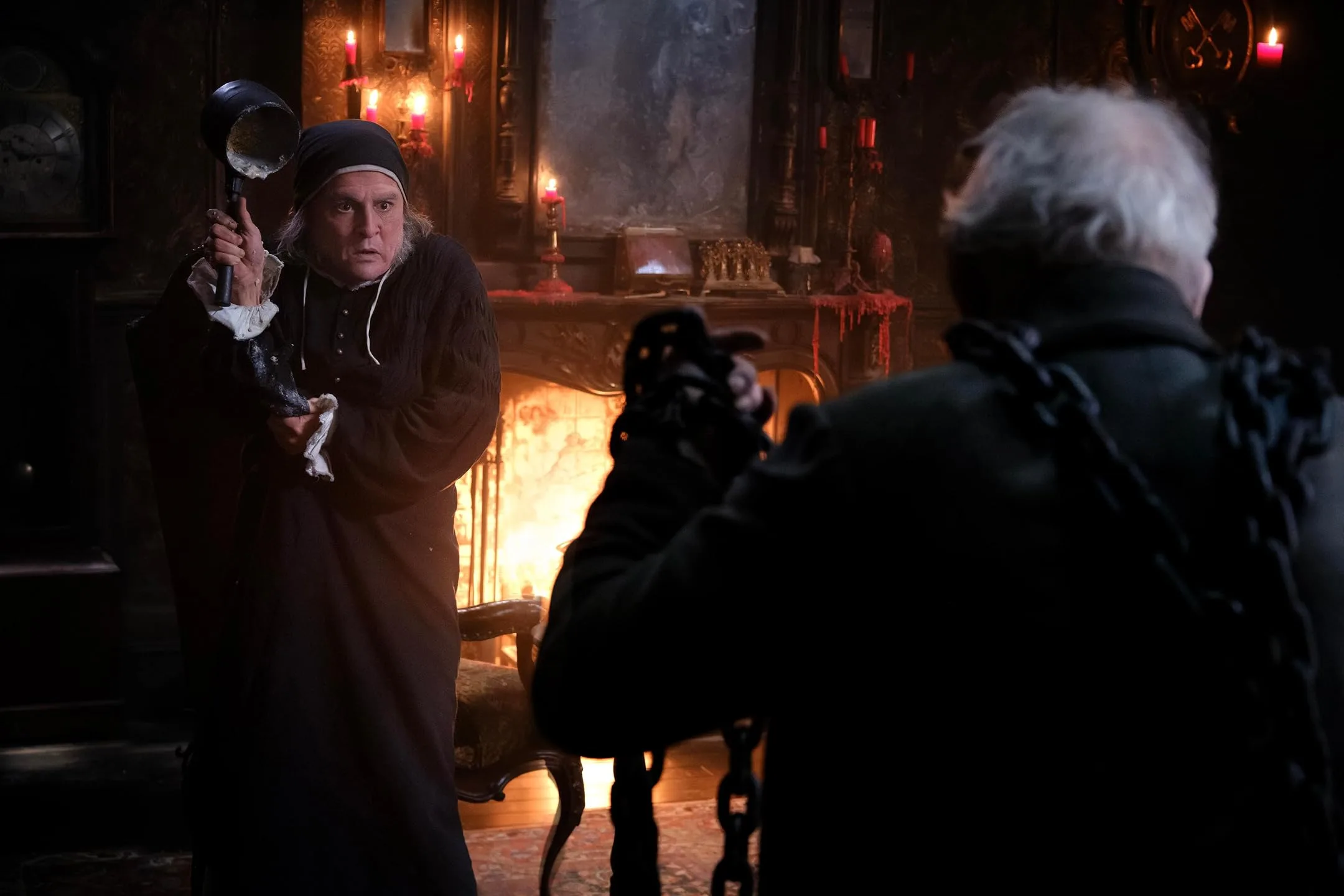
When Ian McKellen returns in chains, that earlier intimacy makes his remorse painful. “I failed to honor the time I was gifted,” Marley says, and McKellen gives the words the exhaustion of knowledge acquired too late. He has lost the ability to make his life mean anything different. His surviving partner still has that ability, though Johnny Depp’s Scrooge initially receives the visitation as another intolerable disturbance. Between them lies the terrible inequality of having time and having none. McKellen makes the warning feel like the last service one damaged man can perform for another.
West’s adaptation of Charles Dickens’s A Christmas Carol, written by Nathaniel Halpern, is most persuasive while it lets that dread occupy the rooms. Its fogbound London and cold gray atmosphere give Scrooge’s withdrawal a climate; the gauzy texture of the image makes the past feel close without making it recoverable. Andrea Riseborough’s Ghost of Christmas Past, white-eyed and corpse-pale, brings an especially intimate discomfort into his halls. Memory arrives wearing a body. Her presence denies him the privilege of remembering only what he can bear, and the practical makeup allows the encounter to retain the uneasy proximity of two performers sharing a space.
The memories themselves offer recognizable reasons for Scrooge’s retreat: childhood loneliness, his sister Fanny’s death, and the departure of Belle as his devotion to money consumes their relationship. Fanny’s son Fred, played by Sam Claflin, carries a family connection Scrooge refuses to nurture. Grief has surviving people attached to it, people whose invitations can be declined. Belle’s reimagining as a future novelist who works in a soup kitchen gives Ellie Bamber’s character a life directed toward others. The contrast with Scrooge is useful because it places another possible way of living within his own remembered experience. He once knew someone who chose it.
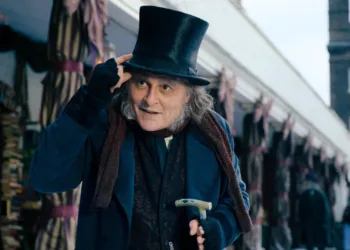
Yet Depp often makes this man’s defenses easier to see than the person defending himself. His irritable timing has comic precision, and there is pleasure in the disproportionate offense he takes at ordinary Christmas goodwill. The grimaces, sudden flinches, and frantic movements keep the body eloquently occupied. They also crowd the passages that need a less demonstrative kind of exposure. Scrooge’s repeated insistence that he has changed from his former self supplies the information his performance struggles to make intimate. I can understand the life that produced this miser without quite feeling admitted to it. McKellen’s remorse, briefly available beside him, makes that distance harder to ignore.
Tramell Tillman gives the Ghost of Christmas Present an appetite strong enough to interrupt this enclosure. Encountered feasting in a pub, he brings bodily enjoyment into a film so heavily furnished with privation and death. His hearty energy has an irritable edge; Scrooge cannot reduce him to another person whose requests can be dismissed. That vitality makes the appearance of Ignorance and Want inside his ribcage especially disturbing. The embryonic ghouls occupy the same body that has been eating and enjoying itself. West makes deprivation physically inseparable from abundance. The image troubles the spirit’s expansiveness without extinguishing it, giving the film a horror that grows directly from the suffering Scrooge prefers to keep elsewhere.
Halpern’s screenplay is less certain about how far that recognition should extend. Scrooge accuses charitable gentlemen of pocketing donations, which could expose the reflex by which he excuses his refusal to give. The film also supplies corrupt advocates and people pretending to be disabled. His suspicion receives corroboration. The danger here is a narrowing of sympathy: help begins to look appropriate only after the recipient’s innocence has survived investigation. Tim Cratchit’s illness is beyond dispute, while need elsewhere comes shadowed by the possibility of deceit. Scrooge can learn to make exceptions without surrendering the habits that kept his heart so well protected. The grotesque children in the spirit’s body demand a less comfortable response than these qualifications allow.
The visits to Bob Cratchit’s household, with Rupert Grint as the underpaid clerk, bring that question down to the scale of a family. The future holds both Tim’s death and Scrooge’s own unmourned departure. Their proximity matters. Fear for the child and fear for himself reach the miser during the same ordeal, and the film cannot wholly separate the two responses. It need not. Terror can be the beginning of attention. Tim’s threatened absence gives this fear somewhere outside Scrooge’s own body to settle, a household whose loss would continue after the spirits had finished with him.
Christmas morning supplies practical evidence that the night has altered his conduct. He spends money, sends for a Christmas bird, and arrives at the Cratchits’ with gifts. These acts deserve their weight: assistance reaches people who needed it. The strain comes from the closing stretch’s determination to revisit and repair so many of the wrongs disclosed during the hauntings. Each correction makes the transformation easier to verify, until the accumulated reassurance begins to crowd out the vulnerability of a man returning to people he has hurt. Depp’s exuberance communicates release with greater force than tenderness. The delight of escaping his fate remains more accessible than the difficulty of approaching somebody else.
The church scene and “Silent Night” montage give this release a devotional shelter, gathering the unsettled night into a Christmas whose consolations are ready to receive him. There is kindness in allowing the frightened man somewhere to go. I wanted his arrival to feel less assured. Marley’s warning had the weight of a life that could no longer be amended; Scrooge’s gifts move briskly through a world made available for amendment. As the film attends to each repair, the awkward intimacy of giving receives less room: the wait for a response, the possibility that a grateful person might still remember the hurt.
Ebenezer is a supernatural holiday fantasy-drama film directed by Ti West that premiered in theaters in the United States and the United Kingdom on November 13, 2026. Reimagining Charles Dickens’ classic A Christmas Carol, the story follows miserly Victorian London businessman Ebenezer Scrooge as he is visited on Christmas Eve by the ghost of his late partner Jacob Marley and three spirits who guide him through his past, present, and future for a final shot at redemption. You can currently watch the film exclusively in movie theaters nationwide.
Where to Watch Ebenezer (2026) Online

Full Credits
Title: Ebenezer
Distributor: Paramount Pictures
Release date: November 13, 2026
Rating: PG-13
Running time: 116 minutes
Director: Ti West
Writers: Nathaniel Halpern, Charles Dickens
Producers and Executive Producers: Emma Watts, Ti West, Johnny Depp, Adam Bohling, David Reid, Stephen Deuters, Jason Forman, Pete Chiappetta, Anthony Tittanegro, Andrew Lary
Cast: Johnny Depp, Rupert Grint, Andrea Riseborough, Sam Claflin, Daisy Ridley, Tramell Tillman, Ian McKellen, Arthur Conti, Ellie Bamber, Charlie Murphy, Henry Lloyd-Hughes, Freddie Lee-Grey
Director of Photography (Cinematographer): Checco Varese
Editors: Ti West, David Kashevaroff
Composer: Tyler Bates
The Review
Ebenezer
Ebenezer gives mortality a physical chill through McKellen’s remorse and West’s invasive, bodily ghosts. Depp’s restless mannerisms keep Scrooge’s tenderness at a distance, while the screenplay’s validation of his suspicions about charity weakens its demand for compassion. The final procession of repairs offers reassurance faster than intimacy can take hold. There is beauty and conviction in this haunting, particularly when its spirits confront the living with time they cannot recover. Scrooge’s eventual generosity feels less inhabited than his fear.
PROS
- McKellen’s deeply felt remorse as Marley.
- Riseborough’s unsettling presence and Tillman’s unruly vitality.
- Ghost imagery connecting deprivation to bodily horror.
- Cold, fogbound atmosphere that makes isolation tangible.
CONS
- Depp’s mannerisms restrict access to Scrooge’s inner life.
- Fraud scenes reinforce the suspicion the story asks him to relinquish.
- Exhaustive final repairs crowd out the difficulty of reconciliation.