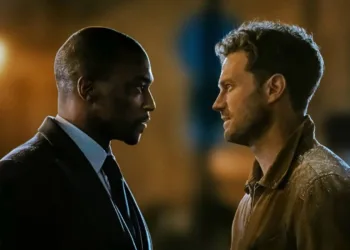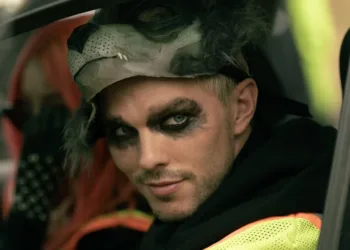






























Ryan’s crew films its bank robberies with the eventual edit in mind. Cameras capture the operation, then graphics, narration, and rapid cuts turn it into something ready for YouTube. Hugo, played by Rhenzy Feliz, assembles the footage; masked frontman Ryan, played by Nicholas Hoult, supplies the sales pitch. David Leitch’s How to Rob a Bank lets us watch criminals produce their own public image, choosing how their audience will understand an encounter before anyone else gets to explain it.
Listen to the difference between those videos and the scenes outside them. The online material arrives louder, crowded with emphatic effects and music, its saturated images decorated with animation and lettering. Ordinary life looks comparatively subdued. This separation gives the film two registers: the crew’s exuberant account of itself and the less inviting world its members inhabit. I enjoyed the confidence of that distinction. Leitch understands how a change in volume and visual density can make recorded events feel like an invitation to participate.
The trouble develops through repetition. The opening robbery, complete with its motorcycle escape, makes an energetic demonstration of the format. As that presentation becomes familiar, the graphics and explanations keep supplying stimulation without generating equal uncertainty. Suspense needs room for us to anticipate a choice or fear an interruption. These edited exploits often arrive with the crew already telling us how to appreciate them. Their control over the presentation makes them persuasive online personalities, but it can reduce the danger we feel while watching their crimes.
That tension gives the film a promising way to update a familiar genre. These Pittsburgh robbers want money, certainly, but Ryan also treats an audience as a resource. Their exploits become arguments addressed to people who feel excluded from the security previous generations were promised.
The camera is an instrument of recruitment. Hoult gives those masked addresses conviction, and the film catches something recognizable about watching an articulate stranger turn private frustration into a public identity. Its difficulties begin when screenwriter Mark Bianculli asks that identity to sustain an intimate drama.
Pete Davidson’s Vince provides the clearest glimpse of the life behind the performance. A veteran supporting a wife and young daughter, he has responsibilities that give the crew’s rhetoric a practical scale. Davidson works in a subdued register, allowing the family material to temper the swagger surrounding the robberies. His restraint is welcome in a film so busy announcing its energy. Those brief domestic passages offer a reason to care about what he might lose, even as the screenplay moves quickly back to the collective mission.

Ryan and his partner Emi, played by Anna Sawai, carry a heavier emotional burden with less preparation. Their shared history involves family loss and unaffordable medical care, information the film holds until relatively late. The disclosure makes their anger easier to understand. It also exposes how little time we have spent with them as a couple. Hoult has been given extensive opportunities to address strangers from behind a mask, while Sawai gets limited space to establish the private relationship that must support the revelation.
Delaying information can make earlier behavior acquire a new meaning. Here, it explains the intensity of Ryan’s commitment without filling in the relationship around it. We know why he is furious; we still have only a restricted sense of how he and Emi live with that fury together. The slower dramatic passages and plaintive Billie Eilish cues ask for an emotional investment the earlier material has scarcely cultivated. The music supplies immediate feeling, but the transition leaves the actors doing considerable work on behalf of experiences we have mostly been told about.
The investigation offers a different pairing with an easier rapport. FBI agent John West, played by John C. Reilly, recruits Reagan Gardner, a software specialist under house arrest, offering relief from her charges for help finding the crew. Reilly’s forcefulness and Zoë Kravitz’s deadpan delivery make their exchanges intermittently enjoyable. Their disagreement over authority gives the arrangement a useful complication: she can understand the robbers’ grievances while working for the institution pursuing them. The banter establishes that friction more readily than the plot tests what either person will do about it.
Reagan’s software contains a particularly useful idea. It locates people through online images, making visibility an investigative tool in a story whose criminals regard visibility as power. The same circulation that builds an audience can help authorities find the person addressing it. That connection could make the two halves of the movie feel tightly interdependent. Instead, Reagan spends stretches away from the action and never directly encounters Ryan. The technological link is present, but its human consequences remain frustratingly remote from the crew’s experience.
Leitch alternates between pursuers and pursued, a structure that usually lets knowledge acquired on one side change our expectations for the other. Here, the switching often feels like a move between adjacent movies. West and Reagan debate justice and order while Ryan’s crew supplies its own explanations elsewhere. There is pleasure in the casting, but the separation limits the pressure those competing perspectives exert on one another. A lively exchange between Reilly and Kravitz cannot by itself make the next robbery feel less secure.
The police-questioning sequence, with Young Mazino appearing as the crew’s lawyer, provides a welcome comic exception. It places the group’s performance inside an immediate confrontation with authority, giving the humor a situation to work through. The mid-film chase and later physical confrontations also provide stretches of direct action. Leitch does not need to fill every interval with a fight, but these passages make the surrounding reliance on explanatory speeches conspicuous. The characters become easier company when they have something immediate to handle.
The ending shifts toward the buoyancy of an elaborate heist fantasy, after the film has slowed down to disclose the pain beneath its rebellious surface. That tonal return is understandable: the crew’s confidence and ingenuity have supplied much of the entertainment. It is harder to accept the emotional timetable attached to it. Ryan and Emi’s history has only recently become clear, and the film’s return to criminal spectacle asks us to set their grief aside before we have had much opportunity to see them live with it.
How to Rob a Bank is scheduled for theatrical release across the United States on November 13, 2026, through Amazon MGM Studios, following its international debut in France on November 11, 2026, with a Prime Video streaming release to follow. Directed by David Leitch, the high-energy action heist comedy follows a crew of Pittsburgh bank robbers who livestream and post their daring heists on social media, inadvertently putting themselves in the crosshairs of a veteran FBI agent and a brilliant software engineer as they plan their biggest score yet.
Where to Watch How to Rob a Bank (2026) Online

Full Credits
Title: How to Rob a Bank
Distributor: Amazon MGM Studios, Sony Pictures Releasing International
Release date: November 11, 2026 (France), November 13, 2026 (United States)
Rating: R
Running time: 2 hours 2 minutes (122 minutes)
Director: David Leitch
Writers: Mark Bianculli
Producers and Executive Producers: Brian Grazer, Jeb Brody, Allan Mandelbaum, David Leitch, Kelly McCormick, Ben Ormand, Mark Bianculli
Cast: Nicholas Hoult, Zoë Kravitz, Anna Sawai, Rhenzy Feliz, Pete Davidson, John C. Reilly, Christian Slater, Tati Gabrielle
Director of Photography (Cinematographer): Jonathan Sela
Editors: Elísabet Ronaldsdóttir
Composer: Dominic Lewis
The Review
How to Rob a Bank
How to Rob a Bank gives the heist movie an appealing digital twist: its criminals edit their exploits into arguments for an audience. Leitch makes that presentation lively, and Davidson’s restraint offers welcome human scale. But repeated visual stimulation weakens suspense, the investigation feels detached, and late revelations ask us to care about relationships barely developed beforehand. There’s an entertaining crime movie here, struggling to support the emotional weight it eventually claims.
PROS
- Robbery videos make public image part of the action.
- Pete Davidson brings restraint to Vince’s family stakes.
- Reilly and Kravitz offer intermittently enjoyable rapport.
CONS
- Busy video presentation often crowds out suspense.
- Ryan and Emi’s relationship cannot support the late emotional demands.
- Investigation and robbery plots exert too little pressure on each other.