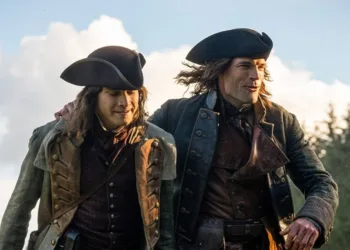































Benjamin Clem’s drumming has a job to do before it has an audience to impress. Military rhythms communicate charges and retreats, helping soldiers act together, and Drummer Boy gives that practical function an emotional stake. Benjamin, played by Lucas Leach, wears a leg brace and wants to serve with the Patriots.
Major Ambrose, played by Iain Glen, recognizes something useful in the young man whom others underestimate. His acceptance makes the instrument part of Benjamin’s struggle for recognition. Being needed means something different from being permitted to tag along.
When those martial rhythms develop into flashy, contemporary drumline passages, the film stretches its eighteenth-century setting without losing that connection to character. The pleasure comes from hearing Benjamin’s contribution become impossible to dismiss.
I like the confidence of these passages, which give a Revolutionary War drama permission to sound exuberantly modern. Directors Ben and Joel David Smallbone are less successful at sustaining that expressive range across the songs, but the percussion establishes a persuasive foundation for their musical experiment: sound can change someone’s place within a group.
Benjamin’s need to prove himself begins inside his family. During the Clems’ Atlantic crossing, a violent incident kills their father and leaves Benjamin with a lasting injury. The story then moves into adulthood, when he and his older brother Jeremiah operate a grain mill with their mother, Rachel. That childhood material gives their later disagreement a shared history. They have survived the same loss, yet Jeremiah understands responsibility as keeping the remaining family secure, while Benjamin wants to act on convictions his brother regards as dangerous.
Richard L. Ramsey’s screenplay makes the split intelligible through a business problem. Benjamin voices his support for colonial independence in front of customers, threatening the mill’s livelihood. Jeremiah joins the British Army to demonstrate the family’s loyalty; Benjamin enlists with the Patriots after Jeremiah cruelly questions his potential as a soldier.
Political allegiance grows out of economic pressure and wounded affection. Jeremiah’s protective instinct can excuse submission, and Benjamin’s idealism carries a personal appetite for vindication. Neither brother arrives at his uniform through an entirely disinterested argument.
Joel David Smallbone gives Jeremiah the intensity of someone who believes he has accepted an unpleasant duty for everyone else’s benefit. The enlistment decision makes that self-image understandable without settling the wisdom of his choice. Leach supplies a useful counterweight, allowing Benjamin’s anger and insecurity to coexist with his convictions.
Their separation follows a familiar dramatic route, but the motives keep it from feeling like a diagram of opposing armies. Glen’s compassionate authority as Ambrose also offers Benjamin an alternative to Jeremiah’s judgment, with recognition attached to something he can actually contribute.

A quieter piece of storytelling begins when the young Jeremiah teaches Emmaline to read. Years later, that childhood connection becomes the basis of the film’s romantic misdirection. Jeremiah courts Lady Elizabeth Balfour, played by Beth Easdown, and sends her letters.
Elizabeth has little interest in answering. Emmaline, the young woman enslaved by Elizabeth’s father, secretly writes back, signing herself “E.” Jeremiah becomes attached to a correspondence whose author he misunderstands. The early reading lessons have prepared an adult action, giving the passage of time a consequence beyond changing the actors’ ages.
This is dramatic irony: the audience understands something a character does not. Here, it makes Jeremiah’s romantic confidence uncomfortable. He can respond to Emmaline’s words while assigning their feeling and intelligence to Elizabeth.
India Brown gives the longing in this relationship an appealing directness, particularly when the music allows emotion to escape the restrictions governing ordinary conversation. The letters keep Emmaline active within the romance, even as their false attribution denies her recognition. Her ability to reach Jeremiah depends on his believing that someone else is speaking.
The device also gives the film’s language of liberty a necessary complication. The brothers can choose sides, however compromised those choices become. Emmaline remains enslaved by Lord Balfour, who is also Jeremiah’s commanding officer. Her situation cannot be resolved by identifying the correct flag or letting go of resentment.
The romance supplies a personal way into that inequality, though its concealed authorship deserves fuller development than the crowded wartime narrative consistently allows. Brown makes the emotional connection credible; the screenplay has less room to explore all that recognizing her would demand of Jeremiah.
The songs face a related problem of space and development. A musical number can suspend outward action while revealing a feeling that dialogue keeps contained. It still needs to leave us somewhere emotionally distinct. “Same Blood” suits the emphasis on family bonds surviving division, and the romantic numbers give Brown and Smallbone room to express yearning. Across the soundtrack, however, the repeated swooning ballad register begins to flatten differences between emotional situations. The singing remains committed, but longing, hurt, and reconciliation too often arrive with a similar musical temperature.
Benjamin’s percussion makes that sameness easier to hear because it introduces a different kind of energy, with a clear physical purpose. The issue is not the use of contemporary music in period costume. It is the limited variety within a score asked to carry several relationships and competing ideas. At 129 minutes, the film spends substantial time expressing feelings while some of the relationships generating them still need attention. The brothers’ conflict has a strong chain of choices behind it; the romance must compete with two military paths, childhood grief, and the growing demand for a shared emotional payoff.
A familiar carol used during a late Christmas battlefield sequence gives the musical form a sharper purpose again. Its associations bring tenderness into a setting organized around obedience and violence, and the film draws considerable feeling from that collision. The appeal to forgiveness is openly insistent, yet the battlefield gives it resistance that the ballads sometimes lack. These characters have been learning to take their places within opposing forces. Asking them to hear an appeal for reconciliation there makes listening itself a difficult act, with military duty still pressing upon them.
Drummer Boy released in theaters nationwide via Lionsgate on October 30, 2026. Directed by Jon Erwin and James Wan, the inspirational musical drama follows a troubled young street musician who finds redemption and a second chance at life after joining an unconventional youth choir led by a passionate veteran conductor.
Where to Watch Drummer Boy (2026) Online
Full Credits
Title: Drummer Boy
Distributor: Lionsgate
Release date: October 30, 2026
Rating: PG-13
Running time: 1 hour 45 minutes (105 minutes)
Director: Jon Erwin, James Wan
Writers: Jon Erwin, Dallas Jenkins
Producers and Executive Producers: Jon Erwin, Andrew Gunn, Kevin Downes, Tony Young
Cast: Nicolas Cage, Russell Crowe, J.K. Simmons, Luke Wilson, Kelsey Grammer, Zachary Levi, Aaron Eckhart, Djimon Hounsou
Director of Photography (Cinematographer): Shelly Johnson
Editors: Andrew S. Eisen
Composer: Lorne Balfe
The Review
Drummer Boy
Drummer Boy finds its strongest musical storytelling in Benjamin’s percussion, where rhythm gives a young soldier a place among people who underestimate him. The brothers’ divided loyalties and Emmaline’s concealed correspondence give the drama substance, with India Brown bringing warmth to the romance. Repetitive ballads and crowded plotting leave some relationships needing further attention, but the late battlefield carol makes the appeal for forgiveness moving without making it feel easy.
PROS
- Percussion connects musical energy to Benjamin’s character.
- The brothers’ opposing choices have credible personal motives.
- India Brown gives the romance emotional directness.
- The battlefield carol gives reconciliation dramatic weight.
CONS
- Ballads offer limited emotional and musical variety.
- The romance needs fuller development.
- Competing storylines strain the film’s dramatic balance.