






















• Latest
  • Trending
The Fissure Review

The Fissure Review: Branching Paths Through a Troubled Past

Brotherhood: A Cinematic Musical Review

Brotherhood: A Cinematic Musical Review: Compassion Cannot Carry Every Chorus

The Florist Review

The Florist Review: Dennis Quaid Deserves a Better Thriller

The Sixty-Year Mission Review

The Sixty-Year Mission Review: The Enterprise Returns to Its Political Roots

Grandmasters Review

Grandmasters Review: Magnus Carlsen Challenges the Chess Establishment

Avatar Legends: The Fighting Game Review

Avatar Legends: The Fighting Game Review: Exceptional Combat Meets Frustrating Limitations

Long Long Night Review

Long Long Night Review: The Tenderness and Tragedy of an Unlikely Family

Etched in Pavement Review

Etched in Pavement Review: Fighting for a Future Beyond the Streets

Situations Review

Situations Review: Greg Vrotsos Finds Comedy in Emotional Cowardice

Four Seasons in Java Review

Four Seasons in Java Review: Progress Arrives, Justice Remains Missing

Nocturne Review

Nocturne Review: Rhythm Combat Has Rarely Felt This Inventive

The Squirrel Review

The Squirrel Review: When a Little Rodent Disrupts a Perfect Society

The Hunting Wives Season 2 Review

The Hunting Wives Season 2 Review: Sophie and Margo Are Still Deliciously Dangerous

  • Home
  • Privacy Policy
  • Terms and Conditions
  • Gazettely Review Guidelines
Thursday, November 26, 2026
GAZETTELY
  • Home
  • Movie and TV News
    Adam Sandler

    Adam Sandler Congratulates Ezra Frech After “Dancing With the Stars” Win

    Amanda Seyfried 1

    Amanda Seyfried Admits She “Told a Lot of People” About Her Secret Holmes Doc Role

    Brad Pitt and Angelina Jolie

    Brad Pitt and Angelina Jolie Settle Château Miraval Dispute After Four Years

    Twilight

    “Twilight” Director on Pattinson’s Bond Casting: “I Almost Fell Out of My Bed”

    Dancing With the Stars

    “Dancing With the Stars” Finale Draws 9.2 Million as Ezra Frech Takes the Trophy

    The Hawk

    Netflix Cancels Will Ferrell’s Golf Comedy “The Hawk” After One Season

    Focker-In-Law

    Ariana Grande Enters the Circle of Trust as “Focker-In-Law” Opens for Thanksgiving

    Oobah Scams for a Better Tomorrow

    HBO Gives Hoaxer Oobah Butler a Series to Con Wine, Wellness and Royalty

    Amy Poehler

    Amy Poehler Returns to TV Lead Role in Peacock’s Archaeology Comedy “Dig”

  • Movie and TV Reviews
    Brotherhood: A Cinematic Musical Review

    Brotherhood: A Cinematic Musical Review: Compassion Cannot Carry Every Chorus

    The Florist Review

    The Florist Review: Dennis Quaid Deserves a Better Thriller

    The Sixty-Year Mission Review

    The Sixty-Year Mission Review: The Enterprise Returns to Its Political Roots

    Grandmasters Review

    Grandmasters Review: Magnus Carlsen Challenges the Chess Establishment

    Long Long Night Review

    Long Long Night Review: The Tenderness and Tragedy of an Unlikely Family

    Etched in Pavement Review

    Etched in Pavement Review: Fighting for a Future Beyond the Streets

    Situations Review

    Situations Review: Greg Vrotsos Finds Comedy in Emotional Cowardice

    Four Seasons in Java Review

    Four Seasons in Java Review: Progress Arrives, Justice Remains Missing

    The Squirrel Review

    The Squirrel Review: When a Little Rodent Disrupts a Perfect Society

  • Game Reviews
    The Fissure Review

    The Fissure Review: Branching Paths Through a Troubled Past

    Avatar Legends: The Fighting Game Review

    Avatar Legends: The Fighting Game Review: Exceptional Combat Meets Frustrating Limitations

    Nocturne Review

    Nocturne Review: Rhythm Combat Has Rarely Felt This Inventive

    Soccer Kid Collection Review

    Soccer Kid Collection Review: A Forgotten Platformer Worth Remembering

    The Gate Must Stand Review

    The Gate Must Stand Review: Building Defenses Is the Easy Part

    Nomori Review

    Nomori Review: Thinking With Portals Gets Complicated

    Hell Let Loose: Vietnam Review

    Hell Let Loose: Vietnam Review: Two Armies, Two Ways to Fight

    Denshattack! Review

    Denshattack! Review: Reinventing the Art of the Perfect Combo

    Road to Empress II Review

    Road to Empress II Review: The Illusion of Political Freedom

  • The Bests
No Result
View All Result
GAZETTELY
No Result
View All Result
The Fissure Review

Brotherhood: A Cinematic Musical Review: Compassion Cannot Carry Every Chorus

Home Games Reviews Games

The Fissure Review: Branching Paths Through a Troubled Past

Enzo Barese by Enzo Barese
14 seconds ago
in Games, Nintendo, PC Games, PlayStation, Reviews Games, Xbox
Reading Time: 5 mins read
A A
0
Share on FacebookShare on TwitterShare on PinterestShare on WhatsAppShare on TelegramSummarize with ChatGPTSummarize with Perplexity

A wall clock displays an hour that contradicts the accompanying narration, and its illustrated design seems incapable of producing the sound the text describes. Such a discrepancy might pass unnoticed in a conventional novel, where readers construct the room from words alone.

In a visual novel, the illustration shares responsibility for establishing reality. The Fissure, developed by Argentina’s SMV Games, adopts a storytelling form refined through decades of Japanese gaming, yet occasionally forgets how closely its pictures and prose must cooperate. The problem becomes especially awkward in a psychological mystery that asks players to question the reliability of everything they encounter.

The setting has considerable promise. Nahuel arrives in San Adraín, the secluded village where his late mother once lived, believing himself a stranger to its cobbled streets and old family home. Yet the smell of burning firewood stirs an inexplicable familiarity, and certain residents address him as someone they have known for years. Others seem disturbed by his presence.

The premise recalls the European Gothic tradition, where inherited property frequently carries obligations and secrets that survive their original owners. Here, however, the ancestral house belongs to a digital narrative whose possibilities extend across several branching routes. How can a community remember someone who cannot remember belonging to it?

The atmosphere established through these encounters is convincing enough to make the central puzzle worth pursuing. Unfortunately, the execution rarely matches the strength of the premise. The Fissure is an uneven visual novel whose occasionally effective writing and worthwhile narrative choices are undermined by inconsistent artwork and intrusive music. I would recommend it cautiously to enthusiasts of compact psychological mysteries, particularly those comfortable with traditional visual-novel conventions. Anyone expecting polished audiovisual storytelling will find its shortcomings difficult to overlook.

Those conventions deserve consideration because the game’s Argentine origins make its relationship with Japanese interactive fiction especially interesting. The visual novel has travelled far beyond the country where it acquired its recognizable modern form, becoming a practical medium for independent developers working with modest resources. SMV Games employs its familiar arrangement of illustrated scenes, extensive dialogue, and decisions that direct the narrative toward different outcomes.

Players accustomed to Western adventure games may find the limited interaction restrictive, but Japanese visual novels have long demonstrated that meaningful participation can emerge from choosing a narrative direction rather than physically manipulating the environment. Judged within that tradition, The Fissure has a reasonably functional structure.
The Fissure Review

Decisions lead toward three principal outcomes, classified as bad, neutral, and good endings. Discovering Nahuel’s past means revisiting choices and following paths left unexplored. As Nahuel struggles to recognize his surroundings, the reader gradually gains the information necessary to interpret them. Each return to San Adraín carries memories of previous possibilities, even though the character’s circumstances begin again.

There is no system that preserves discoveries between playthroughs or changes the narrative according to previously completed routes. The player supplies that continuity mentally. This limits the mechanical ambition, although the endings provide an incentive to continue reading.

Skipping familiar dialogue makes subsequent attempts manageable, and the gallery of unlocked illustrations identifies material still unseen. Accessing the text log, however, requires movement through several menus when reviewing an earlier statement should be straightforward. In a mystery where small pieces of information matter, that inconvenience carries greater weight than it would in a linear adventure.

Japanese psychological horror offers a revealing comparison. Works such as Higurashi When They Cry demonstrate how repeated encounters with a seemingly familiar rural community transform recognition into suspicion. The Fissure approaches similar territory through its villagers’ treatment of Nahuel, but its straightforward branching lacks that tradition’s intricate accumulation of revelations. Its strongest descriptions capture San Adraín’s oppressive stillness, although verbose passages sometimes diminish the tension.

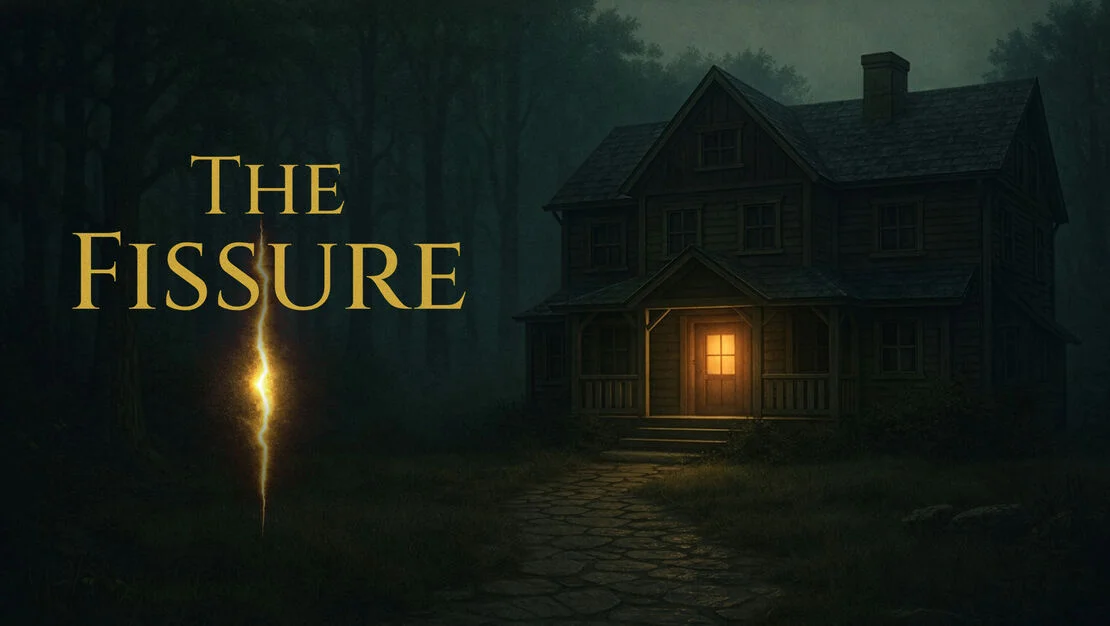
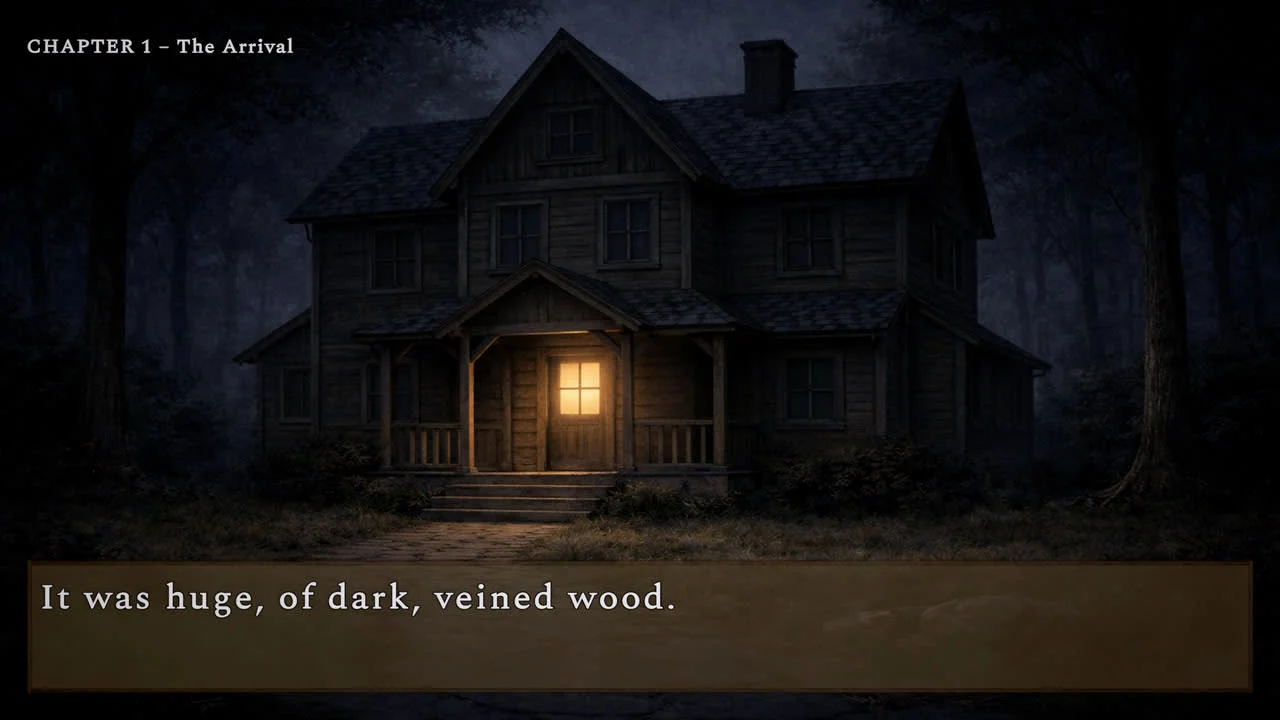
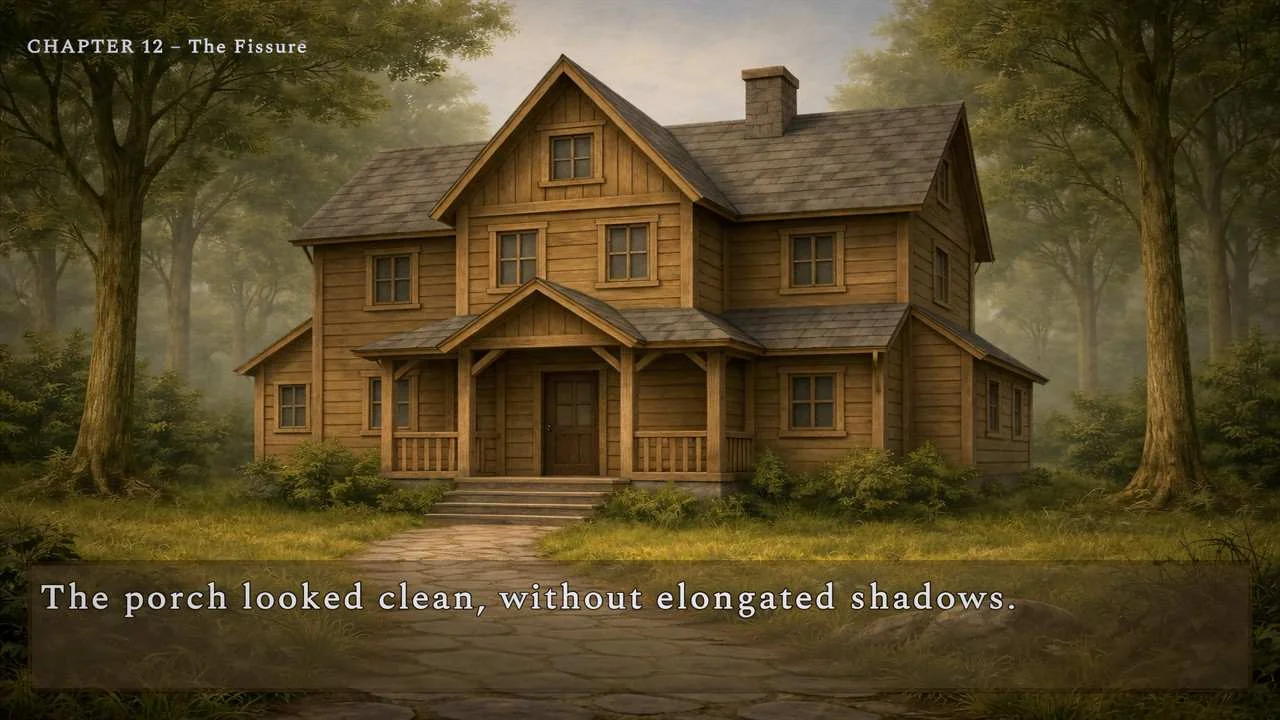
The illustrations create a greater difficulty. The game’s relatively realistic aesthetic occasionally gives deserted streets and isolated surroundings an appropriately desolate appearance. Yet other passages unfold against sparse backgrounds offering little visual reinforcement.

Perspective problems and meaningless background lettering diminish the impression of a coherent physical setting. Most damaging are contradictions between illustrations and narration. A character described with his hands inside his pockets appears with them plainly visible. The wall clock contradicts both the stated hour and the action attributed to it.

These errors matter because the story encourages readers to examine ordinary details for evidence of something concealed. A strange object or contradictory recollection could suggest Nahuel’s perception is unreliable. When visual inconsistencies recur without an apparent narrative purpose, however, the reader loses confidence in the presentation itself. Uncertainty becomes interesting when its causes can eventually be understood. Here, some of that uncertainty appears to originate in inadequate coordination between the written and visual elements.

Realism compounds the problem: unlike stylized illustrations familiar from Japanese visual novels, a naturalistic image invites closer examination of physical details. Their artificiality occasionally resembles the uncanniness that psychological horror seeks to create, but the disconnected descriptions provide little reason to interpret these mistakes as deliberate.

Music presents a similar conflict between genre traditions and their application. Japanese psychological horror has often exploited the uneasy relationship between silence, ambient noise, and sudden musical emphasis. The Fissure favors persistent low drones that gradually intensify even when the accompanying text contains little immediate danger. Nahuel’s circumstances suggest a threat he cannot properly identify, and sustained musical tension could express that anxiety. Unfortunately, the soundtrack repeatedly announces unease before the narrative provides sufficient grounds for it.
The Fissure Review

The early droning compositions become exhausting because their emotional intensity changes so little. Later orchestral passages introduce welcome variation, yet they cannot entirely repair the impression of an atmosphere being imposed upon the material. With no voice acting and limited sound effects, music assumes substantial responsibility for regulating tension. Its insistence makes the measured prose feel slower, especially during passages devoted to establishing information rather than revealing danger. Reading without the musical accompaniment becomes an appealing alternative.

For an Argentine studio, releasing a visual novel across international console platforms offers access to readers whose familiarity with the form varies considerably. The Fissure supports English, Spanish, French, German, and Portuguese, extending access to its text-heavy mystery. Its modest $4.99 price and PlayStation Cross-Buy arrangement reduce the commitment required to try it. Yet accessibility cannot resolve the differences in what those audiences expect from play.

Someone accustomed to Japanese visual novels may accept the static illustrations and minimal mechanical involvement as familiar elements, concentrating instead on the quality of the branching narrative. Someone approaching the game through Western investigative adventures may expect greater freedom to examine San Adraín and interact with its inhabitants. Each perspective exposes a different limitation: the former places pressure on the uneven prose and imagery; the latter on the narrow range of actions. Neither reading can excuse a clock that contradicts the narrative or music that strains to manufacture tension during ordinary exposition.

The mystery remains accessible, and its multiple outcomes give readers reasons to reconsider earlier decisions. Exploring every route can extend a brief experience considerably, particularly for those determined to unlock the entire gallery. But after the major possibilities have been explored, the gallery becomes a checklist for missing scenes, sending the player back through familiar dialogue to fill its remaining spaces.

The Review

The Fissure

6 Score

The Fissure brings an Argentine perspective to Japanese visual-novel conventions, building a promising psychological mystery around fractured memories and a village that knows its visitor too well. Its branching endings reward curiosity, but inconsistent illustrations, overwrought music, and occasionally cumbersome writing undermine the atmosphere. The mystery remains worth exploring for patient genre enthusiasts, especially at its modest price. Unfortunately, the presentation frequently betrays the story's ambitions, leaving an experience whose international influences are considerably stronger than their execution.

PROS

  • Intriguing psychological mystery
  • Meaningful branching endings
  • Effective atmosphere in selected scenes
  • Accessible price and multilingual support

CONS

  • Illustrations frequently contradict the text
  • Intrusive and repetitive soundtrack
  • Occasionally verbose writing
  • Cumbersome text-log navigation

Review Breakdown

  • Overall 0
Tags: EastAsiaSoftFeaturedNintendoSingle SystemSMV GamesThe Fissure
Previous Post

Brotherhood: A Cinematic Musical Review: Compassion Cannot Carry Every Chorus

0 0 votes
Article Rating
Subscribe
Login
Notify of
guest
guest
0 Comments
Oldest
Newest Most Voted

This Week's Top Reads

  • Is This Seat Taken? Review

    Is This Seat Taken? Review: A Satisfying Mental Workout

    1462 shares
    Share 0 Tweet 0
  • Paapa Essiedu Defends Snape Casting: “A Lot of Feelings” Over Harry Potter

    0 shares
    Share 0 Tweet 0
  • Blade Runner 2099 Review: Beautiful Dystopia, Unfulfilled Ambition

    1 shares
    Share 0 Tweet 0
  • Dig Review: A Greek Setting With Too Little Interest in Greece

    0 shares
    Share 0 Tweet 0
  • Melania: The Series Review: A Documentary That Goes Nowhere

    0 shares
    Share 0 Tweet 0
  • Trust Review: Squandered Potential and an Incoherent Plot

    6 shares
    Share 0 Tweet 0
  • The Law of Beasts Review: Two Friends and the Cost of a Promised Outcome

    0 shares
    Share 0 Tweet 0

Must Read Articles

The Hunting Wives Season 2 Review
TV Shows

The Hunting Wives Season 2 Review: Sophie and Margo Are Still Deliciously Dangerous

7 hours ago
Hexed Review
Movies

Hexed Review: Disney’s Witches Have a Motherhood Problem

1 day ago
A living room TV showing an 18 rating badge, with a hand hovering over the remote's pause button.
Movies

Movies to Keep Off Family Night: 16 Films With Taboo Themes, Sorted by How Hard They Hit

by Arash Nahandian
2 days ago
Focker In-Law Review
Movies

Focker In-Law Review: The Exhaustion of Familiar Family Rituals

2 days ago
Way of the Warrior Kid Review
Movies

Way of the Warrior Kid Review: Jude Hill Gives a Familiar Formula Its Fighting Spirit

3 days ago

Gazettely is your go-to destination for all things gaming, movies, and TV. With fresh reviews, trending articles, and editor picks, we help you stay informed and entertained.

© 2021-2026 All Rights Reserved for Gazettely

What’s Inside

  • Movie & TV Reviews
  • Game Reviews
  • Featured Articles
  • Latest News
  • Editorial Picks

Quick Links

  • Home
  • About US
  • Contact Us
  • Advertise with Us
  • Review Guidelines

Follow Us

Facebook X-twitter Youtube Instagram
No Result
View All Result
  • Gazettely | Movie, TV & Game Reviews, News, and Rankings
  • Movies
  • Entertainment News
  • Movie and TV Reviews
  • TV Shows
  • Game News
  • Game Reviews
  • Contact Us

© 2024 All Rights Reserved for Gazettely

wpDiscuz
0
0
Would love your thoughts, please comment.x