




























Theatrhythm: Final Bar Line gives rhythm battles an RPG framework, while Guitar Hero lets the note chart remain the main event. Nocturne sits between those traditions, though it leans decisively toward the second. Its four-lane battles demand musical accuracy, its equipment adds a little room for strategy, and its original story gives each new location a reason to exist. Pracy Studios has made an absorbing, inventive adventure, and one I would readily recommend to rhythm-game fans. Players expecting the depth of a conventional JRPG should adjust their expectations before entering Maya.
Maya is supposed to be paradise, a digital afterlife where human consciousness can continue after death. Karma arrives hoping to meet their brother Spencer, who was uploaded years earlier, only to find a world cut off from the living for roughly a thousand years.
The sun has vanished, creatures called Crawlers roam the ruins, and corruption is spreading through the system. The Welcome Centre still treats Karma like a customer, even issuing a temporary access pass while billing details are sorted out. It’s an amusing introduction to a place whose promise of eternity has survived rather better than its infrastructure.
The personal search becomes considerably richer once Karma meets Kimothy, a restless boy who initially challenges the newcomer over a soda. That encounter doubles as a combat lesson, but it also establishes how naturally the game can connect its mechanics to its characters. Kimothy has spent so long in Maya that he barely remembers life outside it, and his parents were never uploaded. His curiosity and occasional troublemaking keep the relationship lively, while his circumstances give the story’s questions about permanent existence a painful, specific shape.
There is a wider conflict behind Spencer’s disappearance. Karma discovers an ability to cleanse corrupted code, and the search gradually draws them into disputes among Maya’s administrators about the system’s future. Supporting characters have histories of their own, including Satoru, an elderly fish dressed as a monk whose past connects him to the administration.
The eight-chapter story develops these threads efficiently for much of its roughly ten-hour length. Its later chapters shift heavily toward revelations, though the ending moves so quickly that the aftermath receives less attention than these characters deserve.
The 2020 prologue, Nocturne: Prelude, belongs to an earlier stage of the game’s lengthy development. In the finished version, the design confidently gives rhythm priority over elaborate party management. If you’re coming from Theatrhythm expecting that familiar degree of RPG customization, you may find Maya’s progression systems rather thin.
Combat initially looks straightforward. Notes descend along up to four lanes, each linked to a controller button, and successful presses or holds charge a meter with three segments. Karma spends that energy on attacks, ideally when an enemy is preparing a move, since well-timed strikes can deal critical damage and interrupt the threat.
Missed notes temporarily stop the meter from filling, and red mine notes must be left alone. There is a satisfying tension between watching the incoming pattern and deciding when to spend energy. Yet the rhythm performance carries most of the burden: a player who reliably hits notes can get through much of the game without making especially sophisticated tactical choices.
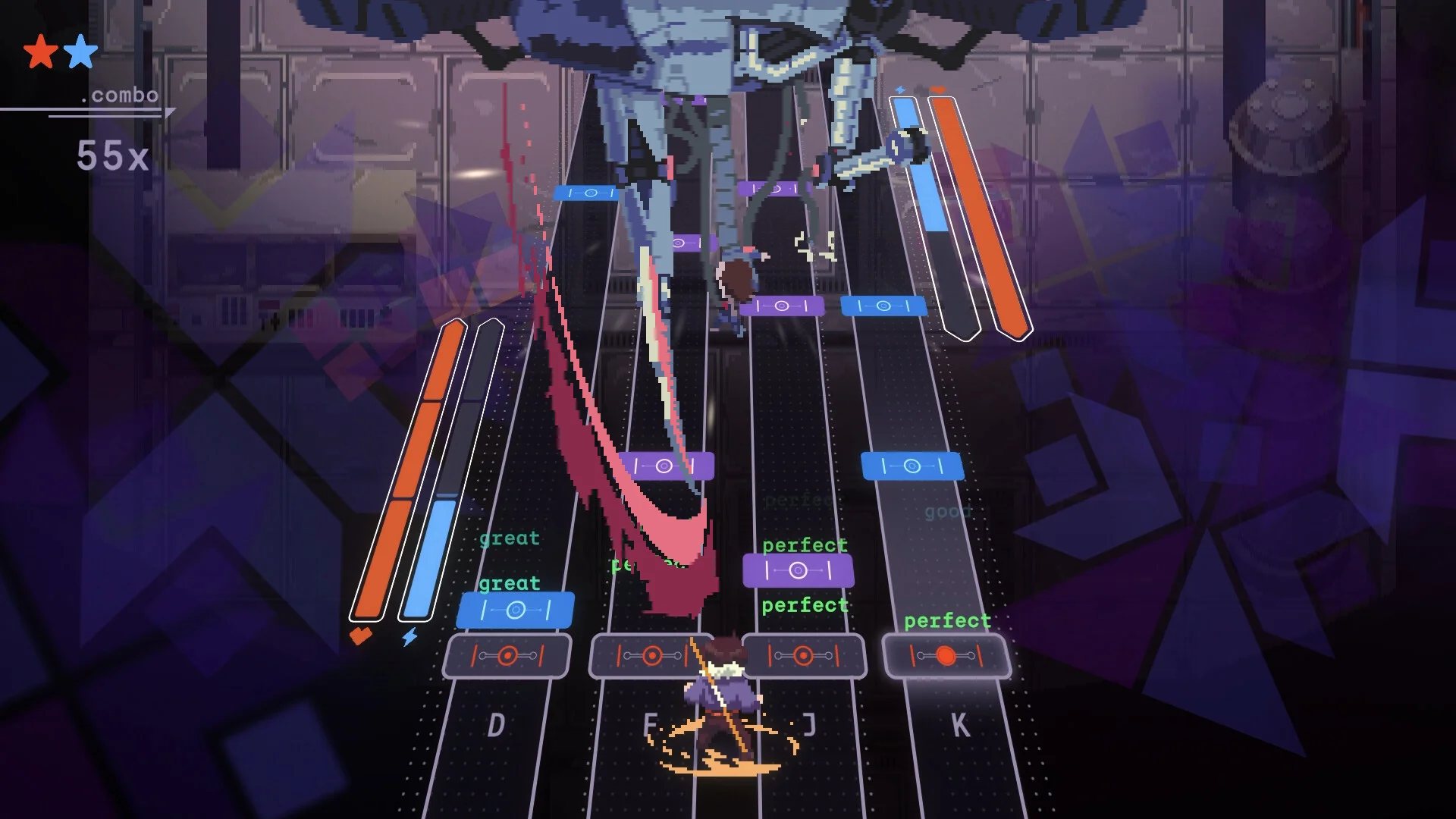
The more interesting decisions come from the opposition. Some Crawlers shorten the visible lanes, others cover parts of the chart or inflict corruption that reduces available health. Bosses pull the interface apart, split the lanes, or send missiles toward them that require precisely timed responses. One major encounter even expands to five lanes. These disruptions change how players read an otherwise familiar display, so learning a new enemy means learning a new way to watch the music.
Corruption-cleansing challenges are particularly good at finding fresh uses for the same controls. Their lanes bend, rotate, disappear, and move across the screen, turning short stretches of exploration into concentrated timing tests. They rarely linger long enough to become repetitive.
Ordinary battles aren’t always so considerate. Reducing an enemy’s health to zero merely staggers it, and the encounter continues until the song ends. The extra breathing room can help Karma recover, but it feels excessive when facing an opponent you’ve already defeated several times.
Music is the reason that repetition remains tolerable for so long. Nocturne has around 101 tracks, moving from chiptune-flavored town and combat music through rock and electronic pieces to sweeping orchestral boss themes performed with the Slovak National Symphony Orchestra.
Those larger arrangements give major fights a different scale, and the varied enemy tracks make new encounters worth hearing. The pixel art supports that range: Maya’s natural areas can be gentle and inviting, then turn harsher as corruption takes hold. Combat animations add character without burying the note prompts under visual clutter.
The game is also unusually considerate about skill differences. Six difficulty settings alter note density and speed, individual lanes can be automated, and controller bindings can be changed. That flexibility matters in a game that occasionally asks players to monitor both complicated charts and an enemy’s pending attack. Completed encounters can be replayed in arcade mode, giving experienced players a reason to chase better performances and newcomers a place to practice. If four simultaneous lanes sound intimidating, there are practical ways to reduce the pressure without abandoning the story.
Equipment offers some variation, although it never reaches the complexity associated with traditional RPG progression. Items from chests and enemies can increase damage, aid regeneration, or extend the time foes remain staggered. Certain pieces introduce specialized effects, including a staff connected to timed ripostes. Unfortunately, concepts such as blocking and armor are not always explained well enough to show how those options interact. Finding a new piece of gear can be rewarding, but the scope for experimentation is narrower than the variety of item descriptions initially suggests.
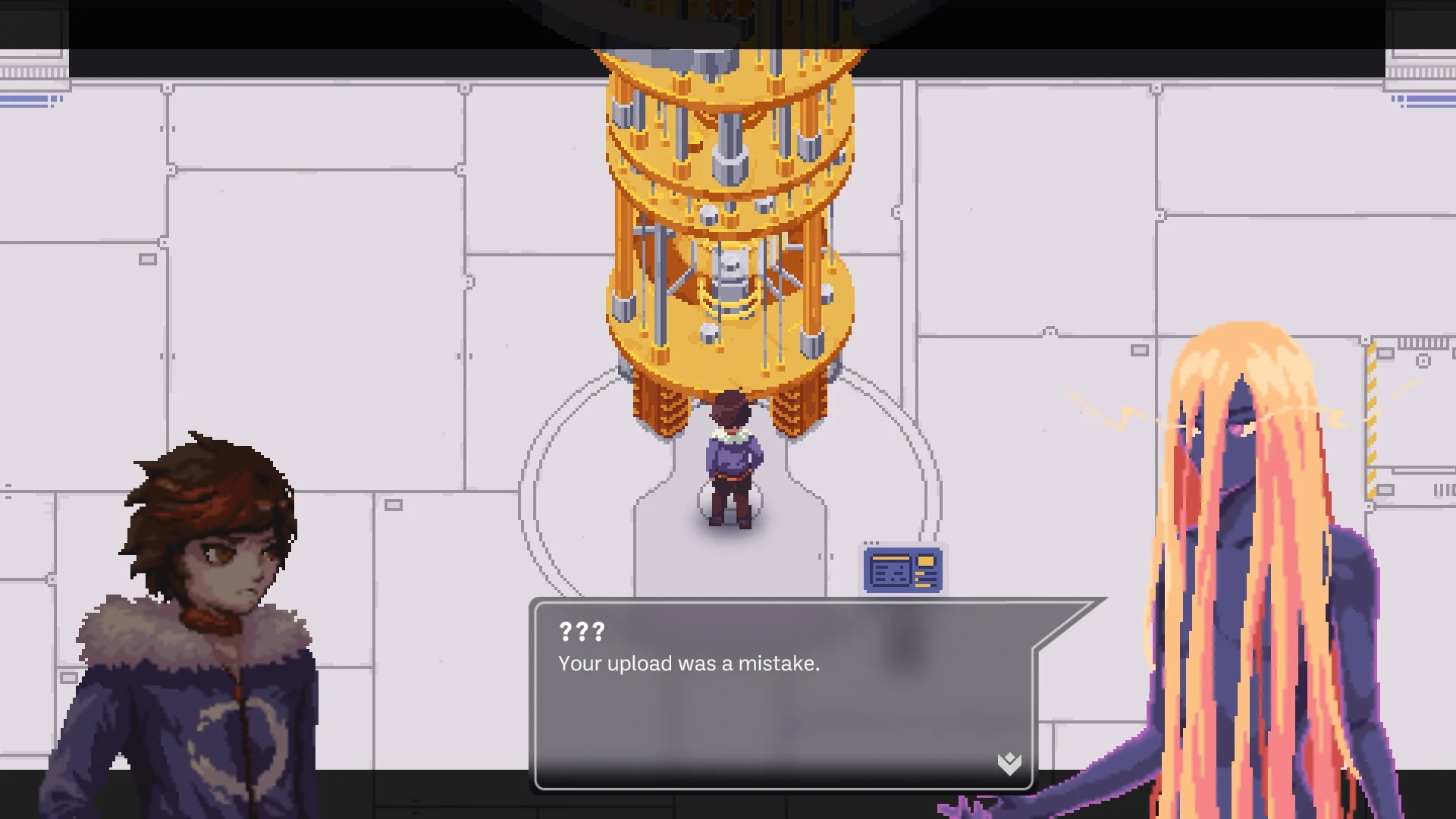
Maya’s biggest problem emerges outside combat. There is no map, minimap, or fast-travel network, even though the story asks Karma to revisit areas and search out hidden equipment. Running is slow, objective hints can be vague, and save points offer no shortcut between previously visited places.
Enemies can notice movement or sound, so careful walking sometimes helps, but pursuing Crawlers can outrun Karma. Once one catches you, there is no escape command. A return trip through an old corridor can therefore become a sequence of full-length musical battles against enemies whose patterns you already know.
That friction is particularly unfortunate because exploration has genuine rewards. The forest in Chapter 3 and the island in Chapter 7 demonstrate how well the pixel art distinguishes Maya’s spaces, and the tucked-away chests encourage a closer look. Yet the absence of dependable navigation makes those spaces harder to appreciate on a second visit.
As the story approaches its more dramatic final chapters, an unnecessary encounter or an uncertain route can interrupt the momentum established by Karma and Kimothy’s growing understanding of the world. Even then, the relationship between the missing brother, the failing afterlife, and the inhabitants trying to survive gives the player a reason to push through the next stretch of backtracking.
The Review
Nocturne
Nocturne finds a rewarding middle ground between Guitar Hero's demanding note charts and Theatrhythm's RPG framework, giving its musical combat an engaging story to support it. Inventive boss encounters, an exceptional soundtrack, and Karma's growing friendship with Kimothy make this ten-hour adventure easy to recommend. Its limited RPG depth, frustrating navigation, and repeated encounters occasionally interrupt the enjoyment, particularly during backtracking. Pracy Studios has created an excellent rhythm-driven adventure whose creativity and emotional storytelling outweigh its rough edges.
PROS
- Excellent, varied soundtrack
- Inventive rhythm combat and boss encounters
- Engaging story with memorable characters
- Flexible difficulty and accessibility options
- Beautiful, expressive pixel art
CONS
- No map or fast travel
- Repeated battles slow exploration
- Limited RPG progression and poorly explained mechanics
- Rushed final chapters