
























Select an exit from a North Vietnamese tunnel network and the screen cuts to a first-person sequence of a soldier crawling underground. It is a modest piece of animation, yet it signals an important change in the military philosophy inherited from the original Hell Let Loose. A series accustomed to interpreting warfare through the European campaigns of the Second World War must now accommodate an army for whom the territory itself represents a strategic resource. The British studio Expression Games understands that transferring its tactical shooter to Southeast Asia requires reconsidering how soldiers occupy and move through space.
Hell Let Loose: Vietnam retains the hundred-player battles, military hierarchy and emphasis on collective action of its predecessor. Fifty American soldiers face fifty members of the North Vietnamese Army across enormous maps. Infantry, armored vehicles, reconnaissance units and transport crews operate within a structure that privileges organization over individual marksmanship. The historical setting introduces a fascinating complication: two armies with substantially different military resources must compete within a system designed to produce reasonably balanced encounters.
The adaptation succeeds often enough to earn a recommendation for dedicated tactical shooter enthusiasts. Its environmental design is excellent, its battles can develop extraordinary strategic complexity, and its treatment of military cooperation remains distinctive. Players accustomed to the accessibility of mainstream shooters should approach with caution, particularly given the technical problems that regularly interrupt combat and the considerable patience required to find a competent squad.
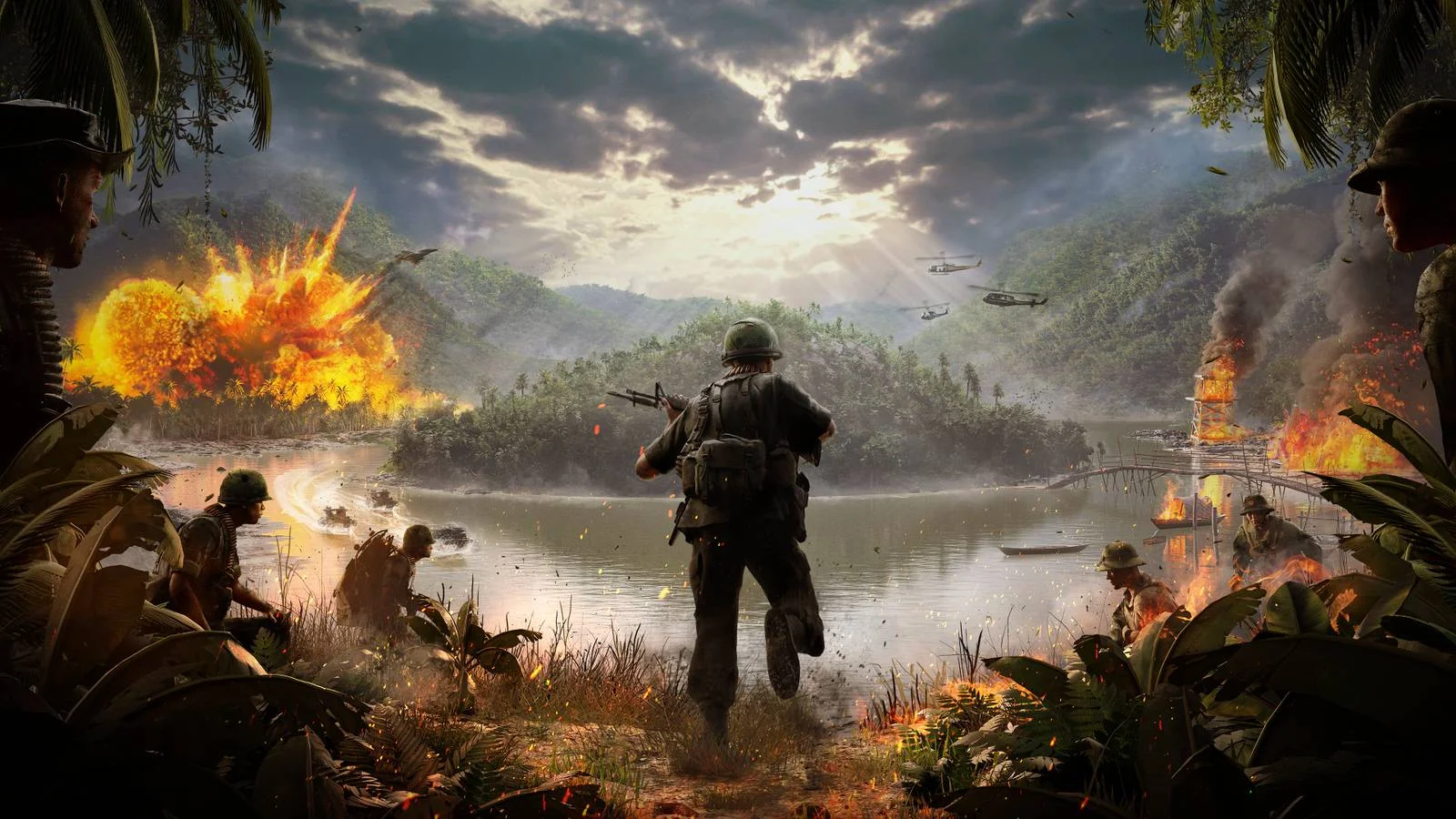
American cinema has given international audiences a remarkably persistent visual vocabulary for the Vietnam War. The helicopter formations of Apocalypse Now belong to that vocabulary, their presence inseparable from the film’s treatment of American military power. Expression Games gives the helicopter a practical function within that familiar image. Transporting soldiers and supplies becomes an essential logistical operation, and a successful insertion can change the direction of an entire battle. The aircraft’s vulnerability to enemy fire introduces considerably different calculations for the people aboard.
The North Vietnamese tunnel system offers an effective counterpoint. Connected underground positions allow soldiers to relocate across territory without exposing themselves to the dangers associated with aerial transport. The strongest expressions of faction identity occur through these contrasting methods of movement. Individual infantry engagements are considerably less differentiated, and the familiar squad structure sometimes makes the opposing armies feel too similar. Expression could have carried its historical distinctions further into ordinary infantry play.
The six maps are perhaps the game’s greatest accomplishment. Thanh Hóa Bridge combines exposed riverbanks with concentrated fighting across a railway bridge, creating encounters that demand different approaches within a relatively small portion of the battlefield. Huế Outskirts uses mountainous terrain and industrial installations to give elevation considerable tactical importance. Both locations offer welcome departures from the assumption that a Vietnam War game must spend its entire duration beneath a jungle canopy.
There is an interesting comparison here with Full Metal Jacket. Stanley Kubrick’s movement from American military training facilities to the devastated urban spaces of Vietnam challenges the familiar cinematic association between this conflict and tropical wilderness. Expression achieves something comparable through geography. Fighting around warehouses, railway lines and cargo containers changes the player’s relationship with cover, distance and enemy visibility. These encounters can produce particularly satisfying firefights because opponents become easier to locate and engage.
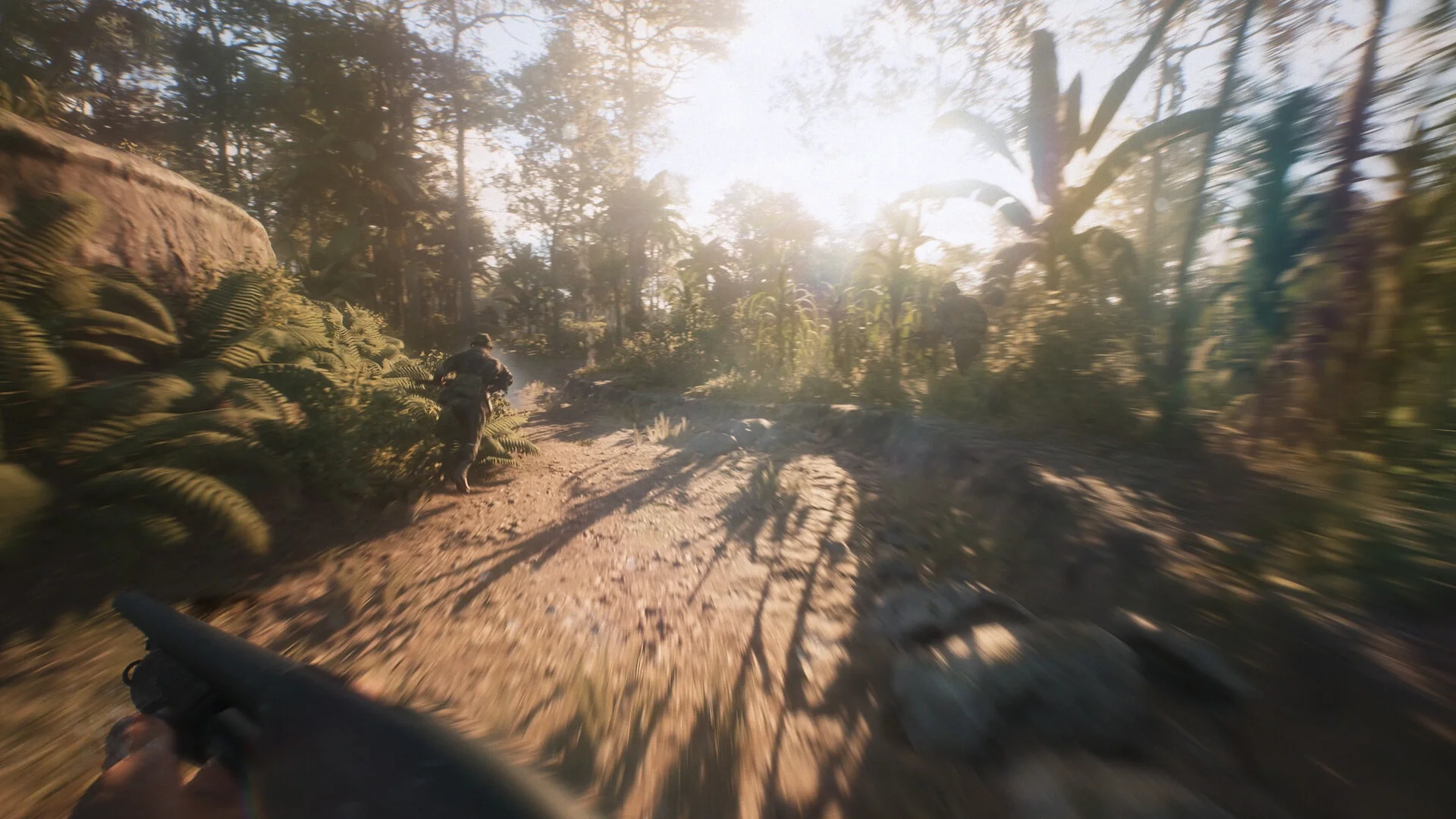
The jungle demands a different kind of attention. A stationary enemy can practically disappear into vegetation, and an encounter may be decided by which soldier detects a slight movement first. The absence of explicit kill confirmation prolongs that uncertainty. Even after firing accurately into a patch of grass, a player may have little idea if approaching the position is safe.
Such vulnerability suits the historical setting, though its implementation can become exhausting. Spending several minutes approaching an objective before dying to an unseen rifleman offers little educational value when the player cannot determine where the shot originated. The effectiveness of ordinary rifles at considerable distances makes this a recurring frustration, particularly when forward spawn positions are poorly maintained.
One of the pleasures of Hell Let Loose: Vietnam is discovering how useful a relatively uneventful personal performance can be. A rifleman supplying ammunition to a machine gunner enables sustained defensive fire. A medic dragging a wounded soldier into cover preserves the strength of a squad. Reconnaissance players can assist an entire offensive by identifying enemy positions and infrastructure.

Six-person squads operate under leaders responsible for establishing spawn points and communicating with their soldiers. Commanders oversee the larger military operation, coordinating resources and support. The generous map dimensions give this hierarchy room to function. An attacking force in Offensive can establish positions behind enemy-held territory, creating pressure from an unexpected direction. The territorial demands of Conquest and Domination make coordination across multiple locations especially rewarding.
Compared with the compressed battlefields of Battlefield 6, these environments give military logistics a much greater presence. Transport vehicles fulfill an appreciable purpose because traveling on foot carries a substantial cost in time. Gunboats are particularly useful, combining mobility, fire support and spawning capabilities along waterways.
The new tutorial provides a welcome introduction to specialist roles. Learning how to participate effectively remains a longer process, since understanding the controls of a particular class provides only partial preparation for the demands of communicating with five other people.
Expression’s interest in military institutions extends to its presentation of weaponry. Jonathan Ferguson of Britain’s Royal Armouries provides spoken information about the available firearms, giving the equipment a degree of historical specificity rarely encountered in multiplayer shooters. His detailed treatment of the weapons reflects the museum’s focus on preservation, classification and historical explanation.
The significance of such details depends partly on where the audience stands. An enthusiast approaching Vietnam through decades of American war cinema may appreciate the opportunity to inhabit both military perspectives. Someone approaching the conflict through Vietnamese history may find the concentration on conventional armed forces a considerably narrower account. The game accommodates the military identity of the North Vietnamese Army, but its interest in Vietnamese life extends little beyond the geographical and tactical conditions of combat.
Sound should be among the most valuable sources of information in environments with severely restricted visibility. The distinctive reports of American and Vietnamese weapons demonstrate the potential of Expression’s audio design, allowing players to recognize nearby military activity through listening. Unfortunately, the sound mix frequently fails to communicate the scale or proximity of danger. Helicopters can become audible surprisingly late, and approaching tanks sometimes produce remarkably subdued engine and track noise.
Intermittent audio interruptions compound the problem. Disappearing footsteps and unreliable radio communications are especially damaging to a game organized around information exchanged between soldiers.
The visual presentation suffers from comparable inconsistencies. Sunlight filtering through the canopy and fog settling across rice paddies give the landscape an impressive physical presence. Foliage shimmering compromises the clarity of these environments, particularly on PS5, and differences in vegetation detail across viewing distances can undermine concealment.
A soldier surrounded by grass may appear considerably more exposed to a distant opponent. Add frame-rate instability during intense firefights, sluggish movement and insufficient feedback during close-range shooting, and the game’s commitment to authenticity occasionally becomes difficult to distinguish from its lack of polish.
There is also a cultural dimension to its dependence on voice chat. International multiplayer communities can generate remarkable instances of cooperation between strangers, and the game’s structure gives these encounters genuine purpose. A well-organized defensive operation requires people to communicate accurately across several positions, anticipate enemy movements and identify where support is needed.
The same communication channels leave players exposed to harassment, including racist impersonations of Vietnamese people. Muting and blocking are useful protections, yet using them can deprive a squad of information upon which its survival depends.
Expression has built a demanding simulation of military interdependence. Maintaining a community capable of sustaining that design deserves as much attention as refining the weapons and battlefields, especially when the people sharing those radio channels may have very different personal relationships with the history being reenacted.
The Review
Hell Let Loose: Vietnam
Hell Let Loose: Vietnam transports a British tactical shooter tradition into Southeast Asia with a convincing understanding of how terrain reshapes warfare. Helicopters, underground tunnels and expansive maps give its battles considerable strategic depth, while coordinated squads can produce exceptional moments of collective achievement. Yet unreliable audio, visual instability and frustratingly opaque firefights frequently undermine the experience. Its military detail is impressive, even if its treatment of Vietnamese history remains culturally narrow. For patient players willing to communicate and endure technical frustrations, this remains a rewarding and distinctive tactical shooter.
PROS
- Excellent, strategically varied map design
- Meaningful helicopter and tunnel asymmetry
- Deeply rewarding squad coordination
- Detailed weapon presentation and military roles
CONS
- Inconsistent audio and technical performance
- Foliage issues undermine fair combat visibility
- Frustrating deaths from concealed enemies
- Heavy reliance on cooperative voice chat
- Limited cultural perspectives on the conflict