




























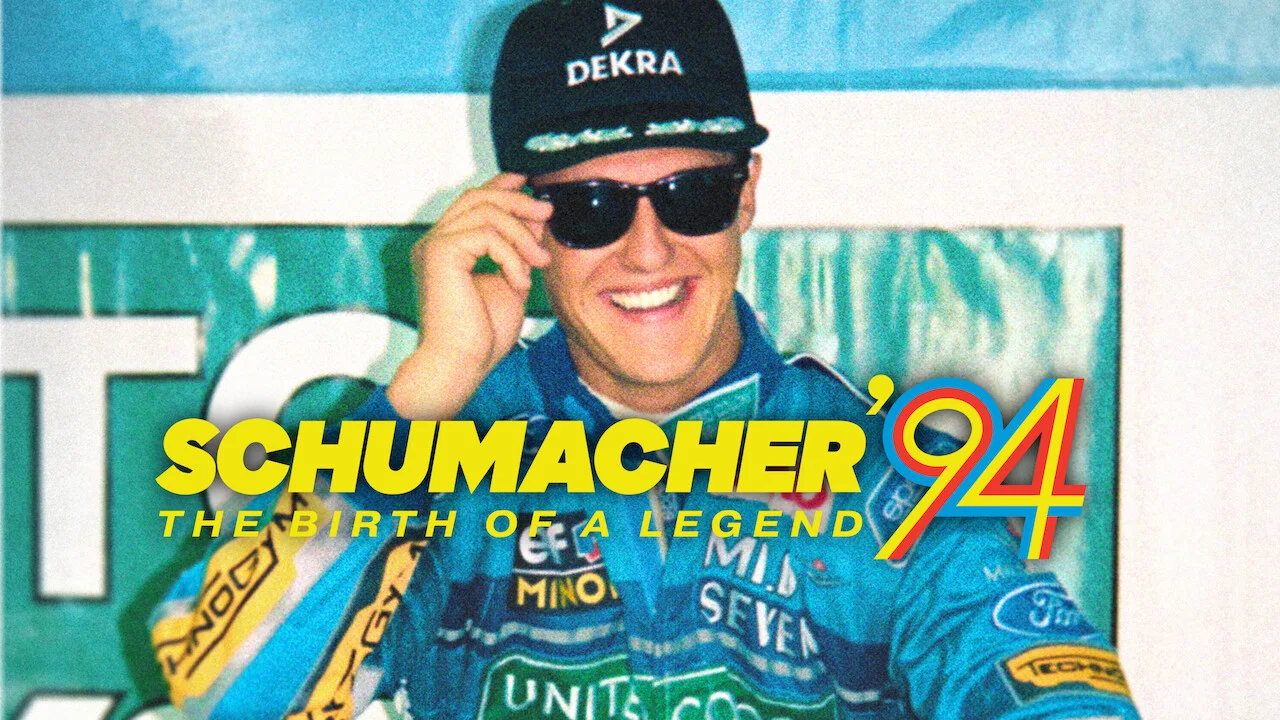

In 1994, Formula One crowned its first German world champion and lost two drivers during a single Grand Prix weekend. Michael Schumacher won the championship by one point, following a collision with his closest rival in the final race. These facts belong to the same historical record, although they suggest rather different stories about ambition, mortality, and sporting justice.
The title Schumacher ’94: The Birth of a Legend announces which story it prefers. A legend is already a finished interpretation of a human being, polished by time and selective memory. Christin Freitag’s Netflix documentary returns to the year before that interpretation became inevitable, carrying the peculiar disadvantage of knowing exactly what it wants us to discover.
Family-supported documentaries about celebrated figures tend to arrive with their moral arguments conveniently assembled. Here, Schumacher’s wife Corinna provides the intimate testimony, while former Benetton team principal Flavio Briatore, manager Willi Weber, engineer Pat Symonds, and other Formula One personalities reconstruct the season.
Schumacher himself appears through archival recordings. I initially regarded this arrangement with suspicion. The people closest to a champion possess extraordinary knowledge of his character, but they are seldom the most enthusiastic investigators of his mistakes (particularly when those mistakes involve their own decisions).
That suspicion proves justified, although the film earns considerable goodwill before exposing its limitations. Freitag has assembled an engrossing historical portrait, and I would recommend it for the remarkable archival material and its unexpectedly affecting treatment of Schumacher’s vulnerability. Its weakness is substantial: the same documentary that examines his fear and grief with sensitivity becomes remarkably accommodating when confronted with his disputed conduct.
The archival footage establishes the atmosphere of 1994 with an immediacy that contemporary Formula One coverage rarely possesses. Mechanics work in T-shirts, drivers answer confrontational questions with reporters practically breathing down their necks, and the engines produce a mechanical violence that survives even through ageing recordings.
German supporters celebrate Schumacher with an intensity that makes his success feel like a national event. Today’s Formula One has perfected the commercial presentation of spontaneity, a rather impressive contradiction when you think about it. The older footage reveals a sport whose public relations machinery had yet to acquire complete control over its participants. Freitag occasionally introduces reconstructed driving images that look artificial beside the genuine material.
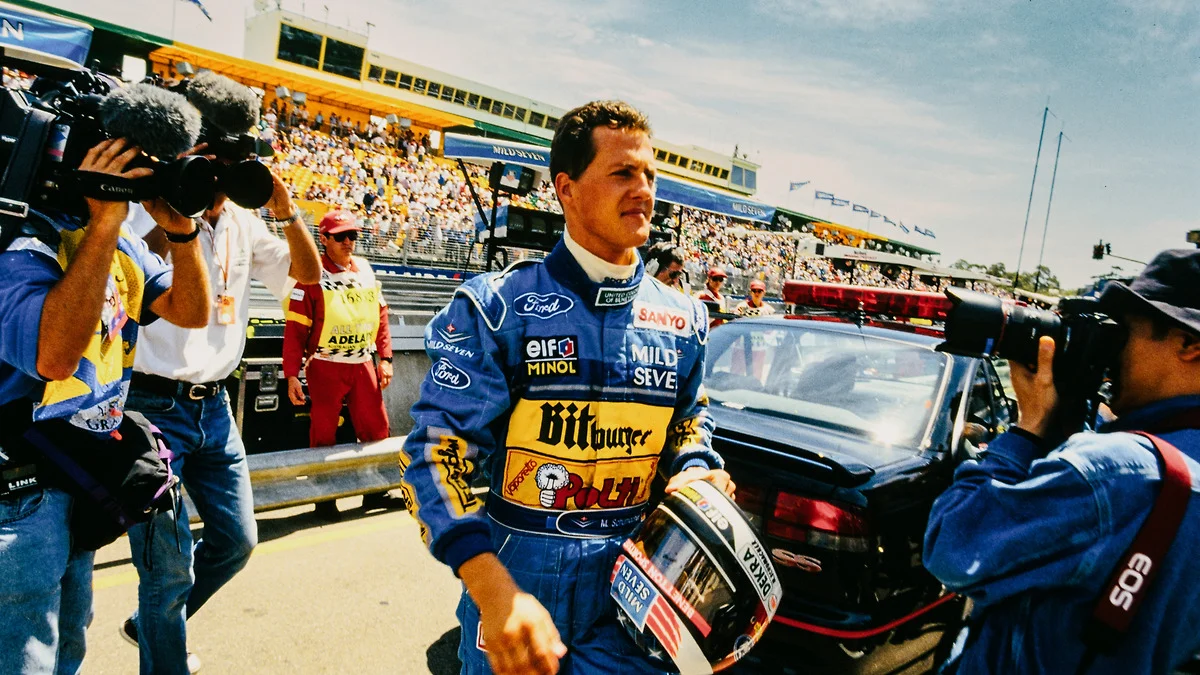
Then comes Imola, and the excitement of watching history begins to feel morally uncomfortable.
The 1994 San Marino Grand Prix weekend occupies a substantial portion of the documentary, and rightly so. Rubens Barrichello survives a horrifying practice accident on Friday. On Saturday, Roland Ratzenberger dies during qualifying. The race proceeds on Sunday, when Ayrton Senna crashes at Tamburello and suffers fatal injuries. Freitag reconstructs the progression through footage of the incidents, the atmosphere surrounding them, and recollections from those present.
Every decision to continue racing becomes increasingly difficult to accept. Schumacher wins that Grand Prix, although the usual vocabulary of victory seems grotesquely inadequate. One photograph captures him standing almost motionless, uncertain what to do with himself after the race. Sporting achievement ordinarily provides a ready-made emotional script. There is a winner, a celebration, an audience, and an agreed explanation for everyone’s happiness. Here the machinery of celebration has continued operating after its meaning has collapsed.
I had underestimated the film’s capacity to disturb its own celebratory narrative.
Archive interviews reveal Schumacher struggling with the possibility that he, too, might die while racing. The young driver who had challenged Senna now confronts the disappearance of the man against whom he measured his abilities. His fear extends to circuits he already knows, turning familiar corners into reminders of what happened at Imola.
This material reveals the psychological contradiction of an occupation that demands extraordinary awareness of danger alongside the ability to suppress its consequences. Courage in this environment cannot mean an absence of fear. Schumacher’s recollections suggest the considerable effort involved in continuing after that fear has acquired a recognizable face.
Corinna’s contributions deepen this portrait considerably. She remembers their early relationship at the Kerpen karting circuit, their experience of his sudden celebrity, and the arguments that followed Imola. Her recollections of conversations around a swing, where they confronted the possibility of losing each other, bring the consequences of racing into an ordinary domestic setting.
Elsewhere, she remembers how Paula Abdul’s Rush, Rush remains emotionally connected to their relationship. Such details could easily become sentimental distractions, yet they acquire significance beside footage of a profession that treats danger as an acceptable working condition. The man being celebrated by enormous crowds was privately struggling with what his continued participation might cost someone who loved him.
The absence of contemporary testimony from Schumacher adds poignancy to these recollections. Following his skiing accident in 2013, his family has maintained strict privacy around his condition, and this documentary offers no new medical information. Watching the young couple through family photographs and home recordings carries an emotional significance that the film scarcely needs to articulate.
Yet intimacy creates its own critical difficulties. Call it the intimacy exemption: the tendency to treat evidence of someone’s private tenderness as though it settles questions about their public behavior. Corinna’s memories convincingly establish Schumacher’s humanity. They tell us little about the fairness of his driving decisions or Benetton’s conduct during the championship. Freitag sometimes allows these questions to merge, as if understanding the psychological pressures experienced by a competitor were sufficient to justify everything he did under those pressures.
The problems become apparent when the film addresses the controversies of 1994. Schumacher’s disqualification at Silverstone for ignoring a black flag, followed by a two-race suspension, enters a larger account of his battles with racing authorities. His Belgian Grand Prix victory disappears after excessive wear is discovered on the underside plank of his Benetton. Allegations concerning prohibited electronic assistance also surround the team, although the discovery of launch-control functionality in its software did not establish that it had been used in competition. The dramatic refuelling fire involving Jos Verstappen at Hockenheim raises further questions about Benetton’s equipment and procedures.
These incidents complicate the documentary’s preferred interpretation of Schumacher as a young outsider facing an antagonistic establishment. Instead, testimony from Briatore and Symonds largely reinforces the team’s defensive position. Weber’s suggestion that Schumacher himself effectively served as the car’s traction control is amusing, but it substitutes admiration for investigation. Come on. Extraordinary driving ability and compliance with technical regulations are separate matters, and a documentary capable of reconstructing Imola with such seriousness should recognize the inadequacy of treating one as proof of the other.
The championship finale at Adelaide makes this imbalance especially difficult to overlook. Schumacher arrives one point ahead of Damon Hill. After damaging his car against a wall, he collides with Hill as the Williams driver attempts to pass. Both retire, preserving Schumacher’s championship lead. The incident remains disputed, and examining it requires serious consideration of competing perspectives. Hill, however, contributes no new interview, appearing only briefly through archival material. The filmmakers reportedly attempted to secure his participation, which explains the absence but cannot compensate for its consequences.
Corinna argues that Schumacher deserved the championship because he achieved his success despite competing in fewer races than his rivals. Emotionally, her loyalty is understandable. Historically, the argument is considerably less satisfactory, since his suspension resulted from an infringement rather than an arbitrary reduction in opportunity. The intimacy exemption is operating at full strength here. A penalty becomes evidence of hardship, hardship becomes proof of determination, and determination begins to resemble moral vindication. The reasoning is circular, but the affection behind it makes the circle unusually persuasive.
What troubles me is the larger cultural assumption supporting this interpretation. Sporting biographies frequently organize a person’s life around the idea that suffering produces greatness. Schumacher’s confrontation with death, the pressure of German celebrity, and the hostility he encountered become stages in the formation of an exceptional competitor. There is psychological truth in that account. Yet the idea grows suspicious when every event, including punishment and controversy, becomes material for the same heroic transformation. People can develop extraordinary resilience and still make questionable decisions. Acknowledging those decisions would hardly diminish the astonishing talent that made Schumacher a champion at twenty-five.
Freitag’s archival material preserves a Formula One culture that was simultaneously thrilling, dangerous, commercially ambitious, and institutionally troubled. Its most affecting images expose the human cost of those contradictions, especially during the terrible weekend at Imola.
The historical record also includes a championship decided by physical contact between two rivals, followed by decades of disagreement about responsibility. At Adelaide, the documentary can replay the collision and allow Schumacher’s closest associates to explain its meaning. Hill’s car remains plainly visible in the footage. His contemporary voice is missing from the conversation.
Schumacher ’94: The Birth of a Legend (Schumacher ’94 – Die Geburt einer Legende) premiered globally on Netflix on October 2, 2026, where it is available to stream. Directed by Christin Freitag and produced by LEONINE Documentaries, the sports documentary revisits Michael Schumacher’s dramatic 1994 Formula 1 season through archival footage and personal interviews with Corinna Schumacher and key figures from the racing world, chronicling his path to his first World Championship title.
Where to Watch Schumacher ’94: The Birth of a Legend (2026) Online


Full Credits
Title: Schumacher ’94: The Birth of a Legend (Schumacher ’94 – Die Geburt einer Legende)
Distributor: Netflix, LEONINE Documentaries
Release date: October 2, 2026
Rating: PG-13 (US), 12 (UK)
Running time: 1 hour 47 minutes (107 minutes)
Director: Christin Freitag
Producers and Executive Producers: Jochen Köstler, Janek Romero, Constanze Guttmann
Cast: Michael Schumacher, Corinna Schumacher, Flavio Briatore, Bernie Ecclestone, David Coulthard, Willi Weber, Kai Ebel, Heiko Waßer, James Allen
Director of Photography (Cinematographer): Nicolai Mehring
Composer: Ben Lukas Boysen
The Review
Schumacher '94: The Birth of a Legend
Schumacher '94: The Birth of a Legend captures the vulnerability behind a formidable champion, particularly through the devastating events at Imola and Corinna Schumacher's intimate recollections. Its archival footage brings a dangerous, less manufactured era of Formula One vividly to life. Yet the film suffers from what might be called the intimacy exemption, treating personal suffering as an answer to questions about sporting responsibility. Schumacher's humanity emerges convincingly. His controversies receive considerably less scrutiny. A moving documentary that deserves to be seen, even if its version of history deserves interrogation.
PROS
- Powerful reconstruction of the Imola tragedy
- Intimate, emotionally revealing testimony from Corinna
- Exceptional archival footage capturing 1994 Formula One
- Thoughtful examination of Schumacher's fear and vulnerability
CONS
- One-sided treatment of championship controversies
- Damon Hill's missing contemporary perspective
- Unconvincing reconstructed driving footage
- Defensive testimony rarely challenged