




























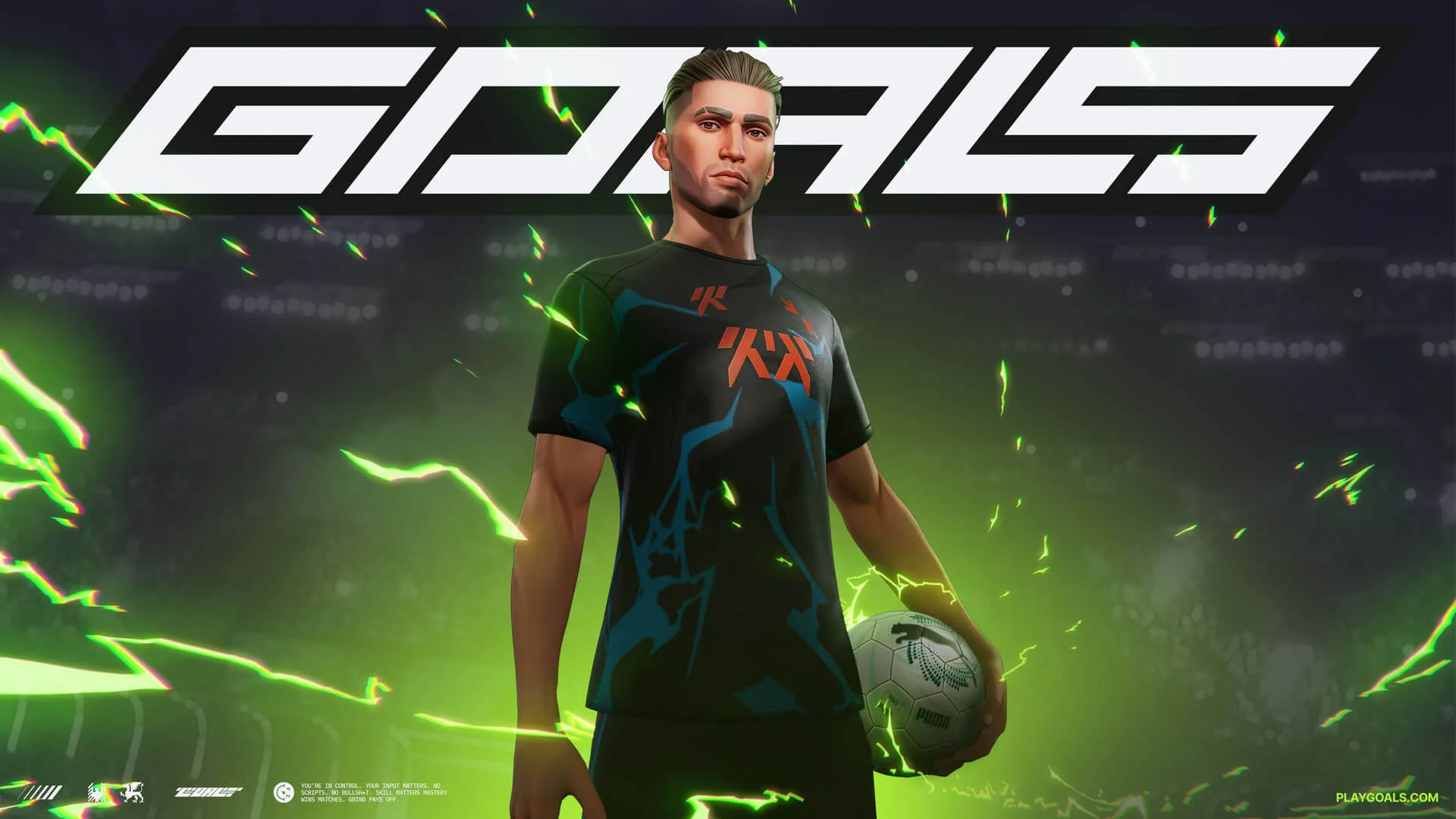

A warning zone creeps across the pitch when someone tries to waste time by holding possession near their own goal. Let it catch the player carrying the ball, and possession switches to the opposition. It is an unusual solution to a familiar football problem, especially compared with EA Sports FC, where running down the clock remains a legitimate tactic. This small intervention tells us something important about GOALS. Swedish developer GOALS AB is willing to change established rules if doing so produces faster, more competitive matches.
That philosophy extends to the controls, where GOALS takes a recognizable football formula and gives players considerably greater responsibility. Anyone familiar with EA Sports FC will recognize the basic layout, but passing requires an adjustment. Assistance is limited, so a through ball depends heavily on direction, power, and timing.
Trying to thread a pass between two defenders demands precision, and mistakes can surrender possession immediately. The satisfaction recalls the older Pro Evolution Soccer games, where mastering the fundamentals mattered enormously. GOALS has some of that same directness, particularly when a carefully weighted pass creates an opening.
I would recommend trying GOALS to anyone who enjoys competitive football games, especially since downloading it costs nothing. There is genuine pleasure in its quick matches and demanding controls. Still, its claim to challenge the established franchises deserves skepticism.
For all its promising mechanics, GOALS suffers from inconsistent movement, limited content, and a progression system whose long-term appeal remains questionable. It is an enjoyable alternative in certain areas, but hardly a replacement for the games it hopes to challenge.
The pace is probably its most immediately appealing characteristic. Players accelerate quickly, change direction sharply, and turn defensive recoveries into scoring opportunities within seconds. Shooting favors accuracy over simply holding down the power button, and curling efforts from outside the penalty area can produce spectacular results. These shots sometimes seem excessively reliable, even when a footballer’s statistics suggest otherwise. Fast attackers can also leave technically superior defenders struggling to recover, making pace especially valuable.
Defending demands careful positioning and well-timed challenges. Mistiming a tackle can leave an opponent with a clear route toward goal. Yet the animation system struggles to keep up with the speed of play. Players sometimes appear stiff when turning, and transitions lack the polish found in EA Sports FC.
Attacking teammates present a greater frustration: they can remain passive, offering few useful runs unless the player intervenes manually. This becomes troublesome when constructing an attack through several quick passes. The controls encourage creativity, but the teammates frequently need additional instruction before that creativity becomes possible.
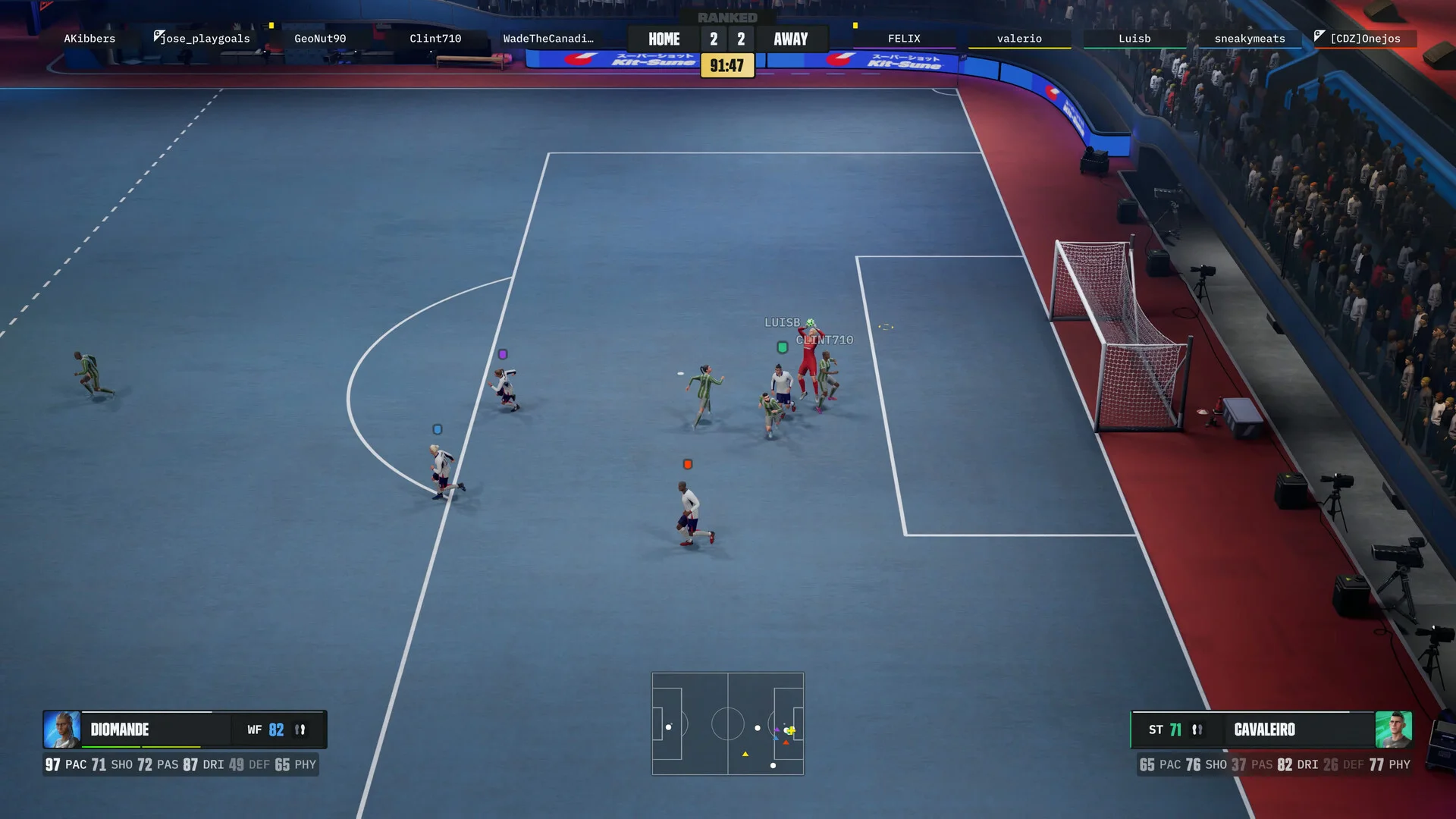
The time-wasting system is a much more successful piece of design. Its advancing danger zone prevents opponents from protecting narrow leads through endless possession, encouraging both teams to remain active until the end. Added time follows a similarly unconventional approach, providing a countdown that allows the final attacking sequence to develop instead of ending play at an arbitrary moment. Anyone who has watched a promising counterattack disappear beneath a final whistle in another football game will appreciate the change. The visible indicator can become distracting during a late scoring opportunity, but the benefit to match pacing is considerable.
GOALS also abandons licensed footballers in favor of procedurally generated athletes, each with individual statistics, physical characteristics, and development potential. Unlike EA Sports FC’s Ultimate Team, where collecting recognizable superstars is a major attraction, GOALS asks players to build around footballers with no existing reputations. A strong striker might encourage crosses into the penalty area, while quick wingers could make wide formations a better choice.
It is an appealing idea for anyone tired of encountering the same famous footballers in opposing squads. Yet removing recognizable names creates another responsibility: making fictional athletes interesting enough to remember. GOALS has trouble here. Character models lack variety, certain players look remarkably similar, and their animations rarely provide much individual personality. The occasional appearance of a real-world personality such as KSI makes the otherwise fictional roster feel slightly inconsistent. Compared with UFL, which uses recognizable footballers to attract squad builders, GOALS needs its generated players to earn that attachment through play.
The aging system offers a potential solution. Footballers enter the game relatively young, improve through accumulated experience, and eventually approach retirement. Their ages increase weekly after their first match, meaning a successful lineup cannot remain unchanged indefinitely. Players reaching retirement age can be exchanged, sold for resources, or converted into Legends.
Keeping older Legends active can influence the team’s average age and introduce statistical disadvantages. Developing a talented young striker therefore involves considering his eventual replacement. Compared with Ultimate Team’s familiar pursuit of better cards, GOALS introduces a reason to think about the lifespan of an entire squad.
Unfortunately, acquiring replacements remains closely tied to card packs. Players come in different rarities, possess different development ceilings, and require experience to reach their potential. New cards can be obtained through challenges, rewards, and packs, with rarity probabilities displayed before opening them. Transparency is welcome, but low chances of obtaining highly rated players can make the process repetitive. A player who spends hours developing a useful footballer may eventually need to begin again with someone new.
Low drop rates alone do not establish a pay-to-win system, and rewards earned through ordinary play provide a route toward improving a squad. Still, the promise of skill-based competition becomes harder to appreciate when repeated losses leave players wondering how much of the gap comes from their mistakes and how much from squad statistics.
That concern leads into the available modes. GOALS concentrates on online competition, with Quickplay and friendlies providing room to experiment and Ranked matches offering a climb through divisions. Tournaments add entry requirements and rewards, while the time-limited Knockout format encourages repeated attempts against increasingly demanding opposition. The variety is reasonable on paper, yet the activities frequently serve the same loop: play matches, earn rewards, improve the squad, and return.

For experienced EA Sports FC players, the difference in scope will be obvious. GOALS lacks the extensive selection of modes that makes its larger competitor attractive to different football fans. Its main competitive formats center on 1v1 matches, with additional cooperative formats planned. Practice facilities and computer-controlled opponents exist, but the single-player experience offers little incentive to remain invested.
The Training Arena deserves credit for introducing offensive and defensive techniques. The interface handles squad management well, using clear statistical indicators and rarity colors to distinguish cards. Graphically, however, the difference from leading football franchises is substantial.
Stylized players and stiff animations lack EA Sports FC’s refinement, though crowd sounds provide a suitable stadium atmosphere. Customization is limited too, with a modest selection of kits and celebrations. For a game built around fictional teams, that shortage of identity is especially noticeable.
The bigger question concerns what happens after the excitement of mastering the controls fades. GOALS can already produce satisfying matches, particularly when manual passing, defensive positioning, and its unusual stoppage-time rules come together. Its competitive systems now need to make those matches matter over weeks of play.
The aging mechanic could make developing young footballers and adjusting formations genuinely rewarding. Yet every retirement also sends players searching for replacements, and the card economy determines how satisfying that process becomes. A successful team is enjoyable to build; repeatedly rebuilding it will demand stronger incentives than another chance to open a pack.
The Review
Goals
GOALS understands what makes a football match exciting, even if it struggles to keep players invested beyond the pitch. Manual passing rewards precision, and its clever approach to time-wasting gives competitive matches welcome urgency. Compared with EA Sports FC, however, the limited modes, stiff animations, passive attacking AI, and repetitive card progression are difficult to ignore. Its aging squads introduce an appealing management challenge, provided replacing retiring players doesn't become a chore. Competitive football fans should give it a try, but established alternatives still offer a fuller experience.
PROS
- Satisfying, skill-based manual passing
- Fast, competitive matches
- Clever anti-time-wasting mechanics
- Interesting squad aging and retirement system
CONS
- Stiff animations and passive attacking AI
- Limited modes and single-player content
- Repetitive card-based progression
- Generic player designs and limited customization
- Questionable gameplay balance