




























Blueberry earns its emotional weight through the specificity of its family memories, especially the traces of an East German childhood beneath its familiar imagery of sadness. I recommend this short narrative platformer for those encounters between private hurt and a parent’s half-understood past. Its jumping and climbing are considerably less persuasive than its conversations.
The most revealing attempt at conversation belongs to Barbara’s mother. She tries to speak about her own life, including her childhood in East Germany, but interruptions keep the account incomplete. Barbara has experienced her chiefly as a source of criticism and conflict; here, another person’s history briefly becomes available. That history cannot explain everything.
The game gives us too little to turn a geographical reference into a diagnosis of an unhappy household, and its restraint is valuable. Barbara’s father drinks, money is scarce, and the reassurance she needs keeps failing to arrive. Her mother’s unfinished recollections introduce something Barbara cannot easily accommodate within those memories: the possibility that the person hurting her has experiences she has never learned to ask about.
A player with family connections to East Germany may hear particular echoes in that attempted explanation. From farther away, the interruption itself may register first. The scene permits both readings because it leaves the mother struggling to be heard, rather than supplying a compact historical explanation for her behavior.
This is a productive foundation for a game about an older woman, nicknamed Blueberry, looking back after becoming estranged from her adult son. Barbara now occupies the parental position she once judged from below. Returning to childhood gives her access to the fear and confusion that adult explanations can make inconvenient. Accusations about something being wrong with her accumulate into doubts about her own worth. The later prospect of understanding her mother does nothing to remove those earlier encounters from the story.
Childhood also supplies the most inventive play. Toilet-paper rolls become things to climb; the floor turns into imaginary lava; a duck becomes transport. These are recognizably domestic objects reorganized by a child’s imagination. Their playfulness belongs within the same life as the alcoholic father and the hostile remarks. Barbara can invent an absorbing game with what surrounds her, even as she lacks the language to describe what is happening at home.

Norwegian studio Krillbite’s Among the Sleep makes a useful comparison here. Its two-year-old viewpoint places domestic space inside the limited understanding of a very young child. Blueberry gains something from extending its perspective across a lifetime: it can return the adult’s knowledge to experiences first encountered in confusion.
That makes its modest childhood inventions worth taking seriously. Climbing a toilet-paper roll establishes a way of perceiving a room that the older Barbara can remember but cannot simply recover. Her mother’s account of childhood arrives from another inaccessible room, so to speak, with its own missing explanations.
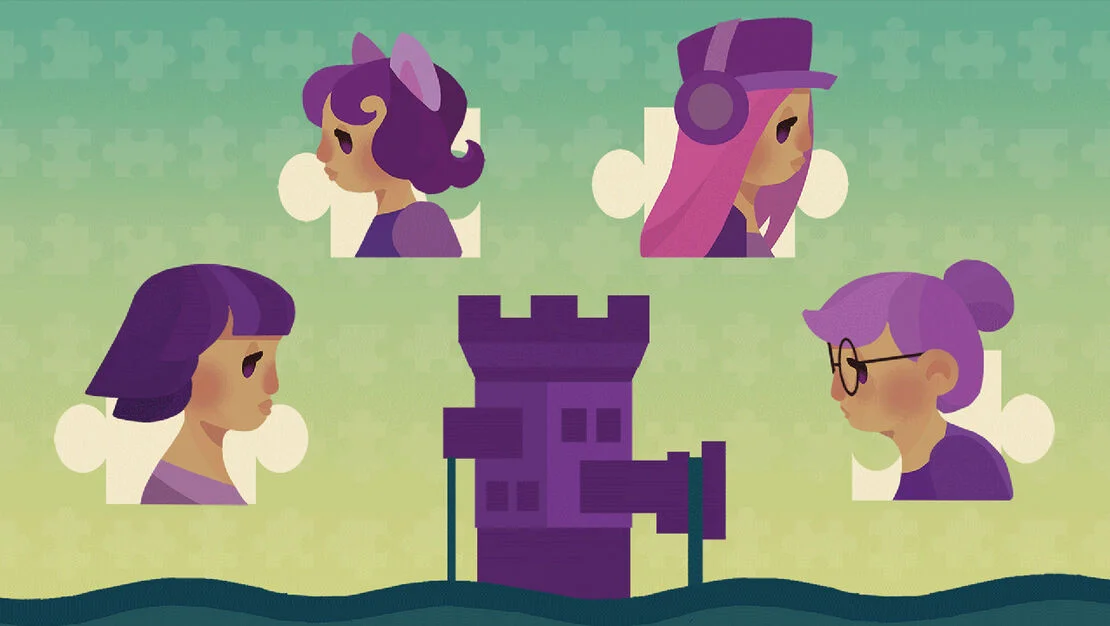
MELLOW Games, based in Cologne after originating in Brisbane, works across that distance through a straightforward device. Barbara climbs a symbolic Tower of Life, passing through doors into memories and collecting puzzle pieces. The structure gives recollection a direction and an activity, even when the memories themselves resist a satisfying resolution.
The changing tasks initially justify this arrangement. A mathematics test turns childhood vulnerability into an encounter with external judgment; answering customer emails relocates pressure to adult employment. Adolescence brings persistent rain and increasingly painful exchanges with her mother.
These shifts make age tangible through expectations and environments. Yet the childhood episodes set a standard the later ones struggle to meet. They allow perception to alter what ordinary objects are for. Later, the gap between one memory door and the next contains a growing quantity of familiar jumping and ladder climbing.
The Blues system does stronger expressive work. As Barbara’s distress increases, color drains away and her surroundings become bleaker and emptier. A dialogue decision can affect that condition; fruit juice, an apple, or playing with a cat can offer a small improvement. The simplicity is effective because the change extends beyond a meter. Something as modest as spending time with an animal gains weight when the space around Barbara has begun to lose its warmth.

Beside Barcelona studio Nomada’s GRIS, however, the limits become clearer. GRIS connects emotional change with abilities that open routes through its world. Blueberry makes its changing environment answer to specific relationships and everyday acts, giving the familiar language of an altered emotional landscape a welcome domestic vocabulary. It deserves credit for that specificity.
The comparison also raises the standard for its traversal: a change in the world’s appearance cannot indefinitely substitute for a change in what the player does there. The tower continues to ask for much the same movements after the memories have entered very different stages of Barbara’s life.
There is a more difficult question inside the meter itself. During conflict with her mother, both characters’ sadness indicators can rise. An exchange that Barbara experiences as an injury becomes visibly damaging to the other participant too. That is an economical way to complicate blame. But once pain has a rising bar and small actions bring it down, the player is encouraged to manage distress as a supply of correct responses. The interrupted East German recollection offers a richer kind of uncertainty: Barbara cannot choose the right reply to a history she has scarcely been allowed to hear.

The platforming needs invention, rather than harsher penalties. Falls and hits send Barbara back quickly to a nearby point, which keeps mistakes from consuming the attention owed to the memories. Loose movement and repeated ladders, hazards, and platforms still make later climbs feel like delays before the next conversation.
Those delays become harder to accept because Barbara’s ordinary life receives relatively little space. Employment appears through customer demands; adolescence through insecurity; family through conflict. The apple and the cat suggest pleasures that might have helped define her beyond the damage she carries, but the game returns insistently to strain. Her suffering becomes easier to describe than her tastes or her habits. For a work capable of making us wonder about the mother’s unspoken past, it is frustrating to have so few opportunities to know Barbara outside her problems.
Her son’s distance makes that omission consequential. He encounters a mother, not the complete history the player is assembling, just as Barbara once encountered hers through remarks and failed conversations. Revisiting those memories may change what she understands and how she speaks to him. It cannot determine what he is ready to hear, or how much contact he wants. His place in the relationship remains a decision Barbara cannot make on his behalf.
The Review
Blueberry
The mother's unfinished memories of East Germany give Blueberry a specificity its familiar emotional imagery needs. Childhood play and the Blues system make family hurt tangible, and revisiting Barbara's life complicates easy judgments of her parents. Repetitive climbs, loose movement, and a protagonist defined too often by suffering hold it back. Still, its attention to the past each generation only partly understands makes this a worthwhile choice for players drawn to intimate narrative games.
PROS
- Family history complicates judgments across generations.
- Inventive childhood interactions express a child's perspective.
- Changing colors and environments make distress tangible.
CONS
- Repetitive traversal and loose movement.
- Barbara receives little characterization outside her troubles.
- Mood management risks reducing distress to correct inputs.