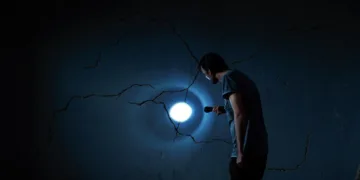





















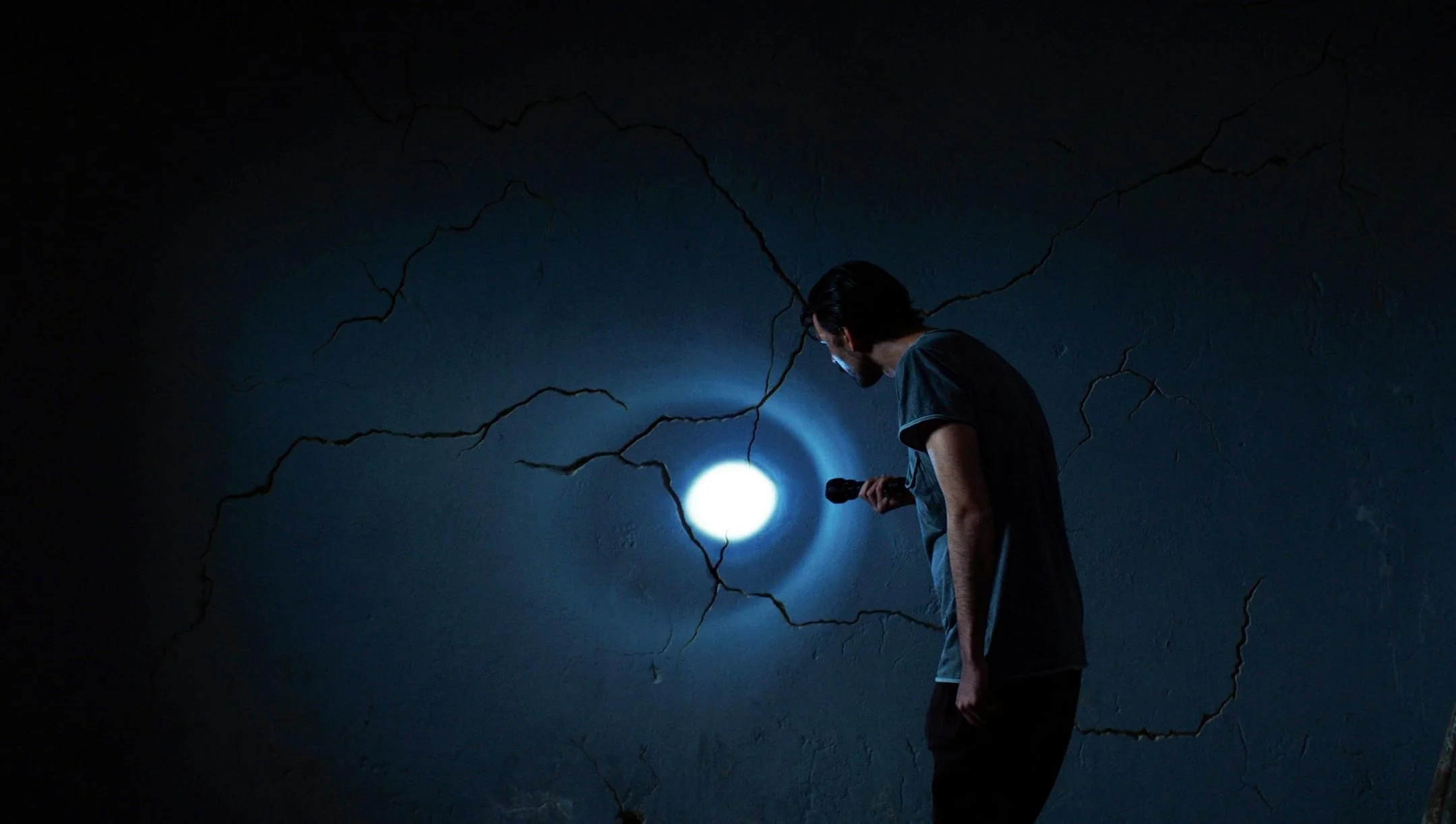

The cracks in the guesthouse walls seem to whisper, and I love how quickly that sound makes a familiar building defect feel wrong. Call it auditory personification: giving an object something like a voice so that we start treating it as a living presence. Here, the whispering in Rana Eid’s sound design makes covering a crack feel like an attempt to silence it. The damage keeps returning after repairs, so the workers face a practical problem that gradually becomes impossible to regard as ordinary maintenance.
“The Home Of Happiness” is what the advertising promises. For Tarek, a Syrian refugee played by Ziad Jallad, the guesthouse supplies work in the woods of Mount Lebanon, along with disturbances he cannot explain. That gap between the comfort being advertised and the experience of constructing it gives In This Darkness I See You a sharp organizing idea. Director Nadim Tabet puts the people preparing someone else’s escape in a place they have little freedom to leave. The village restricts their movements, and the building refuses their efforts to make it presentable.
I would recommend this to viewers who enjoy a ghost story whose atmosphere grows out of a specific place and its tensions. The sound and images earn that recommendation. The screenplay is less assured, especially when explaining the mystery begins to crowd out the relationships that should give those explanations their emotional weight.

There is real pleasure in watching Tabet make the surroundings feel uncertain. Cinematographer Mark Khalife’s moving camera searches the forest, encouraging us to inspect the space between the trees. Charbel Haber and Fadi Tabbal’s score turns that searching into apprehension. A woodland setting already invites a horror audience to anticipate something concealed; the camera gives that anticipation time to work. The film’s grounded appearance helps, too. The construction site feels like a workplace before its walls start behaving strangely, so each disturbance interferes with an activity we understand: these men are trying to finish a building.
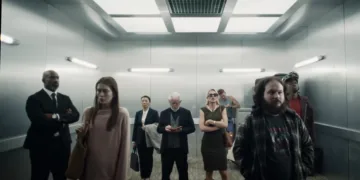
Outside the site, the restrictions are considerably easier to identify. The Syrians cannot enter the village after 6 p.m., and accusations of theft and assault circulate around them. That curfew gives the film’s account of prejudice a useful precision. Hostility determines where a person may go and at what hour. It also limits the value of the guesthouse’s cheerful sales pitch for the men building it: the promised refuge sits inside an environment that already treats them as a problem.
The discovery of old newspapers brings a different version of Syrian power into this setting. Among the headlines are reports of protests against the Syrian military presence in Lebanon. One worker wonders if that history explains the village’s dislike of them. It is an effective question to put in his mouth because he is trying to understand a resentment whose consequences he experiences personally. The newspapers connect a military presence from the past to refugees seeking employment in the present. The men now subject to local rules are being made to carry an association with power they do not possess.
Tabet lets the workers encounter that history as material left inside a house they are clearing. I appreciate the directness of the choice. The past becomes another thing their job requires them to handle, alongside the objects and damaged surfaces on the property.
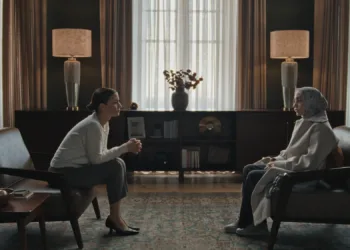
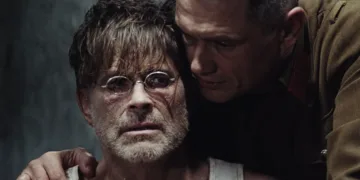
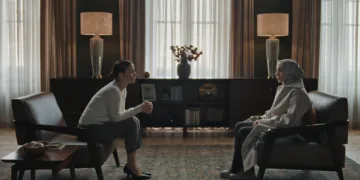
Rana, played by Marilyne Naaman, offers Tarek help with his strange experiences and some welcome kindness within this suspicious community. Her willingness to listen gives their connection a purpose beyond supplying another clue. Yet the writing does not develop that connection with the same confidence it brings to the building’s disturbances. Jallad has to communicate much of Tarek’s uncertainty through his eyes and startled reactions. Those responses keep his alarm visible, but the film returns to his bewilderment so often that his relationships struggle to acquire an equally strong presence. Rana’s assistance makes that imbalance especially noticeable: understanding what is happening to him occupies much of the space between them.
The camera and Walkman Tarek finds in the old house fit neatly into the film’s curiosity about what survives from an earlier time. They are objects made to preserve images and sounds, placed in a story where the past keeps intruding on the present. Their discovery encourages the viewer to expect connections, and the gradual release of information gives that expectation something to feed on. I stayed interested in how these pieces would fit together.
My patience thinned when the flashbacks began spelling out links the film’s imagery had already encouraged me to make. A flashback can change our understanding by giving an earlier event new meaning. It can also interrupt the present to confirm an explanation we have already reached. Tabet’s film sometimes falls into that second use. The returning cracks and the newspaper discovery have already taught us to look for a history that has been covered over. Further explanation needs to supply an emotional discovery, too. Some of these returns to the past feel occupied with making the connections explicit rather than deepening our attachment to the people caught in them.
The disappearances put another pressure on that explanation. Lebanese and Syrian men go missing, and each community directs suspicion toward the other. Whatever Tarek might learn about the haunting, that knowledge does not grant him control over the accusations around him. A supernatural mystery invites us to wait for the truth to emerge; the village has people ready to assign responsibility before it does. For the workers, finding an answer and being believed remain separate problems, with the curfew still determining who is allowed into the village after six.
In This Darkness I See You screens in the International Competition at the 47th Cairo International Film Festival in November 2026, with international distribution handled by MAD Solutions and MAD Distribution. Directed by Nadim Tabet, the thriller-drama follows a Syrian refugee working on a remote renovation and construction site in Lebanon who becomes convinced the site is haunted after eerie, life-threatening events heighten tensions between Syrian laborers and local villagers.
Full Credits
Title: In This Darkness I See You
Distributor: MAD Distribution Films, MAD Solutions
Release date: November 2026 (47th Cairo International Film Festival)
Running time: 1 hour 19 minutes (79 minutes)
Director: Nadim Tabet
Writers: Nadim Tabet, Antoine Waked, Jamal Belmahi
Producers and Executive Producers: Georges Schoucair, Eli Souaiby, Antoine Waked
Cast: Ziad Jallad, Marilyne Naaman, Moe Lattouf, Maya Dagher, Ziad Seaibe, Hassan Doba, Zakaria Kaakour, Mohammad Zarzour
Director of Photography (Cinematographer): Mark Khalife
Editors: Loic Lallemand
Composer: Charbel Haber, Fadi Tabbal
The Review
In This Darkness I See You
I love how a whispering crack can turn an ordinary repair job into something frightening. Nadim Tabet builds on that unease with searching camerawork, an unsettling score, and a sharp connection between supernatural disturbances and the hostility facing Syrian workers. Explanatory flashbacks and Tarek’s underdeveloped relationship with Rana weaken the emotional payoff. I’d still recommend this for its atmosphere and the specific social pressures that give its haunting force.
PROS
- Whispering walls give the sound design a memorable purpose.
- Forest camerawork and music sustain unease.
- Curfews and accusations ground the horror in everyday prejudice.
CONS
- Flashbacks explain connections the imagery already suggests.
- Tarek and Rana’s relationship lacks development.
- Repeated startled reactions limit Tarek’s characterization.