





























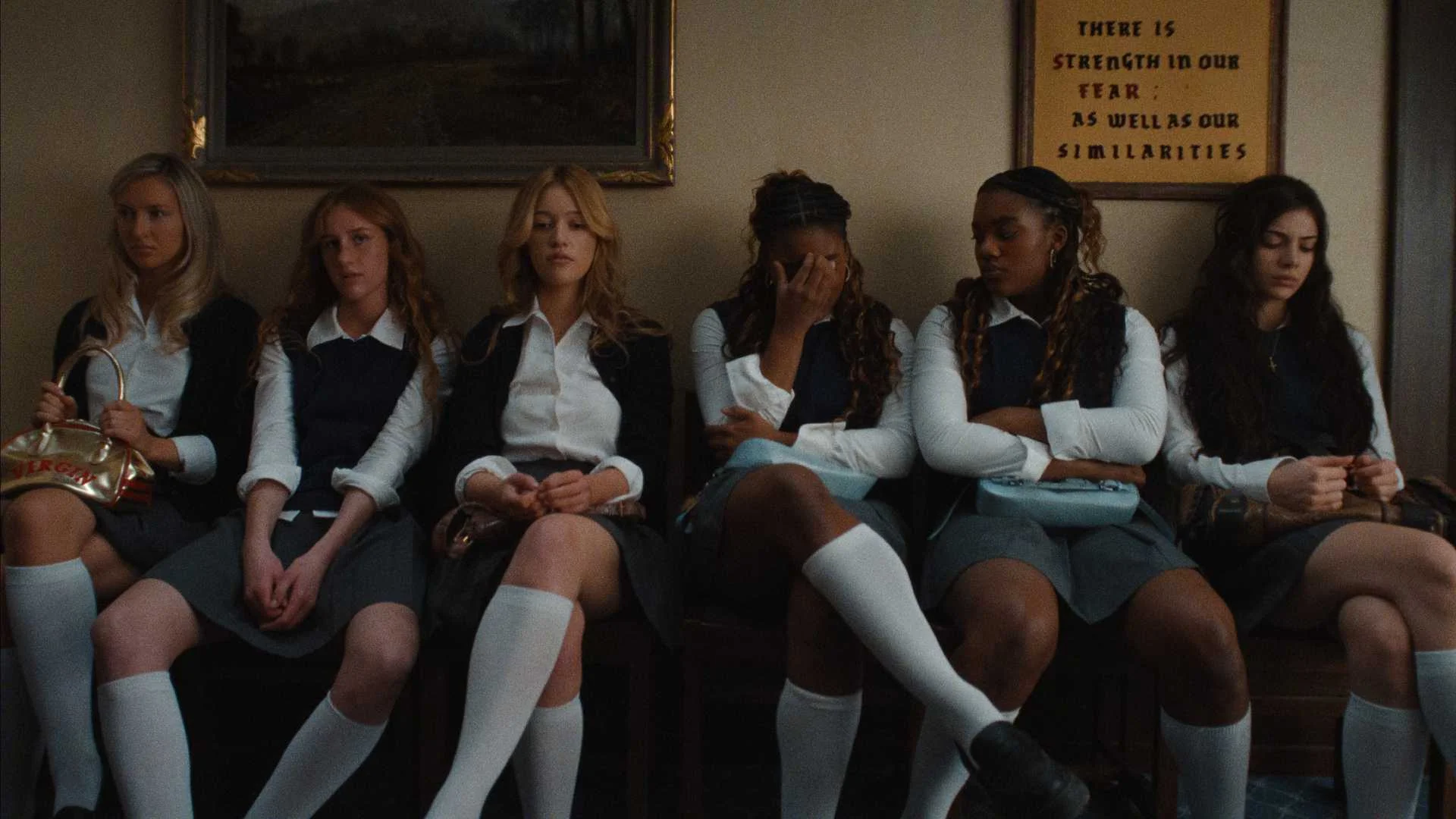

Communion shares screen space with dance-team stretches in the premiere of The Body. The edit brings two kinds of bodily discipline into contact: receiving a sacrament and preparing to perform. Its sexual charge comes without the usual parade of breasts and backsides. That choice matters in a series about girls whose bodies are constantly being interpreted for them. Quinn Shephard’s Netflix drama gives the viewer permission to enjoy what its Catholic setting teaches the characters to distrust, then makes that pleasure vulnerable to the same scrutiny the girls face.
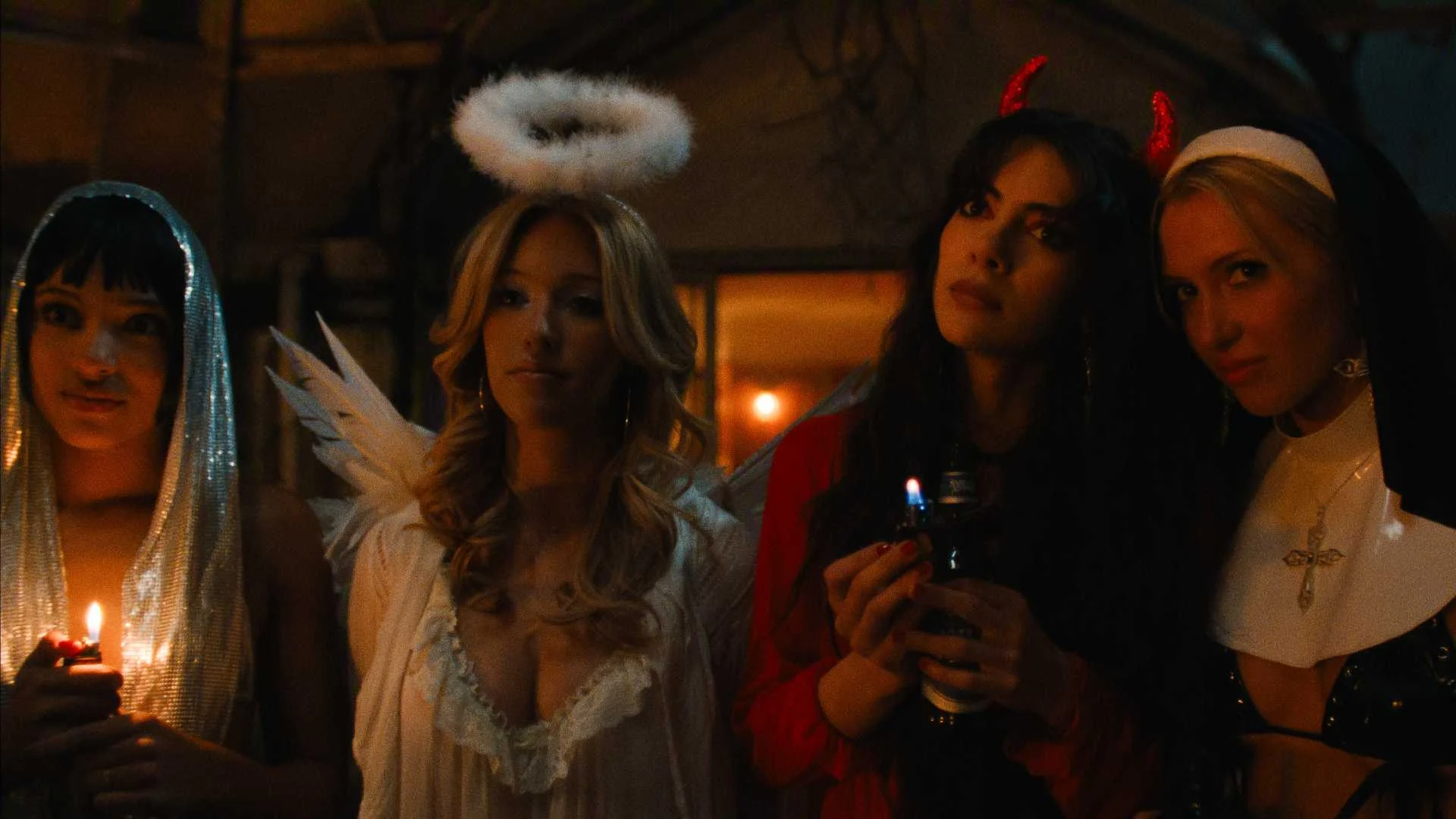
The show’s bright pink, bedazzled title announces a less reverent relationship with its material. Sacred imagery becomes Halloween dress-up; teenage excess gets its own dance number. Some of this is easy provocation. A sexualized religious costume can make a connection between sanctity and desire without having much to say about either. Episode six’s dreamy romantic dance sequence puts the freedom to better use, allowing feeling to determine the form. That is a useful expansion of what queer teen television can offer: extravagance, pleasure, an emotional experience that cannot be reduced to a disclosure or a lesson about prejudice.
The setting is autumn 2004, and the Lions, a Catholic high school’s girls’ dance team, need a replacement before regionals. Their co-captains, Anya Butler (Kristina Bogic) and Elise Zakaria (Sara Boustany), already have an intimate vocabulary. They call each other “wife,” a joke elastic enough to accommodate attraction without requiring Anya to acknowledge it. Boustany and Bogic give that familiarity an ease that makes the evasion hurt. Elise wants recognition from someone who enjoys their closeness while resisting its implications. The religious environment raises the cost of honesty, and Anya passes some of that cost to the girl waiting for her.
The competition for admission makes the team’s power explicit. Grace Franklin (Sofia Wylie) wins the vacant place over newcomer Lisbeth Anderson (Geena Meszaros), whose awkwardness puts her outside the group before she has much opportunity to enter it. Anya’s invitation to a Halloween party at an abandoned convent offers another route inside. A drug-fueled initiation follows; Grace is found unresponsive the next morning and falls into a coma. The Lions conceal the ritual and erase photographic evidence. Their shared secret gives belonging a new condition: remaining loyal now means helping determine what other people are allowed to know.
Lisbeth grasps this arrangement quickly. Armed with material she can use against Anya, she forces her way into a friendship that politeness had only briefly offered. Meszaros gives her a singsong delivery whose sweetness becomes oppressive, while her eager fingers around a Bible suggest a disturbing appetite for the authority it contains. The performance supplies tension even when Lisbeth’s emotional range feels narrow. Her manipulation is understandable without becoming defensible. She wants access to ordinary teenage freedom, yet the access she secures depends on restricting someone else’s choices.
Her circumstances give the religious critique a material foundation. Lisbeth has been homeschooled, has no family computer, and lives with her strict mother Catherine (Louisa Krause) in Church-funded housing. Faith is attached to shelter, parental control, and limited contact with the social world she longs to join. The series is sharper here than in its costume blasphemies. A teenager can mock a religious symbol at a party; escaping the arrangements that govern her daily life is a different undertaking. Lisbeth’s dependency also complicates the easy pleasure of watching an outsider disrupt the popular girls’ order. She brings practices of control into a circle that already has its own.
As visions and religious panic spread, the show preserves room for believers who resist the frenzy. Elise’s skepticism does not require her to abandon faith. Father Sam Franklin (Nnamdi Asomugha), Grace’s uncle and the school priest, tries to establish what happened while dealing with frightened students.
His investigation prevents the Church from functioning as a single, uniformly irrational antagonist. Yet his position promises an interior conflict the writing only lightly explores. Being responsible for the school and related to the girl in the coma gives him urgent work to do; the effect on his relationship with God remains less developed than the activity surrounding him.
The period setting is most useful when it shapes the circulation of information. Basic mobile phones and deleted photographs allow the girls to imagine they can contain the evidence, while gossip travels beyond their control. The absence of contemporary social platforms changes the machinery of exposure without making the community innocent of spectacle.
Television supplies The Simple Life, Iraq War coverage, and The Apprentice. Those fragments locate the girls within a recognizable public culture, though the political implications remain suggestive. The cover-up offers a clearer account of contested truth because it shows people making decisions about evidence, loyalty, and self-preservation.
Across eight episodes, the series is less consistent about which relationships deserve sustained attention. The premiere efficiently connects recruitment, initiation, and concealment, but the early middle stretch loses some of that purpose. The unexpected connection between Elise and Lisbeth’s devout brother Leo (Jackson Kelly) exposes the problem particularly well. Their temperaments create the possibility of contact outside the team’s coercive intimacy, then the pairing recedes after meeting its immediate narrative need. The issue is the allocation of time: a series with room for elaborate genre flourishes lets an unfamiliar relationship become useful before it has become substantial.
That unevenness should be distinguished from the shifts between camp, horror, and romance. The sixth episode’s dance showcase earns its departure from ordinary dramatic presentation by giving feeling an expansive form. The season’s closing deferral is harder to justify.
Its cliffhanger raises a question large enough to change the interpretation of what preceded it, making continuation carry part of the burden of explaining the current season. Uncertainty can be productive, especially in a story about competing accounts of an apparent supernatural event. Here, viewers are left waiting for an answer that may determine how to understand the experience they have already watched.
The Body premiered globally on Netflix on November 11, 2026. Created by Quinn Shephard, the psychological drama and supernatural horror series follows a group of Catholic school girls who begin experiencing prophetic visions and triggering mass town hysteria following a disastrous dance-team initiation.
Where to Watch The Body Online


Full Credits
Title: The Body
Distributor: Netflix
Release date: November 11, 2026
Rating: TV-MA
Running time: Approx. 50-60 minutes per episode
Director: Quinn Shephard
Writers: Quinn Shephard
Producers and Executive Producers: Quinn Shephard, Riley Keough
Cast: Kristina Bogic, Sara Boustany, Geena Meszaros, Nnamdi Asomugha, Louisa Krause, Shirley Chen, Jackson Kelly, Sofia Wylie
The Review
The Body
The Body gives queer teen television room for pleasure, extravagance, and morally difficult girls. Its sharpest religious critique emerges through housing, exclusion, and the power to withhold affection. Bogic and Boustany make that affection persuasive; Meszaros makes its coercive possibilities unsettling. Yet the eight-episode season develops some relationships too lightly, and its substantial cliffhanger leaves too much interpretive work for a possible continuation. The freedom to tell this story produces arresting moments without consistently securing the dramatic attention its characters deserve.
PROS
- Queer desire receives expressive space through dance and camp.
- Bogic and Boustany give Anya and Elise persuasive intimacy.
- Meszaros makes Lisbeth’s manipulation unsettling.
- Religious critique connects belief to material dependency.
CONS
- Sacred imagery sometimes stops at easy provocation.
- Uneven development of relationships and Franklin’s faith conflict.
- A substantial cliffhanger defers central interpretive answers.







