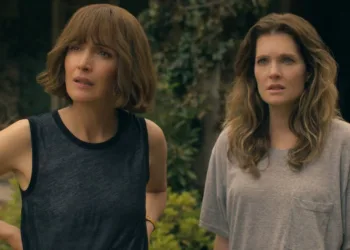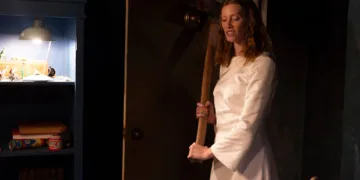








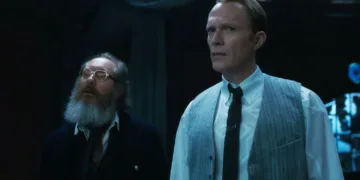





















Simon has good reasons to welcome Mia’s attention. He comes from a home marked by abuse and neglect; she seems interested in giving him the care he has been missing. Their meeting in a park allows a little hope into Kurt Martin’s The Room Below, even with Mia’s fixation on the boy’s resemblance to her dead son. You can understand the attraction of this arrangement for a child without trusting the adult offering it. That makes the invitation to her house uncomfortable before she takes him downstairs and locks him in a bedroom prepared for someone else.
The room resembles the one that belonged to Axel, Mia’s son. Its familiarity belongs entirely to her, which makes it an especially cruel place to put Simon. Everything intended to comfort the mother asks the boy to disappear into a role he never chose. Alyssa Sutherland keeps Mia’s affection active through this violation, giving her enthusiastic delivery a disturbing persistence. Once the door is locked, that cheerfulness becomes something to listen for nervously. Mia can sound pleased with the home she has made while the child inside it is trying to leave.
Sutherland gives the film a reason to remain close to Mia without asking us to accept her account of herself. Years after Axel’s death from cancer, she sees him in children on the street, and her work as a children’s author has stalled. Writing once connected her to the child she loved; now both her work and her household are organized around an absence. This is painful material, and Sutherland allows the wish to resume being a mother to remain legible beneath the abduction. The distress comes from watching her pursue that wish through someone whose actual needs she refuses to acknowledge.
Simon’s resistance gives that refusal something to press against. Gilbert Bradman’s movement between a child’s receptiveness to affection and desperate anger makes the initial connection matter after it becomes captivity. His difficult home has already made safety uncertain. Mia’s house adds another problem: the adult promising protection cannot accept his desire to get away from her. His escape attempts give the film its clearest suspense, because each carries a question about how far her apparent tenderness can accommodate resistance. These exchanges have enough emotional friction to sustain a much tighter film than the one surrounding them.
John, played by Jonathan Rhys Meyers, initially seems capable of extending that friction beyond the basement. He meets Mia in a support group for bereaved parents; his son Henry disappeared and was never found. Their friendship creates an uncomfortable proximity between consolation and discovery. When John takes an interest in Simon’s disappearance, a woman keeping a child prisoner is receiving support from a father living with the absence of his own. His police background gives the search a practical foundation, while the earlier friendship means a visit to Mia’s home could carry personal stakes alongside the possibility of rescue.
Yet those visits too often feel arranged to deliver the next piece of information. John brings up the missing boy with Mia and arrives at her house as the plot needs the investigation to touch her life. The access is convenient, and the film gets less tension from it than the relationship promises. I found myself waiting for the search to return us to Simon rather than becoming absorbed in the search itself. That is a costly shift in attention: the prospect of discovery should make the locked room feel increasingly precarious, but the investigative strand frequently interrupts the fear being built there.

Flashbacks to Mia with Axel and John with Henry fill in the losses behind their connection. They give the adults’ grief a history, but that history also competes with the urgent business of a child trying to survive the present. Martin keeps supplying reasons to understand Mia while Simon’s situation needs development of its own. The later disclosures can rearrange our understanding of events, yet they cannot supply all the anticipation missing between them. Knowing that the story has answers becomes a weaker reason to keep watching than worrying about what Simon might try next.
The creature inhabiting Mia’s home produces a different, more immediate response. Its practical effects benefit from cinematographer Glenn Hanns’s low lighting, which limits how clearly we can inspect its physical construction. There is unpleasant substance to the presence, and keeping it partly obscured makes looking into the darkness an uneasy activity. Those appearances deserve credit on their own scale. The difficulty comes when the film asks that sensory unease to share space with the fear generated by Mia’s treatment of Simon. The creature draws attention toward what it is and how it belongs in her experience, loosening our concentration on the boy.
Mia tending the presence and feeding it human blood does give the creature a place within her distorted idea of care. Meeting a dependent’s needs becomes a reason to inflict harm, an extension of the logic already operating in Axel’s recreated bedroom. But this added relationship makes her seem occupied by demands elsewhere in the house, and that can soften the immediate horror of her choices toward Simon. Her warmth is most frightening when we can see her actively imposing it on him. As she attends to the creature’s hunger, the film spends time on a need she recognizes and services while leaving the captive child’s need to leave waiting outside her attention.
The Room Below was released on digital and on-demand platforms by Uncork’d Entertainment on September 1, 2026, and is available to stream on Prime Video. Directed by Kurt Martin, the psychological horror thriller follows a grieving mother who, after losing her son to cancer and harboring a mysterious creature in her home, befriends another young boy to replace her child, only for her life to unravel when a retired detective investigates his disappearance.
Where to Watch The Room Below (2026) Online




Full Credits
Title: The Room Below
Distributor: Uncork’d Entertainment
Release date: September 1, 2026
Running time: 1 hour 32 minutes (92 minutes)
Director: Kurt Martin
Writers: Kurt Martin
Producers and Executive Producers: Chris Chard, Ty Linegar, Jim Robison, Jaime King
Cast: Alyssa Sutherland, Jonathan Rhys Meyers, Goran D. Kleut, Lauren Grimson, Gilbert Bradman, Bobby Gilchrist, Kathryn Hartman, Paul Chambers
Director of Photography (Cinematographer): Glenn Hanns
Editors: Kent Hau, Brad Hurt
Composer: Angela Little
The Review
The Room Below
The Room Below is most unsettling when Simon’s hope of being cared for turns into a reason to fear Mia. Alyssa Sutherland makes that reversal hurt, keeping affection recognizable inside an act of cruelty. The captivity scenes and shadowed practical creature supply real unease, but convenient investigation scenes and explanatory detours repeatedly interrupt our concern for the boy. The creature further divides attention that the relationship between Mia and Simon has earned. There is affecting horror here, held together less securely than Sutherland’s performance deserves.
PROS
- Sutherland makes maternal warmth frightening without erasing Mia’s pain.
- Simon’s resistance gives the captivity scenes emotional tension.
- Low lighting strengthens the practical creature’s disturbing presence.
CONS
- John’s conveniently timed visits weaken investigative suspense.
- Backstory and disclosures interrupt Simon’s immediate predicament.
- Creature-focused scenes dilute the threat of Mia’s choices.