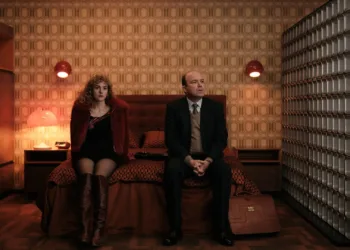

























Mariano Barroso lets Nicasio keep being a grandfather after his grandson has died. He still talks to the boy and maintains their school routine, and The Child allows us to follow that relationship without asking us to believe the child has survived. This is subjective storytelling: events are organized around a character’s experience, including an experience that other people cannot share. The audience knows what Nicasio cannot accept. Barroso uses that distance to make an ordinary act, taking a child to school, hold both affection and terrible knowledge.
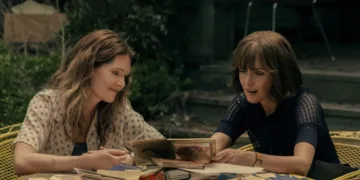
Mariaje, the boy’s mother, presents a different problem of access. Played by Belén Cuesta, she keeps much of her pain contained, while the camera frequently stays close to her. That proximity matters because her grief gives us fewer obvious actions to read. We have to attend to bewilderment and stubbornness without expecting every feeling to become a declaration. Moving between her restraint and Nicasio’s imagined companionship, the film changes how it gives us information about its characters. One keeps a relationship active; the other struggles to understand what her life can become.
The loss has a historical foundation. In October 1980, a gas explosion at a school in Ortuella, Biscay, killed fifty children and two adults. Barroso adapts Fernando Aramburu’s novel through a fictional family affected by that catastrophe. His prologue approaches the event through a kitchen routine, placing a household at the point of rupture. It is an effective choice of scale. Before the story follows people trying to continue their lives, it establishes the ordinary domestic world that has been broken. The quieter drama afterward inherits the opening’s shock without needing to reproduce its intensity.
Cuesta gives that quieter register considerable force. Mariaje’s concern about who she is without being a mother makes the damage painfully specific. Her child’s death has taken away daily obligations and a way of understanding herself. Cuesta’s restraint lets uncertainty remain inside her attempts to rebuild, so apparent determination never becomes easy evidence of recovery. I appreciate how the performance resists making each new behavior a clear sign of improvement. Mariaje can want a future and still have little idea who will occupy it. Her stubbornness makes that effort difficult to read from outside, including for the people nearest her.
Nicasio has an answer to the identity problem, however impossible it is to sustain. He continues doing what his grandson needed him to do. Bringing the boy a sandwich is especially affecting because it gives his attachment a practical task. Elejalde grounds the imagined relationship in the work of looking after someone: conversation, food, familiar destinations. These details make the storytelling device understandable without a psychological explanation attached to every action. We recognize what the routine once meant. Continuing it gives Nicasio somewhere to put affection that has lost its recipient, and Elejalde makes the tenderness of that effort palpable.
The danger in arranging the drama around these two characters would be turning them into neat alternatives, preservation on one side and rebuilding on the other. Pep Ambròs complicates that arrangement as the boy’s father. His anger is direct, and the town’s continuing life feels intolerable to him. Smiling faces become difficult to bear because they seem so disconnected from the scale of his loss. Ambròs gives this response a force that the other performances deliberately contain or redirect. His need for acknowledgment also exposes how little comfort the household’s different defenses can offer one another.

Mariaje’s response to his anger opens up the social dimension of the film. She points out that people grieve in the ways and places available to them. It is a useful correction to the idea that visible normality proves an absence of feeling. The town remains filtered through the father’s estrangement, and his perception deserves attention without becoming the film’s final judgment on everyone around him. Within this small Basque community, public behavior and private distress do not line up conveniently. Mariaje can understand that gap in others while remaining difficult for her own husband to understand.
Barroso is less assured when he supplies emotional information the surrounding drama can already communicate. The brief flashback showing the child alive feels unnecessary beside the routines that make his absence so concrete. Those routines let us infer the relationship through what survives it; the flashback gives us a direct illustration of what has been lost. I found the inference stronger.
The later scenes between Mariaje and Nicasio gain strength from bringing their responses into closer contact. Her effort to construct a future and his insistence on continuing the past start to reveal a shared fear about losing their place in the family. Cuesta and Elejalde keep the differences between them intact, which makes the connection worth watching. Understanding another person’s need does not supply a shared way to live. Their encounters hold a daughter trying to imagine life after motherhood beside a father still finding purpose in the duties of a grandfather.
The Child opened in select Spanish theaters on November 13, 2026, ahead of its global streaming premiere on Netflix on November 27, 2026. Directed by Mariano Barroso and adapted from Fernando Aramburu’s novel inspired by the 1980 Ortuella gas explosion, the drama follows a mother and grandfather as they navigate profound grief and search for distinct ways to cope with the tragic loss of their young son and grandson.
Where to Watch The Child (2026) Online
Full Credits
Title: The Child (El niño)
Distributor: Netflix
Release date: November 13, 2026 (Limited theatrical release in Spain), November 27, 2026 (Global streaming on Netflix)
Rating: TV-14 (Rated 12+ in Spain)
Running time: 1 hour 44 minutes (104 minutes)
Director: Mariano Barroso
Writers: Mariano Barroso, Fernando Aramburu
Producers and Executive Producers: Mariano Barroso, Rafael Portela
Cast: Belén Cuesta, Karra Elejalde, Pep Ambròs, Raquel Ferri, Joan Solé, Alex Infantes, Leyre Berrocal
Director of Photography (Cinematographer): Marc Gómez del Moral
The Review
The Child
Barroso makes grief legible through the different ways his characters continue being family. Nicasio’s school routine keeps a relationship alive in his mind, while the camera’s attention to Mariaje lets Cuesta make uncertainty felt without spelling it out. Elejalde’s tenderness and Ambròs’s anger prevent the drama from settling into one approved response to loss. An unnecessary flashback repeats emotion the surviving adults already communicate, but the later father-daughter scenes earn their feeling through the difficult recognition between them.
PROS
- Cuesta’s restrained portrayal of grief and damaged identity.
- Elejalde makes Nicasio’s imagined companionship emotionally credible.
- Shifting viewpoints clarify the family’s incompatible responses to loss.
- Ambròs gives the father’s anger and estrangement real force.
CONS
- The flashback spells out a loss already conveyed through the adults’ behavior.