















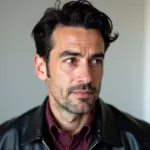
Richard Mitchell no longer holds the mayor’s office in Elmwood Heights, but he still expects the sheriff to listen. His daughter occupies his former position, and the murder of his granddaughter brings him pressing for house-to-house action. In Derek Sulek’s Dead of Night, local government has the intimacy of a family concern.
Richard, played by Miles Anderson, has further political plans for his daughter; Sheriff Weaver, played by Dermot Mulroney, has a crime to investigate. Their competing responses give this California town a potentially useful fault line between public responsibility and private possession.
The killer makes that distinction difficult to maintain. Linda, the mayor’s daughter, is attacked at a playground, and her mutilated body is put on public display. The spectacle reaches beyond a bereaved household, exposing the vulnerability of the family that governs the town.
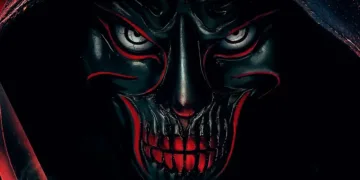
A deputy’s death extends the threat into Weaver’s own institution. These choices position the black-robed, demon-masked murderer close to the town’s sources of authority. Before the mystery has supplied an explanation, the selection of victims gives the violence a social address: people connected to power can be reached.
Yet Elmwood Heights scarcely develops the atmosphere of a place discovering that vulnerability. Work continues, young people meet at a pizza restaurant, and the video store remains open until the killer turns it into another murder site. Keeping businesses open during an emergency is hardly implausible.
What feels missing is the pressure on those ordinary activities, the sense that gathering with friends or serving a customer now requires a changed calculation. The film announces a public crisis through the placement of bodies, then repeatedly allows the town’s routines to function as neutral intervals between attacks. Its geography accumulates crime scenes faster than its inhabitants accumulate fear.
Kelly Weaver offers a firmer connection between private life and the search for answers. Played by Kirrilee Berger, the sheriff’s daughter is an aspiring journalist who examines clues through her own initiative. Her position is productive: she has a personal stake in the household responsible for the investigation, yet her curiosity takes her outside its official procedures. Berger has the advantage of a character with something practical to do beyond waiting to become a suspect or victim. Kelly’s inquiries give the film a continuing human purpose while the adults compete over control of the emergency.
That purpose becomes diluted as the screenplay, credited to Sulek and Eric Durham, distributes suspicion across additional family histories. Donnie Harris, played by Zach Justice, and his widowed father David, played by Scott Grimes, extend the web; David’s mourning introduces an older grief alongside the current deaths. The difficulty is the limited development connecting these separate troubles.
Political ambition, bereavement, and adolescent investigation each request attention, but the movement between them often feels like the maintenance of several possible explanations. The mystery becomes predictable without making that predictability an especially revealing account of the community. Time spent keeping suspects available gives neither Kelly’s pursuit nor the town’s relationships enough room to deepen.

Linda’s explicit mention of Scream during the opening also establishes a particular kind of cultural familiarity. This is an American slasher whose characters have access to the same cinematic vocabulary as its audience. That can be fertile territory: recognizing a convention might alter a decision, sharpen a joke, or complicate the experience of danger. Here the reference mostly confirms a resemblance already legible in the masked attacker and the ensemble mystery. Even the video store, a setting that places movie consumption directly beside murder, contributes chiefly another location for slaughter. Familiarity supplies the film with a recognizable language, but little distinctive use for it.
The attacks themselves deserve a less dismissive assessment. A broken Coke bottle and a stanchion bring the available surroundings into the violence, giving the killer alternatives to repeated knife thrusts. Predominantly practical gore makes injury feel physically present, and the effects sound reinforces that contact. These are tangible pleasures for viewers interested in the construction of a slasher sequence. The video-store attack has force as an assault on several bodies in a shared space, even if the film has done little to establish those people as part of a community. Physical invention survives the thinness of the dramatic preparation.
Chad Narducci’s camerawork makes the division between preparation and attack especially clear. Dialogue receives smooth, slow movement; violence brings a less stable camera. Greg Nicolett’s score likewise intensifies around the killings. The shift supplies immediate agitation, but it leaves much of the intervening material waiting for another signal to become dangerous. A conversation about the murders rarely carries the same unease as the murderer’s arrival. Camera, music, and practical effects can make the attack register sharply without carrying its disturbance into the next stretch of ordinary life.
The final act finds some momentum by concentrating the carnage. Its predictable unmasking supplies little shock, yet the action after that disclosure has an energy the investigation frequently lacks. Once the identity is known, continued violence changes the immediate question from solving the crime to surviving its perpetrator. There is room for excitement in that narrower task, and Sulek gets further by pursuing it directly. The cost becomes apparent in what the escalating assaults leave little time to explore: how the surviving relationships might look after suspicion has acquired a name.
Dead of Night was released in select theaters and on digital platforms on November 13, 2026, via Level 33 Entertainment. Directed by Derek Sulek, the horror thriller follows a local sheriff who fights to capture a ruthless killer while his daughter becomes dangerously obsessed with uncovering the murderer’s true motives.
Where to Watch Dead of Night (2026) Online
Full Credits
Title: Dead of Night
Distributor: Level 33 Entertainment
Release date: November 13, 2026
Running time: 1 hour 49 minutes (109 minutes)
Director: Derek Sulek
Writers: Eric Durham, Derek Sulek
Producers and Executive Producers: Oren Kamara, Derek Sulek, Dan Sheldon
Cast: Dermot Mulroney, Scott Grimes, Kirrilee Berger, Alex Camacho, Zach Justice, Jake Busey
Director of Photography (Cinematographer): Chad Narducci
Editors: Casey McClelland
Composer: Greg Nicolett
The Review
Dead of Night
Dead of Night gives its American small-town setting a promising conflict between family influence and public duty, then struggles to make the community feel the consequences of murder. Kelly’s investigative initiative provides a human anchor, while practical gore and improvised weapons give the attacks genuine force. The scattered family histories and predictable mystery offer little sustained tension, and the Scream references rarely develop into an independent perspective. Its energetic final violence supplies immediate excitement while leaving the town itself thinly imagined.
PROS
- Practical gore and inventive use of everyday objects.
- Kelly’s active role in pursuing the investigation.
- Energetic action after the killer’s disclosure.
CONS
- Town routines carry little accumulating fear.
- Dispersed family subplots weaken character development.
- Predictable mystery.
- Familiar horror references yield little fresh insight.