





























The workers at Aesthetician Labs own their studio. The mercenaries in its collaboration with Dutch-Egyptian developer Rami Ismail have rather less say in their employment. Based in Rochester, New York, the cooperative publicly values secure working conditions; Australia Did It: End-of-the-World Railway Defense Business imagines a freight company that can replace its personnel whenever the cargo needs protecting. The Australian name fronts an international production set on the dried-out Atlantic seabed. Its most legible cultural reference is the employer that keeps recruiting through a catastrophe while making survival the employee’s responsibility.
That employment arrangement becomes uncomfortable through six spaces on a train. At each station, cindermint earned by killing enemies and surviving turns purchases mercenaries to defend the convoy. A crowded defense might require workers who cannot all leave together. Departure gives them a short boarding window, after which anyone still outside is abandoned. The player therefore handles recruitment and evacuation with different calculations: the number of guns required to survive the station can exceed the number of people worth carrying onward. The company’s indifference acquires a practical accomplice in the person arranging the escape.
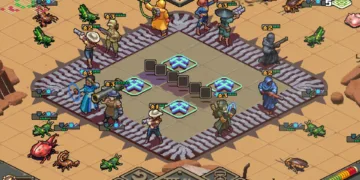
Fortunately, arranging those guns offers considerable pleasure. The station’s compact grid receives pressure from several directions, and its inner transport belt lets defenders rotate without spending their individual movement allowance. A threatened approach can be answered by redistributing the existing crew, preserving movement for further adjustments. This gives the battlefield a pleasing logistical flexibility. A useful firing position is temporary, dependent on the next wave and the locations of everyone else. The attractive pixel-art insects and mutants belong to a ruined world, but the work of keeping its freight moving remains briskly organized.
Merging complicates that organization in productive ways. Equal-level mercenaries can combine into stronger versions or new specialists, so the pistol, shotgun, and radiation recruits become material for an expanding vocabulary of attacks. Two level-two Radshots produce a Hazmire, which weakens targets and can strike several enemies, at the cost of shorter range. Combine that specialist with the Auto Pistols produced from upgraded Gunslingers and a Stormcaster becomes possible, bringing radiation damage over time and wider lane coverage. The discovery is satisfying because a new unit changes the shape of the defense you can construct.
The shorter reach of a Hazmire makes the exchange tangible. Losing a body through fusion can free transport space, yet the remaining specialist still needs a position from which its abilities matter. Power and coverage refuse to stay interchangeable. The hazardous fire drawback attached to a heavy railgun unit adds another reason to question an apparently desirable upgrade. Curiosity has a cost in cindermint, bodies, and placement, which prevents experimentation from becoming a detached collection exercise. A combination must survive the circumstances in which you created it.

Staying for another round supplies resources for that experiment while inviting stronger opposition. This is where the disposable-worker satire encounters a small resistance within its own rules. Once you understand what a specialist contributes, abandoning it becomes harder to justify. The attachment is functional: that unit covers an approach, applies an effect, or completes a developing build. Yet functional attachment still alters the evacuation calculation. The employer purchases replaceable labor; the player gradually learns distinctions between workers that the hiring system initially reduces to three basic roles.
Those distinctions travel with the train. Between stations, the crew fires automatically at surrounding swarms while the player directs fire and can trigger an overdrive ability. The shift from turn-based defense to an on-rails autobattler gives the earlier decisions a second setting in which to prove useful. Carrying a particular specialist matters beyond the grid where it was assembled. Reduced direct control need not diminish that authorship: watching a carefully chosen crew fire together can provide the pleasure of seeing preparation take effect, without asking the player to repeat the same positioning puzzle.
The action communicates its results poorly, though. Projectiles become difficult to separate from the surrounding activity, and damage to the train or its defenders is hard to follow. The station phase lets you consider a unit’s position against an approaching threat; transit makes it harder to identify which part of the crew is succeeding or failing. This weakens the connection between the modes. A build can survive the swarm without teaching much about its strengths, while a damaging passage may leave the necessary adjustment obscure. The visual abundance supplies spectacle at the expense of useful diagnosis.
Missing information already troubles the quieter half. The separate tutorial leaves interactions unexplained, and unit damage, ranges, special abilities, and enemy behavior receive inadequate treatment. An enemy reference that gives health without explaining its attack pattern offers little basis for planning around it.

The fusion preview and discovery compendium support curiosity, but recognizing a possible recruit cannot substitute for understanding what it will do. Discovering an unexpected specialist is enjoyable. Committing scarce resources without adequate knowledge of its basic rules makes the same experiment unnecessarily expensive.
Unreliable inputs create a different problem. Cursor loss interrupts work on the grid, and a move reversal that restores a unit to the wrong square can spoil the attack it was supposed to recover. Such failures damage the trust required by a game whose evacuation decisions already demand precision. Better explanations would leave these mistakes untouched. There is an unfortunate echo of the fictional company’s casual approach to training in the incomplete guidance, but the resemblance supplies no excuse for making the player absorb the cost.
Repeat play depends heavily on what can be learned from that cost. Discovery records persist, reward cards modify the current run, and unlockable train models offer different statistics, without a permanent currency ladder steadily strengthening the starting crew. That arrangement gives accumulated knowledge considerable responsibility.
Early discoveries can justify another attempt; familiar combinations eventually require a clearer sense of how to use them differently. After a lengthy failed run, an identifiable mistake offers something concrete to reconsider at the next station. An unexplained interaction or misplaced reversal sends the player back through the recruitment process with the original uncertainty still intact.
The Review
Australia Did It: End-of-the-World Railway Defense Business
Australia Did It turns corporate indifference into absorbing tactical decisions: recruit another defender, attempt a fusion, decide who gets aboard. Its international production finds a recognizable target in disposable labor, while mobile defenses and inventive specialists give that satire mechanical substance. Poorly explained abilities, muddled transit feedback, and unreliable move reversal compromise the pleasure of learning. The strongest station encounters reward resourcefulness, but repeated runs ask for confidence that the interface struggles to earn.
PROS
- Discoverable unit combinations reshape tactical possibilities.
- Rotating defenses create flexible positioning choices.
- Recruitment and evacuation give corporate satire practical weight.
CONS
- Incomplete explanations obscure unit and enemy behavior.
- Transit combat makes damage and build performance difficult to read.
- Cursor loss and unreliable reversal undermine precise planning.