























Misty Jones has a reputation for being difficult, and Heartland keeps arranging for her to be right. When Jessica Chastain’s retired country singer slashes a dismissive manager’s tires, then offers a surveillance camera her middle finger, the scene gives us the satisfaction of watching professional courtesy expire. The gesture is funny because she knows she is being recorded. Nashville can keep its evidence. She has stopped submitting herself for approval.
Yet writer-director Shana Feste is careful about how much disapproval we might feel. Misty’s aggression usually finds someone unpleasant enough to justify our enjoyment. Her language, drinking, and readiness to pull a gun advertise a woman beyond respectable behavior, while the screenplay keeps her essential decency protected. The people who exchange threats backstage and smiles before the cameras seem considerably less honest. Misty is allowed to look outrageous because the film has already sorted out who deserves it.
That arrangement acquires some force when her niece disappears. Charlie Heart (Carter Faith), a young country singer with a history of erratic behavior, has been missing for days. Her father, Donny (Paul Sparks), asks his estranged sister for help; the police and Charlie’s handlers are inclined to treat her absence as another episode of unreliability. Misty leaves her Georgia farm and returns to the Nashville she abandoned twenty years earlier. An established reputation has become an excuse to stop looking closely. Charlie’s previous behavior is made to explain her present absence before anyone has adequately investigated it.
Here, being difficult becomes a useful qualification.
Chastain gives Misty’s refusal to cooperate with indifference a physical, occasionally excessive pleasure. She storms through encounters with people accustomed to controlling access, and her confrontational behavior keeps the questioning from becoming entirely mechanical. The film sells the fantasy of having sufficient nerve to make an evasive person answer you. It also gives that fantasy a specific grievance: a young woman’s distress has become inconvenient to the people managing her career.
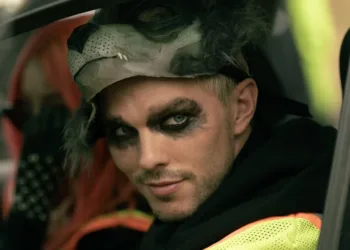
I initially wanted Feste to leave Misty’s righteousness less securely insured. But that demand deserves examining. An angry female protagonist need not commit an unforgivable act to justify being taken seriously, and there is nothing artistically disreputable about enjoying her refusal to behave. The weakness lies in how little resistance the mystery offers her interpretation of this world. Roy Combs (Garrett Hedlund), Charlie’s well-connected manager, her singer ex Jace (Ross Lynch), and an obsessive fan provide a succession of suspicious encounters. Too often, meeting the next possible culprit changes the name under examination without substantially changing our understanding of what might have happened.
Local suspense survives this problem. The visit to the fan’s dark, neglected home, where his grandmother is also present, makes the immediate encounter uneasy. Feste and cinematographer Khalid Mohtaseb can make a room feel dangerous even when the larger plot has become easy to anticipate. Their neon-lit clubs and performance spaces also give the investigation a recognizable social setting: people threaten, negotiate, and perform within the same small professional world. The film has atmosphere and forward movement. Its revelations supply less disturbance than its individual confrontations promise.
The music offers a different kind of inquiry. Lyrics Charlie leaves behind become part of Misty’s search, and Chastain’s performance of her niece’s song makes listening an act with practical consequences. A piece of work that could circulate as entertainment contains something requiring personal attention. That connection gives the country setting a purpose beyond the hats and illuminated stages. These people make careers out of expressing pain; recognizing the person expressing it proves a less reliable skill.
Feste is less persuasive when she piles familiar signs of damage around Misty. The drinking, casual sex, loneliness, and Grammy stored in an almost empty refrigerator make her unhappiness legible with remarkable efficiency. The refrigerator is practically a personnel file. Chastain supplies the instability these shorthand details cannot: the tearfulness beneath an aggressive entrance, the sense that an insult can become either a weapon or a small collapse. Her broadness sometimes approaches caricature, but the exposed hurt keeps interfering with the swagger.
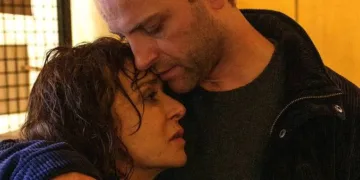
The encounter with Clark (John Hawkes), Misty’s songwriter ex-husband, gives that interference room to develop. Their shared history cannot be managed as easily as another hostile interview. Chastain and Hawkes play the conversation as people testing what remains usable between them, with familiarity providing no guarantee of comfort. Misty can intimidate strangers into responding; knowing someone intimately leaves her with fewer such advantages. Here the film’s interest shifts from finding the withheld fact to living with knowledge neither person can simply discard.

Donny’s relationship with his sister carries a similar possibility, but their shared secrets receive concentrated attention without enough subsequent development. The investigation keeps creating reasons for Misty to revisit her past, then moves her toward the next suspect before those returns can change much between the people involved. The problem is a distribution of attention. Feste can find time for another suspicious man while a difficult family conversation is left carrying years of estrangement almost by itself.
That imbalance reaches the stage in Misty’s duet with the former friend and rival played by Jennifer Nettles. Musically, their pairing gives her return an appealing generosity: she can occupy a performance without having to fight for every inch of it. Dramatically, the reconciliation asks the song to settle a relationship that has received limited preparation. Female solidarity is a welcome possibility here, but it becomes thinner when treated as the appropriate destination for a woman whose anger has made everyone uncomfortable.
I can enjoy the duet and still resist the suggestion that sharing the spotlight completes her rehabilitation. Nettles gives the encounter warmth, and for the length of the performance, Misty has someone beside her who is participating in the music rather than demanding an explanation for her behavior.
Heartland is a country music-infused mystery thriller directed by Shana Feste that premiered globally on Netflix on November 13, 2026. The film follows reclusive former country superstar Misty Jones as she returns to Nashville to investigate the sudden disappearance of her rising-star niece, plunging into the dark underbelly of the music industry while confronting her own past. You can currently stream the movie worldwide exclusively on Netflix.
Where to Watch Heartland (2026) Online


Full Credits
Title: Heartland
Distributor: Netflix
Release date: November 13, 2026
Rating: R
Running time: 114 minutes
Director: Shana Feste
Writers: Shana Feste
Producers and Executive Producers: Peter Chernin, Jenno Topping, Randall Poster, Jason Owen
Cast: Jessica Chastain, John Hawkes, Carter Faith, Garrett Hedlund, Jennifer Nettles, Ross Lynch, Ben Dickey, Paul Sparks
Director of Photography (Cinematographer): Khalid Mohtaseb
Editors: Dominic LaPerriere
Composer: Danny Bensi, Saunder Jurriaans
The Review
Heartland
Heartland makes an entertaining case for refusing to behave, with Jessica Chastain finding hurt beneath Misty's aggression. Its songs and confrontation with her ex-husband suggest a richer inquiry into the women Nashville celebrates, then stops hearing. I don't need Misty to be less defensible; I need the mystery to test her understanding instead of confirming it so readily. Predictable suspects and abbreviated relationships leave that promise partly fulfilled, even when the music makes reconciliation sound convincing.
PROS
- Chastain balances abrasive humor with exposed hurt.
- Songs make listening part of the investigation.
- The Clark confrontation gives shared history emotional complexity.
- - Nashville atmosphere and the stalker encounter sustain local tension.
CONS
- Suspect encounters offer little genuine uncertainty.
- Family conflicts and reconciliation receive insufficient development.
- - Familiar damaged-star shorthand overexplains Misty's unhappiness.