
























Two operations take place beside each other because there is electricity for only one light. In Levan Koguashvili’s Guria, this is a practical arrangement, arrived at within a hospital that must accommodate wounds without having enough of the things required to treat them. Morphine is scarce too. The absurdity invites laughter, then leaves the patients lying there, still dependent on the same inadequate provision of care. Being hurt has brought them into a place where somebody will try to help. How much help their bodies can expect is another matter.
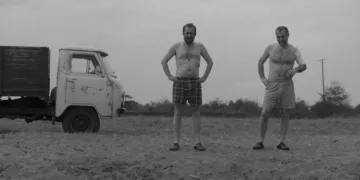
The black-and-white photography makes this precarious world surprisingly easy to remain inside. Gigi Samsonadze and Giorgi Shvelidze give the gray tones a delicate range, with fine grain and mist lending the rural landscape a softness that sits uneasily beside the injuries.
There is pleasure in looking, even when the circumstances offer little comfort. Sometimes that beauty puts a little too much distance between the viewer and the deprivation. Yet the hospital’s crowded improvisation resists becoming picturesque: care still requires enough light to work by, whatever consolations the image offers us.
Zuriko, a widowed hazelnut farmer played with dour restraint by Kakhaber Tcholadze, reaches this predicament after refusing to accept a poor price for his crop. His friend Gela accompanies him in search of a better buyer; armed robbery interrupts the errand.
In this western Georgian community during the early post-Soviet 1990s, selling what you have grown can expose you to someone else’s gun. Zuriko’s stubbornness has a touching modesty. He wants his labor to be worth something, and the refusal to accept otherwise sends him out onto the road with a friend willing to help him try.
Elsewhere, people sing. The polyphony heard at the beginning returns through rehearsals and communal occasions, giving the film an intimacy that its wandering narrative sometimes struggles to sustain. At choir practice, the weathered faces belong to people engaged in something they can still do together, without waiting for an electricity supply or a fair offer from a buyer.
The sweetness of their voices can feel almost startling against the material frustrations surrounding them. Singing occupies time differently from bargaining. These people can remain with a phrase, listening and responding, while so much of their daily contact involves trying to obtain something in short supply.
Koguashvili finds similar emotional space within the Miss Guria pageant, whose prize is a food processor with its instruction booklet. The modesty of the reward and the ceremony around it produce an affectionate embarrassment. It would be easy to look down on the occasion; the film spends enough time among these people for their wish to participate to acquire its own weight. In a place where disappointment is so readily available, preparing for a contest offers something to anticipate.

Across approximately two hours, however, that patience becomes difficult to distinguish from dispersal. The first half keeps offering encounters, customs, and comic inconveniences, renewing our acquaintance with the village while delaying a deeper investment in its particular relationships.
When the romantic rivalry involving Zuriko’s son Achi, his classmate Eka, and the brash Beso takes greater hold, the story asks for an attachment that the accumulated anecdotes have only partly supplied. I could feel fondness for the company without always feeling the force of its changing circumstances. The later emphasis on consequences arrives after a long stretch in which incidents have chiefly provided opportunities to spend further time here.
One small gesture supplies the intimacy that this expansive approach can miss. Maia, the music teacher Zuriko pursues, sees him flirting with women at the beach and walks away, then turns back to kick sand at him. Natia Nikolaishvili lets irritation interrupt the dignity of her departure.
Leaving should have been sufficient; her hurt requires that brief, ridiculous return. The action is funny because it is so poorly suited to concealing what she feels. For a moment, courtship loses its communal bustle and becomes the embarrassing experience of caring about somebody who has made you feel replaceable.
Other women receive less room to be emotionally untidy. Irma, a prospective wife for Zuriko, encounters the scrutiny of his former mother-in-law, Veriko, and her inability to pluck a chicken becomes evidence against her suitability. The practical test is comic, but it leaves little space for the experience of arriving somewhere to be assessed for domestic usefulness.
Eka’s place within the boys’ rivalry becomes still less comfortable when the later drama turns on bride abduction. The film has considerable patience for male foolishness and the trouble it creates; its access to her desires is thinner. Mocking the men’s posturing does not resolve that absence. Their mistakes keep them vivid, while the women affected by them can remain frustratingly difficult to know.
Gela, played by Vamekh Jangidze, receives a fuller share of the film’s affection, and his friendship with Zuriko carries a tenderness that needs no declaration. He goes along to find a buyer. He shares the danger that follows. That practical availability makes their bond moving, particularly in a world where requesting help elsewhere so often exposes another shortage. It also makes Gela available for punishment.
He repeatedly takes punches, sometimes to settle disputes for which he bears no responsibility. Drink and physical confrontation allow the men to negotiate their way back into one another’s company, with Gela absorbing some of the expense. The warmth between these friends remains palpable as he is drawn into the humiliating work of keeping peace, taking a blow so that somebody else’s quarrel can end.
Guria had its world premiere at the 83rd Venice International Film Festival on September 9, 2026, and is touring international film festivals following its selection as Georgia’s official submission for the 99th Academy Awards. Directed by Levan Koguashvili, the tragicomedy follows a forty-five-year-old widowed hazelnut farmer in post-Soviet western Georgia who refuses to accept unfair prices from buyers while pursuing a local music teacher amid everyday absurdities and family pressures.
Where to Watch Guria (2026) Online
Full Credits
Title: Guria
Distributor: Cineworx GmbH Distribution, Loco Films
Release date: September 9, 2026 (Venice Film Festival)
Running time: 1 hour 58 minutes (118 minutes)
Director: Levan Koguashvili
Writers: Boris Frumin, Levan Koguashvili, Giorgi Kekelidze
Producers and Executive Producers: Olena Yershova, Levan Koguashvili, Boris Frumin, Pascal Traechslin, Donato Rotunno, Stefan Kitanov, Kanat Doğramacı, Elisa Fernanda Pirir
Cast: Kakhaber Tcholadze, Natia Nikolaishvili, Vamekh Jangidze, Davit Natsvaladze, Anamaria Kamladze, Sergi Kviloria
Director of Photography (Cinematographer): Gigi Samsonadze, Giorgi Shvelidze
Editors: Pia Dumont
Composer: Giorgi Gordeladze
The Review
Guria
Guria finds a bruised tenderness in people who keep offering one another company when practical help is scarce. Its gray landscapes and communal singing make that company inviting, while Zuriko and Gela’s friendship carries the uncomfortable weight of loyalty. The wandering construction weakens the later drama, and the women seldom receive the emotional freedom granted to foolish men. Yet Maia’s wounded gesture on the beach gives this affectionate, uneven film a sudden closeness that its larger ensemble cannot always sustain.
PROS
- Finely textured black-and-white photography
- Communal singing creates genuine intimacy
- Nikolaishvili’s precise expression of Maia’s hurt
- Moving friendship with an uneasy cost
- Affectionate humor grounded in everyday hardship
CONS
- Episodic sprawl weakens the later drama
- Women receive limited emotional depth
- Visual beauty occasionally distances the hardship