



















Black Church Bay is a remarkably assured psychological thriller, one that understands how the most beautiful images can contain the ugliest moral arrangements. Writer-director Rhys Marc Jones makes his feature debut with a film whose visual intelligence proves as important as its disturbing subject matter.
Cinematographer Lasse Ulvedal Tollboll photographs the Anglesey coastline in brilliant natural light, allowing the sea to glitter beneath expansive blue skies. It is an almost aggressively inviting landscape, apparently offering freedom from the restrictions of ordinary life. Yet the relationship unfolding against this picturesque background involves an imbalance of power that no amount of sunshine can disguise. Jones has the confidence to establish his darkest material under the clearest possible illumination.
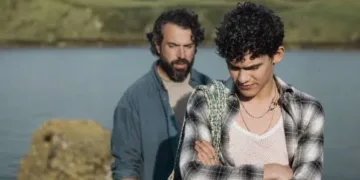
Forty-year-old Barry (Tom Cullen) takes eighteen-year-old Jasper (Joe Locke) sailing for a secluded weekend along the Welsh coast. At the harbor, a stranger casually assumes they are father and son, an innocent misunderstanding that immediately exposes the uncomfortable discrepancy between appearances and reality. Barry is a respected schoolteacher, Jasper is his student, and their clandestine sexual relationship threatens everything the older man has constructed around himself.
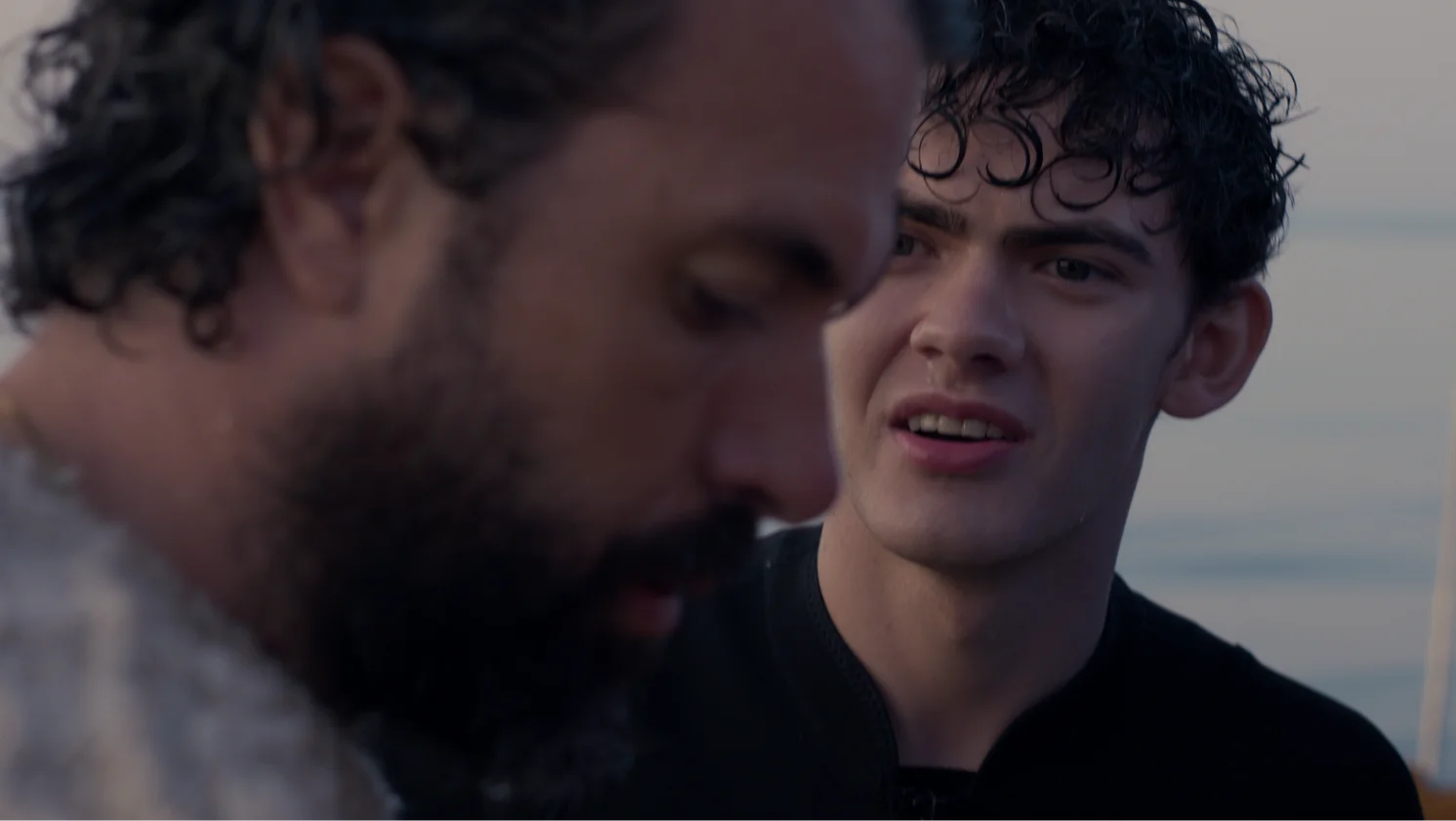
Open water suggests limitless possibilities, yet their boat is an extraordinarily confined environment in which Barry controls the circumstances and Jasper possesses little institutional power. Even before anything goes wrong, Jones has established a visual contradiction between physical openness and psychological confinement.
The early interactions between Cullen and Locke give that contradiction considerable force. Jasper approaches their encounter with the confidence of someone accustomed to displaying his private life on social media. Barry regards the same intimacy as a potentially catastrophic breach of secrecy.
When the possibility of being recognized by local youths arises, Cullen conveys Barry’s anxiety through a sudden collapse of his already fragile composure. His character cannot experience desire without calculating the danger of discovery. Locke, meanwhile, gradually exposes the vulnerability beneath Jasper’s provocative confidence, particularly once the teenager finds himself isolated from his familiar social environment.
This is an excellent, deeply uncomfortable character study, and Cullen’s performance makes it especially difficult to look away. Barry is closeted, maintaining a relationship with fellow teacher Kelly (Marli Siu) while pursuing anonymous encounters with men through dating apps. His professional respectability provides a convenient disguise for a private existence he refuses to acknowledge publicly.
A teaching position, apparently, remains a remarkably effective form of camouflage. Cullen plays this compartmentalization with extraordinary control, letting Barry’s mounting anxiety emerge through his reactions to increasingly dangerous circumstances. Yet his performance never asks us to mistake psychological distress for innocence. Barry’s genuine fear of exposure exists alongside his willingness to exploit a much younger student.
Jasper’s secret recording of an intimate encounter crystallizes the differences between them. For Jasper, documenting sexual experience belongs to a culture of openness, experimentation, and social visibility. For Barry, the existence of such footage represents a potentially devastating loss of control. The camera becomes a particularly loaded object within a film already concerned with the consequences of being seen.
Their contrasting attitudes reflect different generational experiences of queer identity, but the imbalance extends beyond attitudes toward sexuality. Barry possesses professional authority and a carefully maintained public reputation. Jasper, despite his confidence, remains a teenager pursuing an adult who occupies a position of responsibility over him.
When Jasper disappears during the night, the film’s psychological tension changes character. Barry awakens to find himself alone aboard the boat, uncertain of what has happened and terrified of the consequences of revealing their relationship. His return to school offers no refuge. Jasper’s absence becomes increasingly alarming, police inquiries begin, and the community mobilizes around the missing teenager.
Barry must continue performing the role of a concerned teacher while concealing information that could fundamentally alter the investigation. Jones, serving as his own editor, intersperses these developments with flashbacks to the sailing weekend. Each return to the past modifies our understanding of the relationship, introducing additional uncertainties into a situation already saturated with deception.
The cinematography undergoes a corresponding transformation. The expansive daylight compositions of the opening give way to half-lit silhouettes, oblique framing, and oppressive shadow. Jones draws upon the visual grammar of classical noir, particularly its use of chiaroscuro to express moral instability. The earlier coastal images had suggested that the world was available to Barry and Jasper without restriction.
The later compositions increasingly deny Barry that sense of freedom, placing his growing desperation within visually unstable environments. Off-kilter angles make familiar spaces feel uncertain, while the shadowed imagery gives his carefully concealed existence a physical form. Barry’s public identity remains intact, yet the film’s visual treatment of him becomes progressively fractured as his behavior grows harder to defend.
There is something particularly effective about locating this expressionistic anxiety within ordinary school surroundings. Barry’s workplace represents the respectable identity he is desperate to preserve, and every interaction there threatens to destroy it. The contrast between his institutional authority and his increasingly compromised personal conduct lends the school sequences an atmosphere of suffocating hypocrisy.
Oliver Coates’s score intensifies this instability through nervous strings and low, heartbeat-like percussion. Its most effective passages work alongside the film’s deliberate silences, creating a pattern of mounting pressure interrupted by moments of unnerving stillness.
During the investigation, the gradual accumulation of information becomes almost physically exhausting because Jones refuses to release the tension through easy explanations. The flashbacks provide additional knowledge without guaranteeing certainty. We learn enough to question Barry’s account of events, then find ourselves trapped once again within his limited understanding of what happened.
This manipulation of sympathy is the film’s most sophisticated psychological achievement. Barry’s circumstances make his panic comprehensible, and Cullen possesses enough emotional subtlety to prevent the character from becoming a conventional villain. Yet the closer we remain to his perspective, the greater the risk of overlooking the teenager whose disappearance has created the crisis.
Jasper gradually becomes an absence around which everyone else constructs explanations. Locke’s earlier performance makes that absence especially troubling. His character’s brashness, vulnerability, and desire for recognition establish an individual considerably less simple than the public image subsequently assembled from his sexual history.
The investigation also exposes the community’s troubling assumptions about queer teenagers. As Jasper’s intimate photographs and relationships become subjects of scrutiny, his sexuality threatens to overshadow his vulnerability. Dylan Michael’s Miles, another student connected to Jasper, becomes caught in this exposure, losing control over information concerning his own private life.
His predicament provides a revealing counterpoint to Barry’s carefully protected identity. The adult teacher has spent years concealing his sexuality behind professional respectability, whereas the younger characters find their privacy compromised by an institutional response ostensibly intended to protect them. The school’s and wider community’s reactions expose the persistence of shame and suspicion beneath an apparently accepting social environment.
Jones handles these tensions with considerable intelligence, although the story’s sustained concentration on Barry creates a lingering discomfort about whose suffering receives the greatest dramatic attention. His fear dominates the narrative, while Jasper increasingly exists through recollections, disclosures, and the judgments of others. That imbalance serves the film’s psychological design, particularly as viewers find themselves hoping Barry will escape certain situations despite understanding the implications of his conduct. The moral difficulty arises from the distance between what Barry fears losing and what Jasper has already lost.
Unfortunately, the final third occasionally sacrifices the psychological precision that makes the preceding material so effective. Barry’s earlier paralysis gives way to increasingly frantic behavior, and the acceleration does not always feel proportionate to the careful development of his character. The film has spent considerable time examining the incremental pressures behind his decisions, making the sudden concentration of consequential actions feel somewhat compressed. Cullen remains convincing, but the narrative briefly seems impatient with the very uncertainty it has cultivated so effectively.
The ending presents a different challenge. Jones refuses conventional narrative closure, introducing a disturbing degree of surrealism into a thriller previously grounded in recognizable social and psychological behavior. The imagery of students sitting unresponsive with their backs turned carries an almost expressionistic severity, recalling the earlier transformation of familiar spaces into manifestations of Barry’s distress.
Its abruptness may frustrate viewers expecting the investigation to resolve its central mysteries, and the preceding rush makes the transition less graceful than it might have been. Yet the refusal to provide reassuring answers remains consistent with the film’s treatment of responsibility and institutional failure. The students’ motionless figures offer no readable response, leaving the implications of Barry’s actions suspended before an audience that has spent much of the film searching his face for signs of guilt.
Black Church Bay had its world premiere in competition at the Zurich Film Festival on September 25, 2026, followed by UK festival screenings at the BFI London Film Festival in October 2026 and the Leeds International Film Festival in November 2026, ahead of a general UK and Ireland theatrical release through Vertigo Releasing scheduled for Spring 2027. Written, edited, and directed by Rhys Marc Jones and starring Tom Cullen and Joe Locke, the Welsh psychological drama-thriller follows a deputy head teacher whose secret double life threatens to unravel after a sixth-form student disappears following a weekend sailing trip off the coast of Anglesey.
Full Credits
Title: Black Church Bay
Distributor: Vertigo Releasing (UK and Ireland), The Bureau Sales (International Sales)
Release date: September 25, 2026 (Zurich Film Festival world premiere), October 15, 2026 (BFI London Film Festival UK premiere), Spring 2027 (planned UK and Ireland general theatrical release)
Running time: 1 hour 47 minutes (107 minutes)
Director: Rhys Marc Jones
Writers: Rhys Marc Jones
Producers and Executive Producers: Alex Polunin, Tristan Goligher
Cast: Tom Cullen, Joe Locke, Marli Siu, Rakie Ayola, Julian Lewis Jones, Celyn Jones, Dylan Michael, Gwen Ellis, Nathan Hall
Director of Photography (Cinematographer): Lasse Ulvedal Tolbøll
Editors: Rhys Marc Jones
Composer: Oliver Coates
The Review
Black Church Bay
Black Church Bay is a gripping, morally unsettling psychological thriller that uses light and shadow to expose the fragile architecture of secrecy. Tom Cullen delivers a superbly controlled performance, while Rhys Marc Jones transforms the Welsh coastline into a landscape of deception and mounting guilt. Intelligent editing, oppressive cinematography, and Oliver Coates's unnerving score sustain the tension. The hurried final act weakens some of that precision, and Jasper occasionally becomes secondary to Barry's suffering. Still, this remarkably confident debut deserves attention for its refusal to offer easy moral comfort.
PROS
- Exceptional, psychologically complex performance from Tom Cullen
- Striking cinematography with meaningful use of light and shadow
- Expertly controlled suspense through editing and sound
- Intelligent examination of guilt, power, and queer identity
CONS
- Final act accelerates too abruptly
- Surreal ending feels insufficiently developed
- Jasper's perspective sometimes gets overshadowed