





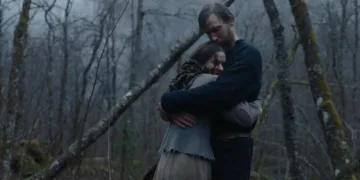



















Question a child with his mother nearby in Hillthorn and the response arrives as a card depicting her disapproving gaze. There is no dialogue exchange to explain her objection. You have to read the relationship, recognize an obstacle, and decide what this encounter permits. The card supplies a social fact rather than an answer to the missing-person case. It is a small, effective way of placing the player outside the settlement’s accepted company: you can see that a rule exists before you understand everything it protects.
Developed by Montreal studio Fool Moon with Finnegan Motors, Hillthorn gives detective noir and rural folk horror a shared visual vocabulary. The private investigator arrives with a professional reason to ask questions; the secluded community has its own ideas about who deserves answers.
Neither tradition needs an explicitly Canadian setting to travel through this Canadian production. Their meeting makes the cards particularly useful. A person, a place, an object, and a hostile reaction can occupy the same tabletop, asking the player to interpret the connections between them. Short labels and descriptions remain, but conversation gives way to images whose meaning depends on their company.
The investigation concerns Olivia’s disappearance near Mount Hillthorn, and its basic grammar is taught before the case gets underway. Even the menu requires cards to be investigated. Inside the mystery, Investigate, Talk, and Explore combine with cards representing the things around you.
Add a clue to an exchange with a character and it becomes the subject of a question. Combine a key with the relevant locked door and access follows. Teaching the menu through this same procedure gives the interface a pleasing continuity: the activity used to enter the game becomes the method used to understand its world.
That world also extends beyond the cards. A window throws its shadow across the office background; tree shadows establish the forest around the playing surface. These details give the investigator a position within a place, even while the objects available for inspection remain abstracted into pictures. Ambient sounds and occasional noir-inflected music supply an environment the cards cannot fully display.
The reduction of dialogue has a related benefit for a game travelling between languages, including its Brazilian Portuguese localization. Much of an encounter’s meaning survives outside a translated sentence. Yet the mother’s gaze still demands interpretation, and the presence of localized text acknowledges that pictures cannot carry every distinction unaided.

The strongest interactions make understanding useful without treating every image as another tool. Some thought and feeling cards are informational, requiring the player to adjust an interpretation rather than drag them through every possible combination.
Elsewhere, gaining access becomes a decision about conduct. A locked house can be entered with its key or forced open at the cost of injury and increased suspicion; another lead can be pursued instead. The outsider’s position acquires practical consequences here. Information can be obtained through an action that makes the investigator’s presence less welcome, leaving the player to weigh entry against its cost.
There are limits to the reasoning this vocabulary supports. A page containing the symbols needed for a lock supplies a solution to transfer, while finding the person who provides a key can reduce a promising lead to an acquisition task. The manageable set of cards makes experimentation readable, but readability alone cannot give each puzzle depth. Hillthorn is often most persuasive in the interval before an answer, when a reaction or clue changes the player’s understanding of someone. Once that uncertainty has resolved into the correct object for the correct opening, the remaining action can be routine.
The repeating day adds another way of reading the settlement. From midday until midnight, each action spends part of a limited allowance, after which the loop takes away physical possessions and some evidence. A church sermon at 6 p.m. gives this system its clearest social expression. You can attend the gathering or investigate places while their occupants are elsewhere. Religious practice becomes a timetable with consequences for access. Learning the village means learning what its residents do together, then deciding how to use an opportunity created by their absence.

Retained knowledge gives later attempts direction. Passwords survive as knowledge, and shortcuts eventually reduce certain repeated tasks and routes. Multiple endings also give the investigation reasons to continue beyond its first resolution. The important distinction is between returning with a different plan and repeating a plan whose meaning is already exhausted. Remembering a password can remove uncertainty, but remembering where to acquire a physical item does not necessarily remove the errand. The player’s understanding develops faster than the inventory can be rebuilt.
Forest travel exposes that uneven relationship through directional cards that must be selected in sequence. Initially, finding a route belongs to the work of deciphering an unfamiliar mountain. Repeating it alongside the recovery of familiar keys spends time without necessarily changing the investigation.
Later shortcuts offer real relief, though the remaining retrieval work still competes with following new leads. The midnight reset can make a successful discovery feel provisional because its practical use depends on reconstructing the circumstances around it. Attention shifts from Olivia’s disappearance toward fitting known actions into the available hours.
A midgame timing requirement makes the problem sharper. Progress depends on reaching a particular condition at the right place and time, but the relevant clue has already served another timed action, leaving its further application poorly signalled. The difficulty lies in recognizing that the investigation still needs something from apparently understood information.
This differs from the sermon, whose announced hour gives the player a basis for planning. Here, repeated attempts can consume the day while offering little reason to revise the right assumption. Existing leads become usable again after the condition is met, but until then the player must keep rebuilding an investigation without knowing which part of its schedule needs to change.
The Review
Hillthorn
Hillthorn brings noir’s questioning outsider into folk horror’s guarded community, giving their encounter an expressive card language. A mother’s disapproval and a church gathering become information the player must interpret and use. Shadows and sound sustain the menace, but repeated retrievals, simple lock solutions, and a poorly signalled timing requirement weaken the pleasure of discovery. Its visual storytelling earns attention; its investigation too often makes understanding wait upon another round of errands.
PROS
- Expressive cards turn social cues into investigative evidence.
- Menu interactions teach the investigation’s visual grammar.
- Shadows and ambient sound give the tabletop world atmosphere.
- Community routines create meaningful choices about access.
CONS
- Repeated travel and item retrieval interrupt new discoveries.
- Some key and symbol puzzles require little deduction.
- A midgame timing requirement lacks clear guidance.