



























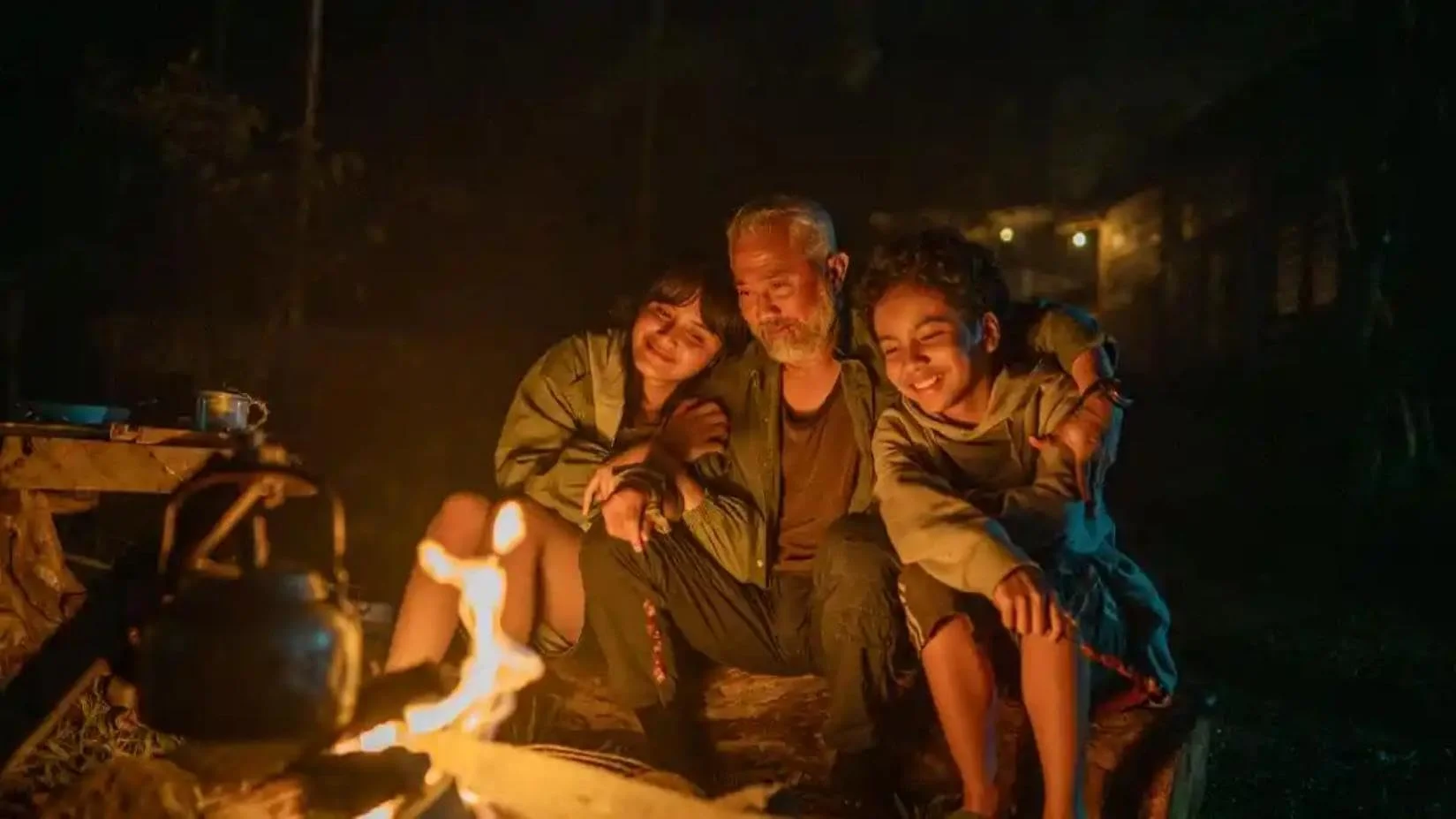

Putri and Dimas try to leave their grandfather’s home and discover that the local shopkeepers are a danger of their own. Hari comes to their rescue, disposing of three men with the efficiency of someone whose quiet retirement has done little to erode his training. The encounter gives the children an immediate reason to depend on a man they barely know. For Lukman Sardi, playing the retired commander, it establishes a useful distinction: Hari can protect his grandchildren long before he knows how to make them feel at home.
His intervention depends on Mayang, a deaf girl he helped after her parents died, who alerts him to the children’s predicament. She has already befriended Putri, extending a connection the grandfather struggles to establish himself. This small chain of assistance gives the rural Central Java setting some human texture. Hari’s solitude exists within a community where earlier care can return as practical help, and where predatory neighbors complicate the apparent peace. Director Sidharta Tata allows that mixture to disturb the refuge before the criminal gang arrives to destroy it.
The trouble in Never Surrender, also titled Serangan Balik, follows the children from Jakarta. Their father, Agus, played by Dennis Adhiswara, leaves them with Hari while attempting to profit from a drive containing evidence of money laundering. The children are the offspring of Hari’s late daughter, so this temporary arrangement carries an obligation that his withdrawn manner cannot comfortably express. Read beside Hindi family melodrama, the household has a familiar double function: it offers shelter while bringing unresolved duties into close quarters. Here, the children’s resistance to staying with their grandfather prevents family membership from automatically producing trust.
Tata and co-writer Khalid Kashogi give that resistance ample time but limited development. At approximately 140 minutes, the film repeatedly divides its attention between the household’s uneasy adjustment and Agus’s increasingly dangerous dealings. The pursuit of the drive supplies a clear route toward confrontation; the estrangement needs a less predictable accumulation of exchanges and decisions. Instead, the early rescue establishes Hari’s usefulness, and much of the subsequent setup leaves the emotional distance broadly where it was. The rural calm can delay the assault without making the family substantially richer. This is an imbalance of dramatic attention, rather than a problem with the premise’s simplicity.
The later training passage demonstrates how much these strands could accomplish together. Information about Hari’s military past accompanies preparations for the coming attack, while his work on Putri’s archery gives grandfather and granddaughter something specific to do with each other. Callista Arum’s character gains a skill with an immediate place in their defense.
Instruction supplies a form of contact suited to Hari’s reserve, allowing him to offer knowledge where conversation has been difficult. The montage moves briskly because background, changing relationships, and impending danger share the same activity. Its economy makes the earlier separation of those concerns feel especially cumbersome.
Sardi gives the physical side of that instruction credibility. His swift handling of the local men and his later combat with younger opponents make Hari’s expertise convincing without requiring a theatrical transformation into an action hero. The reserve remains; it simply acquires another use. His guilt over people he could not save during his military service also gives the protective role a particular urgency. He recognizes the prospect of failing someone again. Yet the film develops his capacity to act with greater precision than his capacity to live with others, leaving Sardi’s controlled presence to carry some emotional weight the writing has only sketched.
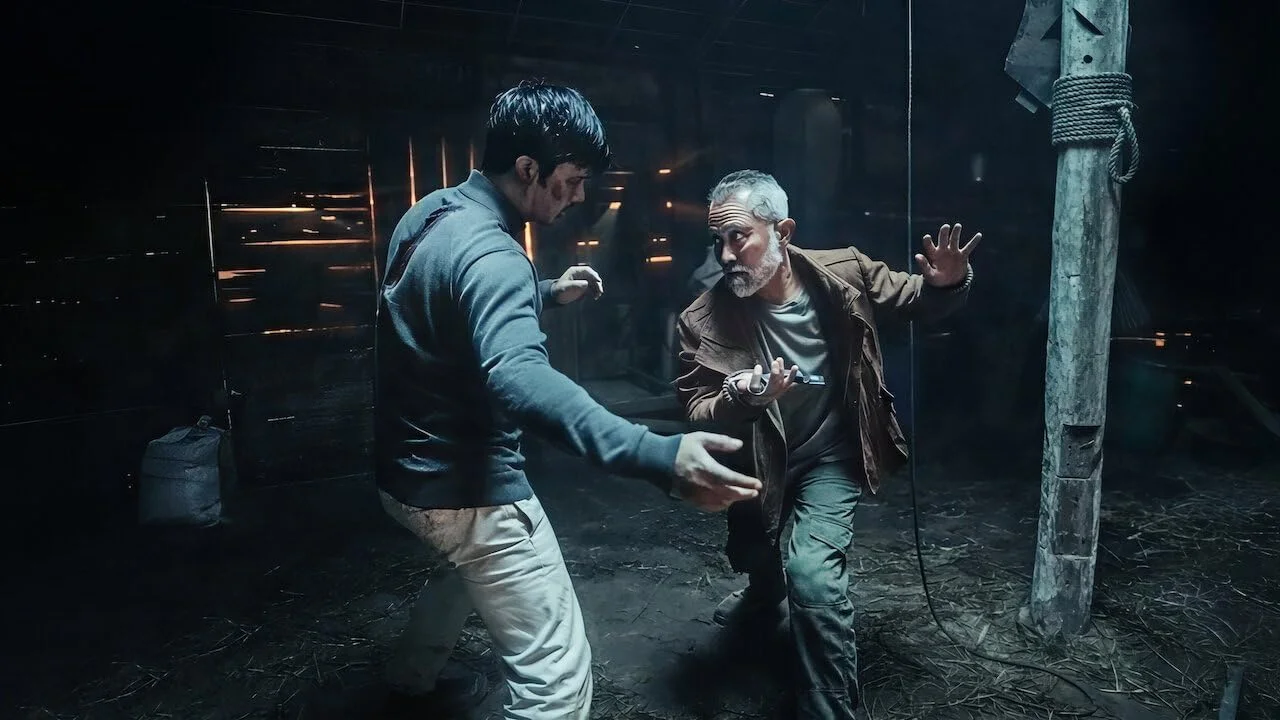
The criminal brothers supply a harsher expression of family attachment. Derby Romero’s Bastian, with his glasses and deceptively mild appearance, becomes frightening through his readiness to use a knife; the fight with Hari strips away any suggestion that he is merely an eccentric subordinate. Ulo, played by Donny Alamsyah, combines a composed exterior with cruelty, and his bond with Bastian helps turn a retrieval operation into personal retaliation. Kinship gives both sides reasons to fight, while their conduct keeps the distinction clear. Hari tries to get the children out of danger. Ulo brings violence into their home to satisfy his own claim of loyalty.
The action becomes most persuasive when Tata lets its changing scale determine the staging. Armed encounters among the trees give way to closer physical contests, and cuts between two simultaneous fights catch the rhythm of the movements rather than repeatedly forcing the viewer to start again.
The opening military operation is less successful: a knife fight inside a dark hut makes effortful viewing of action that should establish Hari’s competence. Later illumination improves visibility, though the mobile camera and quick cuts still sometimes compete with the choreography. Longer takes offer welcome stretches in which Sardi’s movement can register without so much editorial interruption.
Within the extended siege, preparing the house matters almost as much as defending it. Traps in and around the building turn familiar surroundings into a resource, while the children’s participation changes the distribution of responsibility. Hari remains the expert, but the household no longer functions as a collection of people waiting for him to save them. Putri’s archery connects the preparation directly to the confrontation. The film earns some of its strongest pleasure through that continuity: a lesson becomes useful under pressure, and the family begins to operate with a coordination its earlier conversations failed to establish.
The children choose to stay after Hari attempts to send them away, giving their participation an emotional basis beyond his need for assistance. Their decision also leaves his protective role in an uncomfortable position. Accepting their help means teaching them to survive an armed assault through violence of their own. Putri’s archery carries that tension into the fighting: the skill he has helped her develop gives her a means of defending herself, then makes her someone he must depend on. Sending the children to safety was his preferred expression of care; staying requires him to accept theirs.
Never Surrender premiered globally on Netflix on November 12, 2026. Directed by Sidharta Tata, the Indonesian action thriller follows a guilt-ridden veteran who must unite with his estranged grandchildren to survive when a deadly gang descends on his remote home.
Full Credits
Title: Never Surrender (Serangan Balik)
Distributor: Netflix
Release date: November 12, 2026
Rating: TV-MA
Running time: 2 hours 17 minutes (137 minutes)
Director: Sidharta Tata
Writers: Khalid Kashogi, Sidharta Tata
Producers and Executive Producers: Kimo Stamboel, Edwin Nazir
Cast: Lukman Sardi, Callista Arum, Sulthan Hamonangan, Derby Romero, Donny Alamsyah, Dennis Adhiswara, Ismi Melinda, David Hendrawan
Director of Photography (Cinematographer): Bagoes Tresna Aji
Editors: Akhmad Fesdi Anggoro
Composer: Abel Huray
The Review
Never Surrender
Never Surrender finds its strongest family drama in the practical work of survival. Lukman Sardi makes Hari's combat expertise persuasive, while the grandchildren's participation gives the siege an emotional purpose beyond defending the house. The training and coordinated resistance develop relationships that the prolonged setup leaves thin. Uneven action visibility adds friction, but the central tension holds: Hari learns to accept the children's care by allowing them into the danger he wants to keep from them.
PROS
- Sardi's credible physical performance and restrained presence.
- Grandchildren who actively contribute to the household's defense.
- Training that connects family attachment with practical skills.
- Rhythmic editing between simultaneous fights.
CONS
- Prolonged setup produces limited relational development.
- Underlit opening knife fight.
- Busy camerawork and quick cuts sometimes obscure choreography.