



















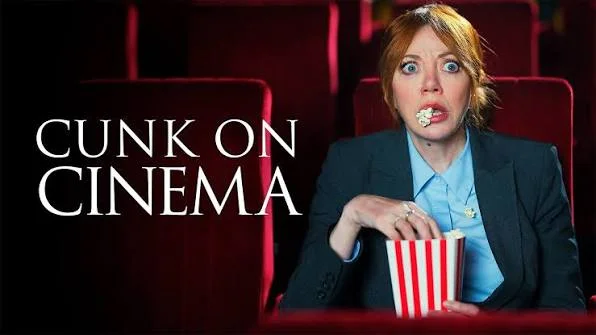

Philomena Cunk insists that Martin Scorsese is called Marvin, and Mark Kermode’s correction scarcely inconveniences her. He has the right answer. She has the capacity to keep talking. Watching him try to resolve this minor factual dispute, you begin to appreciate how much ordinary conversation depends on an agreement that being wrong might require something of you.
Diane Morgan gives Cunk no visible reason to reconsider. Her delivery has the flat certainty of someone explaining a parking restriction, while the pauses allow Kermode to attempt repairs she has never requested. The error itself is disposable. Morgan makes its persistence funny: Cunk can solicit expertise and remain untouched by the encounter. Kermode’s knowledge becomes another obstacle to finishing her question.
This is excellent casting for an authoritative documentary presenter. In Cunk on Cinema, the character surveys film history from early moving pictures to blockbusters and artificial intelligence, equipped with the familiar privileges of the format: handsome locations, declarative narration, interviews with people who know things.
Charlie Brooker and his fellow writers supply enough actual information to sustain the educational disguise. Morgan supplies a woman for whom information is mostly an interruption. Her apparent boredom matters. She rarely seems excited enough by an error to take responsibility for it.
I initially took the pleasure of these encounters to be straightforward: we know something Cunk doesn’t, and she cannot conceal it. But her treatment of The Bicycle Thief makes that explanation feel a little self-serving. She identifies the peculiar status of a revered classic that people can recognise, admire by reputation, and indefinitely avoid watching. Knowing the correct title hardly acquits the audience here. Cultural literacy can become a collection of passwords, useful for gaining admission to conversations (watching the film can wait). Cunk’s incuriosity has an embarrassingly respectable cousin.
That doesn’t make her a secret sage. Her question about how the shark composed the music for Jaws is gloriously dense, collapsing the creature on screen and the work that makes its presence frightening. Yet it also tests the temptation to treat every stupid question as disguised wisdom.
Taken seriously, hers would erase the composer altogether. The writing can puncture secondhand reverence without pretending that craft is an elaborate fraud. Its brief explanations of the Kuleshov effect, for instance, give viewers a real account of how meaning is produced through editing, inside a programme whose presenter keeps misunderstanding how films get made.
The affection for cinema lives in that gap between her account and the programme’s knowledge. You can laugh without passing an entrance exam, but the material rewards attention to the things she dismisses. The viewer’s advantage becomes less secure, and potentially less smug, once recognition stops being sufficient. Kermode is trying to communicate with another person. Reciting Scorsese’s filmography from the sofa would be considerably easier.

The interviews work best when that attempt to communicate develops its own comic pressure. Cunk asks Michael Bay about trying filmmaking without explosions, a question close enough to an ordinary criticism of his work to invite an answer. Her extended account of a friend’s bowel accident makes a different demand: he must now receive something with no professional reason to be in the conversation. The duration becomes part of the imposition. Morgan’s seriousness keeps offering him the possibility that a relevant point might eventually arrive, while the subject matter steadily withdraws it.
There is no need to decide how much Bay knew beforehand. His participation works through the visible effort of continuing the exchange; a claim that he was genuinely furious would add a production story the scene cannot establish. The comic labor is shared. Morgan’s refusal to release the premise needs another person willing to stay with it, and the guests’ patience often gives the absurdity room to grow. Kermode’s corrections create resistance; Bay’s continued presence allows a tangent to acquire an unreasonable amount of space.
Repeatedly mangling Battleship Potemkin’s title has less room to develop. The childish pleasure is real, and I wouldn’t demand that every rude noise justify itself intellectually. Still, once the substitution is familiar, the next appearance can feel like an allotted slot being filled. The interviews allow another person’s response to alter the rhythm. The recurring misnomers sometimes leave Morgan executing a joke whose destination we reached ahead of her. Her refusal to acknowledge the silliness can carry weak material, but it cannot make every recurrence feel newly necessary.
Artificial intelligence gives Cunk a practical solution to the inconvenience of other people. When an expert contradicts her, she can appeal to ChatGPT for support. The habit fits her precisely: a source becomes attractive because it will validate the answer she already prefers. The familiar documentary arrangement places a knowledgeable person opposite her; the chatbot offers an escape from having to listen. This is a sharper use of the technology than a detached warning about Hollywood’s future, because the problem acquires a recognisable user and an immediate purpose.
The repeated AI interventions do begin to labor a point the character has already made legible. Giving Buster Keaton a Cornish voice supplies an absurd novelty, but the invitation to recognise her terrible judgment becomes predictable when each new demonstration asks for much the same response. The satire is most pointed when her satisfaction reveals a standard of value, rather than merely confirming that she likes rubbish.
Her presentation to screenwriter Steven E. de Souza of a brief generated clip showing a giant chicken chasing a man gets at that standard. She has acquired moving images, an incident, something to show someone. What interests me is how little curiosity she brings to the distance between that acquisition and filmmaking.
Across her encounters with people who make and discuss cinema, she keeps meeting decisions, skills, and explanations that could complicate her enjoyment. The chicken clip requires her to recognise none of them. Her satisfaction leaves de Souza facing the strange task of discussing a medium with someone who appears delighted to have bypassed the work he does.
Cunk on Cinema premiered on BBC Two and BBC iPlayer on November 12, 2026, before expanding internationally on Netflix on November 15, 2026. Directed by Al Campbell and led by Charlie Brooker’s writing team, the three-part mockumentary series features the deadpan investigator Philomena Cunk as she humorously examines the history of filmmaking from early cameras to modern CGI and artificial intelligence.
Where to Watch Cunk on Cinema Online
Full Credits
Title: Cunk on Cinema
Distributor: BBC Two, BBC iPlayer, Netflix
Release date: November 12, 2026 (United Kingdom), November 15, 2026 (International / Netflix)
Rating: TV-14
Running time: Approx. 30 minutes per episode (3 episodes)
Director: Al Campbell
Writers: Charlie Brooker, Diane Morgan, Ben Caudell, Jason Hazeley, Joel Morris, Sam Ward
Producers and Executive Producers: Charlie Brooker, Jessica Rhoades, Diane Morgan, Sam Ward, Mark Kinsella
Cast: Diane Morgan, Michael Bay, Benedict Cumberbatch, Mark Kermode, Catherine Bray, Mark Cousins, Jim Al-Khalili, Ashley Jackson
The Review
Cunk on Cinema
Cunk on Cinema makes being wrong look wonderfully undemanding. Morgan's deadpan turns correction into an endurance test, while the writing's affection for film exposes the viewer's own borrowed reverence. I wouldn't mistake Cunk's occasional insights into cinephile pretension for wisdom; her indifference to craft is part of the joke. Recycled misnomers and insistent AI satire sometimes make the mechanism too visible, but the patient human exchanges keep producing fresh comic friction.
PROS
- Morgan's unwavering deadpan sustains the absurdity.
- Patient guests give the interviews room to develop.
- Film knowledge sharpens the jokes about cultural pretension.
- Cunk's chatbot use extends her refusal to accept correction.
CONS
- Repeated title mangling becomes predictable.
- AI satire sometimes labors an established point.