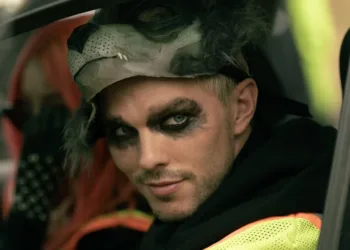






























Gabriel arrives in Baltimore with a complaint about the neighborhood. He would have preferred somewhere wealthier. In Jimmy Jenkins’s God with Us, heaven responds to this lapse in charity through wardrobe: Michael supplies an outdated red tracksuit, leaving the visiting angel looking distinctly less authoritative than he intended.
The joke has a useful target. Gabriel may possess supernatural credentials, but his first appraisal of earthly life requires correction. Lil Rel Howery’s indignation gives the costume change its comic force; divine employment has apparently failed to eliminate status anxiety.
The discovery of an infant abandoned in a garbage can changes what Gabriel’s assignment demands. Faced with a child whose mother has struggled with addiction and homelessness, he asks Michael what to do. The film moves from an angel’s dissatisfaction with his surroundings to a life those surroundings have failed to protect. Its celestial imagery, introduced through talking shooting stars, establishes a universe with supervision. The baby’s predicament makes the distance between being watched and being cared for painfully tangible.
That child is Mary Anne Thomas, the future mother in Jenkins’s contemporary Nativity. Her grandparents take her in after her mother’s fatal overdose, though Willie Earl’s initial refusal makes this welcome conditional before Gayle persuades him.
Jenkins locates the sacred within a Black community capable of sheltering Mary and hurting her. At ten, she is already someone other children advise a newcomer to avoid. Joseph, known as Junie, disregards them and joins her on the bus. His choice gives their attachment an ethical foundation before either child understands the role awaiting them: he approaches someone his peers have instructed him to dismiss.
Twelve years later, Joseph has an architecture degree; Mary has a laundromat job and repeated rejections from junior colleges. Aspen Kennedy and Ashley Olivia Fisher play the adult couple. The disparity in their prospects could make Mary merely the disadvantaged partner awaiting miraculous recognition.
Her standing at work supplies a necessary corrective. Her colleagues value what educational gatekeepers have declined to certify. These details matter because the film’s religious promise would be considerably weaker if Mary acquired dignity only upon becoming useful to a prophecy.
The pregnancy arrives around the midpoint, after a substantial investment in this shared history. That delay earns some of its time. Joseph’s refusal to be embarrassed about their abstinence, even when his friends mock him, establishes a loyalty the pregnancy will strain under radically different conditions.
Family objections to their engagement add ordinary social pressure before the couple’s claim of a miraculous conception makes them objects of disbelief. Their eventual flight to Bethlehem, Pennsylvania, carries the burden of accumulated rejection. The competing conspiracy plot is less helpful to this preparation. It repeatedly enlarges the danger when the relationship has already supplied a persuasive reason to care.
The thriller announces its political world through public signs. Protesters demand religion’s removal from government-funded institutions; a newspaper reports the elimination of references to God from public schools. These are the premises of Jenkins’s fictional America, and they place the church under threat before the central miracle occurs.
The Stone Angels then turn hostility into conspiracy. Their leader, Boozer, played by Roger Guenveur Smith, is also the FBI director, an arrangement that gives persecution the resources of the state. A familiar thriller device is doing substantial theological work: the institution entrusted with protection becomes the instrument of danger.

The Stone Angels’ black hooded robes make their allegiance especially easy to read. Costume performs the work that a murkier conspiracy film might leave to investigation. We are invited to recognize menace immediately, in an atheist organization that has adopted the ceremonial wardrobe of an occult sect. The surrounding pageantry offers little uncertainty about Boozer’s function. The suspense concerns what the conspirators will do, rather than the reliability of the moral categories used to identify them.
Jenkins does give disbelief a history. Walter Moon, played by Rotimi, describes physical and sexual abuse by the church leaders who raised him. Rosa Lee, Ashley Rios’s investigative journalist, remembers her mother giving money to a church until the family was financially devastated. Those accounts introduce injuries that religious authority has helped inflict. They also require distinctions the conspiracy threatens to blur. Rosa’s wish to investigate church finances is a legitimate response to an intelligible grievance. Walter’s infiltration of Dr. Amos’s church, as the Stone Angels prepare violence, involves a different set of choices.
The film acknowledges religious wrongdoing, then gives its organized, present-tense menace to militant unbelief. That imbalance limits the inquiry its wounded characters could sustain. Their experiences open questions about trust and accountability; the black robes make the destination of judgment look settled. There is room for a defense of religious freedom here, particularly against coercion. The conspiracy’s bluntness makes it harder to hold that defense beside the church’s own capacity to damage lives.
Jenkins is more agile when a joke exposes Gabriel’s assumptions than when humor assigns an identity to somebody else. An exchange in which children reject a white Jesus offers an opportunity to question the apparent neutrality of a familiar religious image. Then an absent-father stereotype becomes the basis for identifying Jesus as Black. The joke changes the terms of recognition. Blackness enters the sacred picture carrying a derogatory association the audience is expected to recognize quickly enough to laugh.
This is a failure of comic construction with particular consequences for Mary’s story. Junie’s childhood kindness depends on resisting the instant classification his friends offer him. The Jesus exchange solicits precisely that speed of recognition, attaching identity to a ready-made judgment. The children’s challenge to whiteness could have allowed a sacred figure to become familiar without that familiarity requiring an insult. Instead, viewers asked to recognize themselves in the image must also encounter the stigma supplied as its identifying feature.
God with Us was released in select theaters on November 13, 2026, through Variance Films. Directed by Jimmy Jenkins, the modern-day drama reimagines the classic Nativity story by following inner-city childhood sweethearts whose faith and relationship are tested when the young woman miraculously becomes pregnant.
Where to Watch God with Us (2026) Online

Full Credits
Title: God with Us
Distributor: Variance Films, Blue Harbor Entertainment
Release date: November 13, 2026
Rating: PG-13
Running time: 1 hour 45 minutes (105 minutes)
Director: Jimmy Jenkins
Writers: Jimmy Jenkins
Producers and Executive Producers: Jimmy Jenkins, Jenkins Brothers
Cast: Ashley Olivia Fisher, Aspen Kennedy, Rotimi, Lil Rel Howery, Gregory Alan Williams, Ashley Rios, Roger Guenveur Smith, Clifton Powell
The Review
God with Us
Jenkins gives Mary a life worth attending to before heaven announces her significance. Her relationship with Joseph supplies the emotional stakes, while Gabriel’s costume troubles make divine authority amusingly fallible. The conspiracy is less perceptive: its black robes settle moral questions that Walter and Rosa’s histories should keep open. A racial stereotype further compromises the film’s invitation to reconsider familiar judgments. This Nativity finds genuine feeling in ordinary loyalty, then crowds it with persecution machinery.
PROS
- Shared childhood gives Mary and Joseph’s relationship meaningful stakes.
- Mary’s working life establishes dignity independent of prophecy.
- Gabriel’s costume gag effectively punctures his class prejudice.
CONS
- The conspiracy distracts from the couple’s stronger drama.
- Blunt villain coding limits the treatment of disbelief.
- A racial stereotype undermines the film’s inclusive message.