



























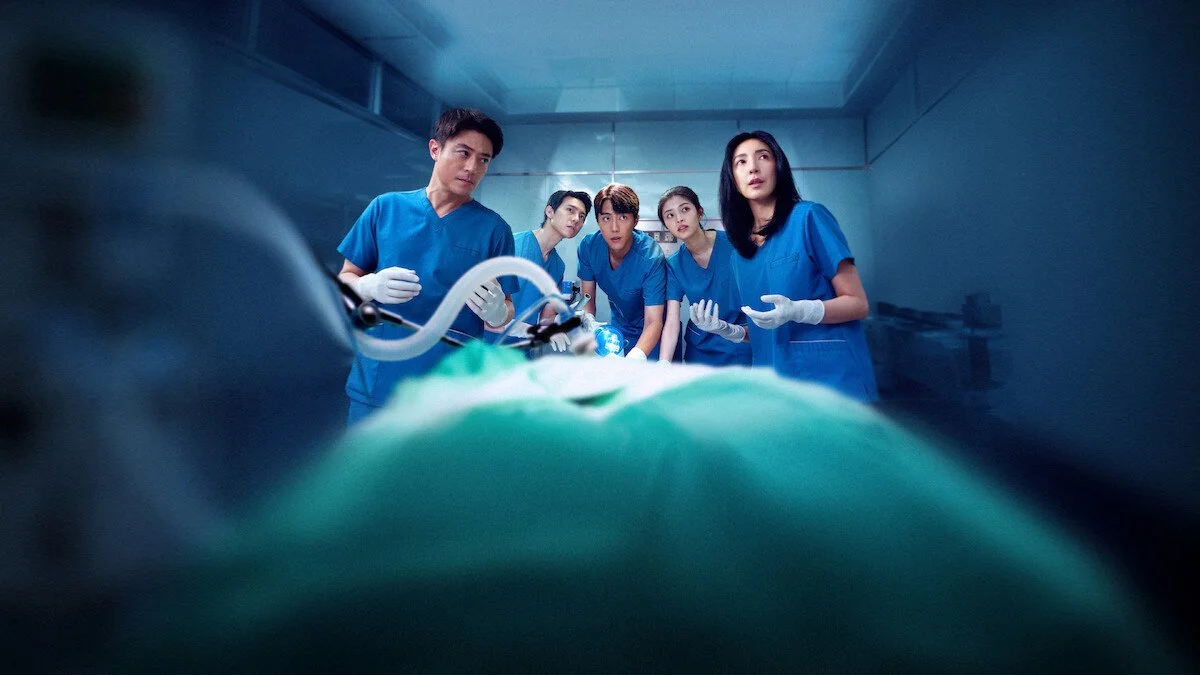

Yang-da University Hospital has arranged a press conference to announce a device that lets staff summon help when patients become violent. Then an emergency calls Chou Cheng-chun away from the presentation, irritating the director. The interruption supplies an early measure of institutional priorities in Netflix’s Taiwanese drama Miracles of the ER: caring for people can interfere with the business of being seen to care. The device may serve a useful purpose. For the moment, though, the hospital has cameras assembled and a senior doctor walking out on them.
Two episodes later, first-year resident Tang Hsi (Chan Tzu-hsuan) encounters a version of staff protection that requires no new technology. After a patient sexually touches her, a senior colleague suggests she might have provoked him. A curtain has blocked the CCTV view.
He Yu-hua challenges the accusation, while Cheng-chun objects to the treatment of the residents, but support from sympathetic superiors cannot remove Hsi’s calculation about her future. Even after another recording provides evidence, she fears spending her first residency year entangled in litigation. The hospital can announce protection collectively; claiming it still carries an individual cost.
The writing gives this experience an existence beyond the confrontation. Hsi hides it from her mother, then breaks down privately, where neither a disciplinary panel nor a protective colleague can repair it. Geng-ming’s violent intervention risks turning her assault into a demonstration of his decency, a familiar way for television to transfer attention from an injured woman to a righteous man. Hsi’s reluctance to sue complicates that route. Her decision is shaped by professional vulnerability, and the series allows it to remain uncomfortable. Having someone willing to fight for her does not make the workplace safe to return to.
Lin Geng-ming (Kent Tsai), the outsider Cheng-chun recruits into a trio of new residents, presents a different test of the hospital’s judgment. His first-day lateness comes from helping an ambulance through traffic, which supplies an immediately flattering explanation for an apparent fault.
His mishandled intubation resists that easy redemption. So does his failure to register another patient’s elevated heart rate. These mistakes give the novice real work to do before the audience can comfortably celebrate his compassion. Medical drama often treats warmth as a credential the establishment has foolishly overlooked. Here, warmth has to coexist with a worrying deficit in clinical readiness.
His attention becomes professionally useful through conversation. A patient’s wife mentions an earlier toothache, supplying information that helps him understand the illness; listening changes what he can diagnose. Yet the Hsin-mei case prevents empathy from becoming an infallible alternative qualification.
Geng-ming notices injuries that expose abuse, then needs Cheng-chun to challenge his sympathy for a woman whose actions have endangered children. His instinct to remain involved can uncover what a chart leaves out, and it can misjudge responsibility. That inconsistency gives Kent Tsai’s resident a stronger basis for development than the comforting discovery that the least accomplished recruit was secretly the best doctor all along.
Chiang Tung-yen (Payne Peng), academically assured and emotionally guarded, initially looks designed to occupy the opposite position. Their friendship is useful because it creates exchanges across those roles: Geng-ming seeks diagnostic advice outside work, making room for knowledge that his own conversational gifts cannot supply.
The series becomes less interesting whenever the residents settle into their assigned types, with Hsi as the ambitious competitor beside them. It becomes sharper when their different abilities affect a patient’s treatment. Television’s familiar novice ensemble earns its place through that practical interdependence, rather than through a declaration that every personality brings something special.

The same scrutiny needs to reach the senior doctors. Cheryl Yang’s Yu-hua carries a malpractice dispute from settlement discussions into court, where a failure to check for a brainstem haemorrhage becomes a finding against her. Her distress invites sympathy without making that finding self-evidently unjust.
The distinction matters in a series so attentive to staff exhaustion and hostility from patients’ families. Geng-ming is slapped by the son of the patient he failed to intubate properly, then faces further anger when he apologizes. The violence is indefensible; concern about the treatment remains legitimate. The drama is strongest when sympathy for its recurring characters leaves those responsibilities visible.
Wallace Huo gives Cheng-chun the brooding authority expected of the senior doctor who takes risks and attracts institutional suspicion. His emergency thoracotomy, performed without waiting for a surgical consultation, makes procedural scrutiny look painfully detached from the time available to save someone.
A later child emergency unsettles that moral arrangement: memories of an earlier loss overwhelm him, and he leaves before the procedure is finished. The mentor who sees promise in others cannot always supply the steadiness they need. Huo’s troubled presence gives the heroic-doctor role a useful instability, especially beside Yang’s veteran facing the consequences of her own decisions.
Across eight episodes of roughly forty to fifty minutes, the series also asks these characters to sustain a crowded assortment of dramatic obligations. The third installment contains Hsi’s harassment, a teenage patient’s pregnancy, a child emergency, a double date, and Yu-hua’s hearing.
Each has a plausible place in this workplace, but plausibility does not settle the problem of attention. Hsi’s private distress needs space to register; the relationship conversation asks us to begin reading a different set of signals. The pressure comes from repeated changes in emotional task, with several serious experiences competing to determine what the episode is asking its audience to carry forward.
The double date does have a purpose. Cheng-chun’s wish for a family to come home to gives his life a need that professional usefulness cannot satisfy, while Yu-hua’s skepticism about love permits a register beyond culpability and endurance. Smaller gestures can do similar work with less narrative machinery.
Red bean doughnuts handed to the residents as a welcome establish a community that exists alongside the hospital’s failures. These scenes give the staff something to lose if exhaustion drives them away. The series’ warmth is persuasive when belonging takes this ordinary, collegial form.
Its discussion of research exposes another pressure that deserves some of the space taken by competing emergencies. Yu-hua and Huang You-chang question promotions tied to papers, while You-chang’s researchers face a publication deadline.
Hsi encounters the same system through her mother’s returning cancer and the need to enter a drug trial. Research acquires different meanings according to where someone stands: career evidence, a deadline, a possible treatment. Placing those demands within one hospital keeps the objection to publication metrics from becoming a dismissal of research itself. Hsi still needs the work to produce something her mother can use.
Miracles of the ER premiered globally on Netflix on November 12, 2026. Serving as Taiwan’s first emergency-room medical drama, the series follows an average medical graduate handpicked by a brilliant physician as he navigates high-stakes medical crises, ethical dilemmas, and fierce competition among elite peers.
Where to Watch Miracles of the ER Online


Full Credits
Title: Miracles of the ER
Distributor: Netflix
Release date: November 12, 2026
Rating: TV-MA
Running time: Approx. 48-60 minutes per episode (8 episodes)
Director: Isaac Li, Huang Ching-tsu
Writers: Huang Ching-tsu
Producers and Executive Producers: Jade Lee
Cast: Wallace Huo, Cheryl Yang, Kent Tsai, Chan Tzu-hsuan, Payne Peng
The Review
Miracles of the ER
Miracles of the ER gives medical television a useful test of its loyalties: care for doctors while keeping their mistakes open to scrutiny. Hsi’s response to harassment and Geng-ming’s uneven competence turn familiar workplace roles into arguments about protection and professional worth. Wallace Huo’s fallible mentor strengthens that approach. Resident archetypes remain visible, and the crowded eight-episode format makes serious experiences compete for attention. Still, its warmth earns trust through colleagues helping one another, without granting the hospital’s public promises an easy pass.
PROS
- Staff protection examined through Hsi’s professional vulnerability.
- Compassion tested alongside clinical competence.
- Sympathy for doctors preserves room for accountability.
- Collegial warmth grounded in ordinary gestures.
CONS
- Competing storylines crowd the emotional aftermath of serious events.
- Residents sometimes retreat into familiar character types.