






















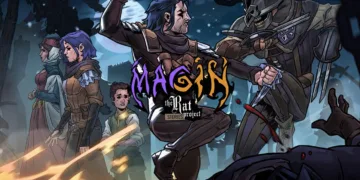







Soldier reaches the missing heroes in Annihilated and has to choose which three to leave behind. The rescue squad has already been reduced to a single survivor, and the people it came to retrieve cannot manage an escape together. Their familiar job titles now describe abilities they cannot reliably provide. The Hero answers only yes or no, the Mage has lost her magic, the Warrior occupies a fragile doll body, and the Priest has transferred his faith to something called the Great One. Choosing a partner means deciding which version of this damaged party will accompany you to the surface.
The Warrior makes that decision less straightforward than a list of disabilities suggests. He likes his new body. Learning about the expectations attached to his former life as a fighter complicates the assumption that recovery means returning him to his old role. JRPG character arcs often connect personal growth with becoming better at an assigned specialty. Annihilated leaves room for someone to question the assignment itself. His cheerful response to an apparently disastrous transformation gives the writing somewhere to go beyond revealing how badly the heroes have suffered.
With the Priest, the gap between a familiar role and its altered purpose becomes a practical problem. His powerful healing reduces sanity, increasing the danger of certain events outside combat. He also insists that Soldier stand in front of him during battles, restricting the positional flexibility available with other partners. The healer can keep the pair alive while making the escape less secure. His unsettling allegiance matters because accepting his help changes what happens next, and the game lets dependence develop through decisions that remain useful in the moment.
These relationships give the four routes their appeal. Each companion changes conversations, discoveries, and the choices leading toward multiple endings, while the dungeon retains its shared framework. Returning with someone else offers another account of the party’s collapse and another set of abilities with which to confront its aftermath. That puts the replay incentive closer to a branching visual novel than to a roguelite built around discovering new combinations of upgrades. Soldier contributes dialogue and internal commentary throughout, so the relationship also has a second personality capable of interpreting what the companion reveals.
Combat gives this structure an effective foundation in disposable equipment. Weapons and items appear as cards, but the carried inventory is available in hand. There is no cycling deck determining which tools arrive this turn. Equipment instead has limited uses, with destruction commonly producing an enhanced or additional effect. You can even destroy an item before exhausting it. Where deckbuilders encourage refining a collection across repeated draws, Annihilated asks how quickly you can turn the equipment you have into the equipment you need next.
The enemy Break gauge supplies the connection. Damage wears it down, and suitable attacks that destroy their own weapon can then steal equipment while dealing extra damage. Spending an item can replenish your options, making conservation a less dependable rule than it first appears. The Mage fits neatly into this process: her ordinary attack is weak, but it reduces the Break gauge effectively. Losing her defining spellcasting ability has left her with a useful contribution that takes some understanding of the system to appreciate. Soldier’s modest basic attack makes the search for replacement equipment especially consequential.

Visible enemy intentions and targets help you plan these exchanges, while front and rear positions affect exposure and access to certain attacks. Execution comes in two forms. One uses a moving cursor and timed inputs; the other lets you choose a target area and resolve the action through a displayed probability. Equipment and statistics influence the targeting system.
The timing option adds an execution demand to the resource decisions, and the probability option provides an alternative for players who prefer to concentrate on those decisions. Neither guarantees a deep tactical puzzle every turn. Strong available weapons can make direct damage the simplest effective answer, leaving some of the inventory’s possibilities underused.
The larger dungeon structure is less inventive. Branching map nodes offer fights, treasure, events, and rest, with route selection replacing the physical exploration of a traditional dungeon crawler. Death returns you to the beginning of the current floor, reshuffling encounters without requiring a replay of every earlier floor. That saves time, yet the equipment loss can make a short retry awkward. A pair defeated with a useful collection of items returns with basic supplies and must rebuild through whatever opportunities the reshuffled floor provides.
Curse, earned through consuming equipment, connects those attempts. It can improve event outcomes and rewards, support healing and equipment improvements, or help purchase known items. Unspent resources feed experience, providing persistent growth. These are useful supports, but gaining levels does not immediately replace a lost selection of tools.
When a dangerous encounter follows limited chances to restock, another attempt can become a search for usable supplies rather than a substantial tactical revision. Instant-death events governed by checks add another source of abrupt failure. The loop offers less room for elaborate long-term builds than its roguelite framing suggests; the companion’s next revelation supplies a stronger reason to persist.
The illustrated presentation makes those revelations inviting without smoothing away their discomfort. The Warrior’s cute doll body sits uneasily against oppressive dungeon surroundings, while manga-like image sequences give major story moments a visual emphasis beyond ordinary text boxes. Undertale provides a useful comparison for the combination of approachable character designs and interface disturbance. Distorted text and apparent screen disruption, particularly around the Priest, allow the presentation itself to participate in the unease. These devices work because the characters already give familiar fantasy roles unfamiliar meanings.

The writing is less confident about leaving those meanings to the reader. Soldier’s internal monologues sometimes keep explaining feelings an interaction has already communicated. A character’s response can establish a contradiction clearly, then the commentary spends additional time interpreting it. In a game whose routes depend on gradually reassessing a companion, that extra explanation reduces the space for the player’s own reading and slows the movement toward the next exchange.
The English text has a separate problem with clarity. Awkward phrasing and typos interrupt conversations that must carry their meaning without voice performances, and two distinct status effects share a name. Deliberately distorted dialogue can express a character’s instability; an ambiguous status label interferes with identifying what the battle system is doing. When the same wording identifies different effects, the player has to reconstruct a distinction the terminology should have supplied.
The Review
Annihilated
Annihilated earns its return trips through the people you take along. The Priest’s costly healing and the Warrior’s pleasure in his new body give familiar JRPG roles consequences beyond their job descriptions. Weapon destruction adds useful tactical decisions, though limited long-term builds and equipment-starved retries leave the dungeon loop less satisfying than the character routes. Overexplained exchanges and rough English text further weaken the delivery. Players drawn to branching RPG stories will find the strongest reasons to return in choosing a different companion.
PROS
- Distinct companion routes with meaningful choices
- Character traits shape tactical trade-offs
- Weapon destruction rewards resource turnover
- Illustrated horror unsettles familiar fantasy imagery
CONS
- Limited long-term build variety
- Equipment loss can stall retries
- Internal commentary overexplains exchanges
- English errors and ambiguous status labels