





















Graham Anderson wants to get his car through the East Berlin checkpoint without a search. The guard prefers to discuss his wife’s forthcoming cervical screening appointment. In the opening of Emma Moran’s Honey, the state demonstrates its reach through a man enjoying the opportunity to embarrass a woman. The medical detail has no apparent bearing on the crossing. Its usefulness lies in making Anne Anderson hear a stranger announce that her private life is available for inspection. The guard can afford to be jovial. Everyone else must accommodate his joke.
The operation that follows gives British intelligence a less dignified appearance. Anderson, played by Rory Kinnear, helps smuggle a young agent into East Berlin through disguises, switched number plates and a sheepdog costume. Moran allows espionage to look ridiculous without making the checkpoint’s threat imaginary.
The elaborate business of evading observation supplies the physical comedy, while the guard’s knowledge supplies the discomfort. This early movement establishes a productive difference between the people who make surveillance an instrument of humiliation and those who must turn themselves into something absurd to escape it.
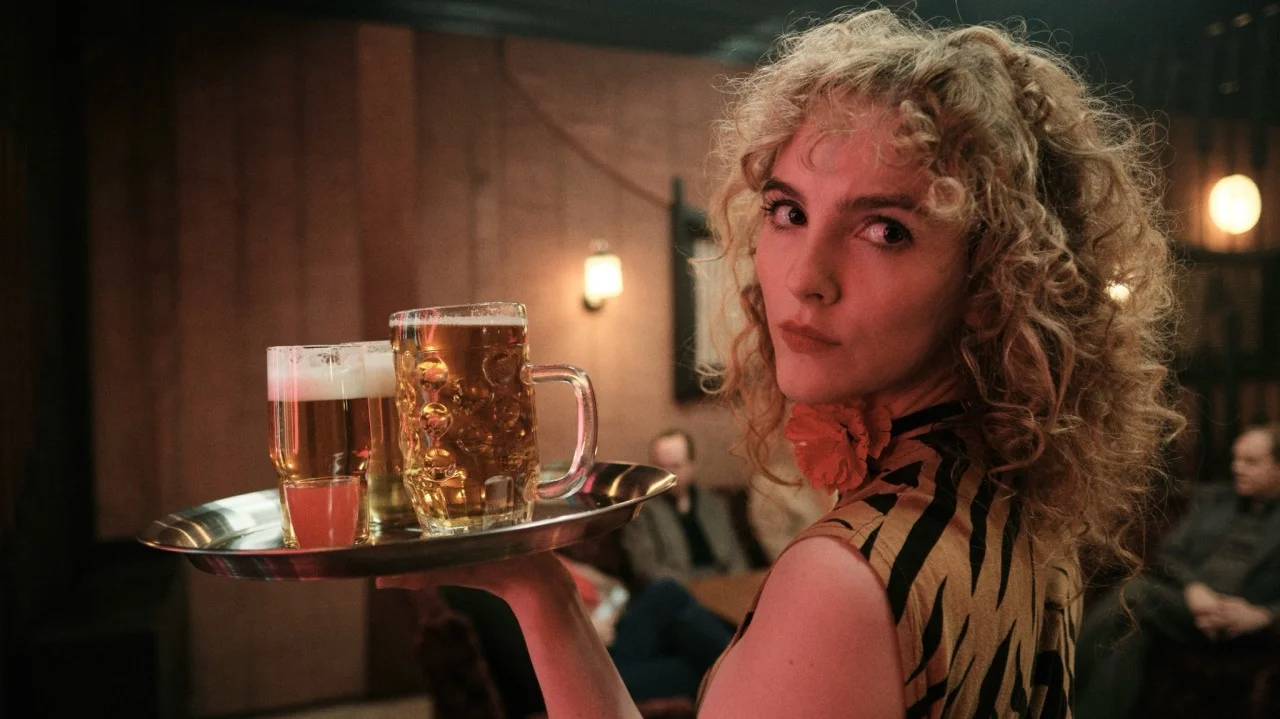
Two years later, in 1982, the smuggled agent has acquired an identity and a tedious occupation. Martha Schmitt, played by Ann Skelly, serves drinks and collects compromising photographs of men whose appetites make them useful targets. She is Carolyn Martens, the younger incarnation of Fiona Shaw’s character in Killing Eve, though the borrowed identity requires little explanation here. Her employers have found a convenient application for her body and appear satisfied with the arrangement. Martha’s boredom gives the premise its friction: being good at the task assigned to her has become an obstacle to receiving another.
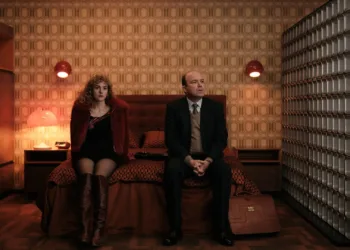
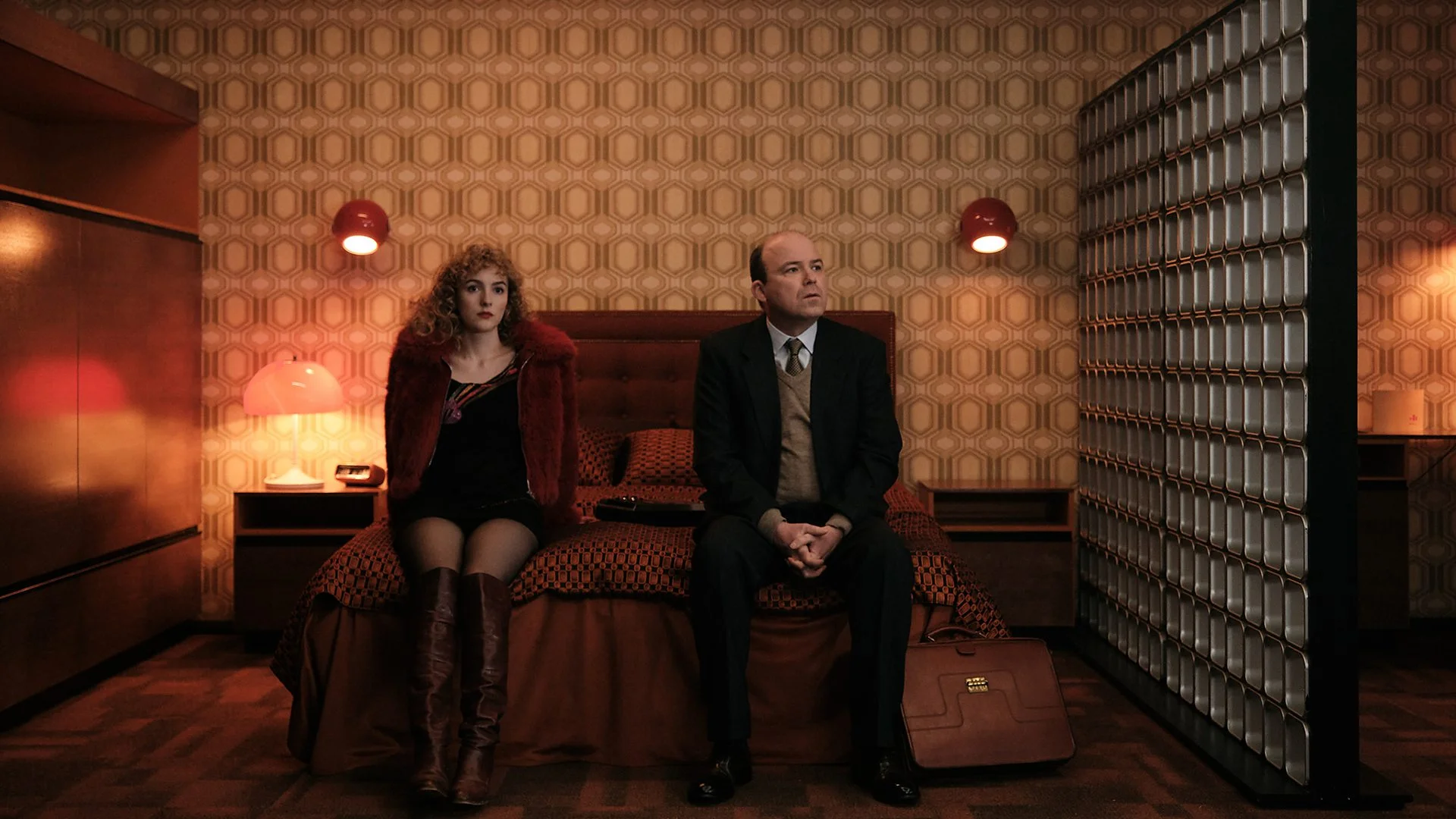
Her hotel-room debrief with Anderson turns the sexual assignment into a joke at the listeners’ expense. They play recorded sex sounds to cover their conversation, providing the surveillance agents with an intimate encounter that contains none of the information they want.
Moran makes the gag work through the distance between apparent access and actual knowledge. The listeners can enter the room electronically and still misunderstand what is happening inside it. For Martha, whose work depends on producing sexual evidence, the recording offers a small opportunity to decide what an observer gets to hear.
Skelly’s resourcefulness becomes especially persuasive when Martha takes an intelligence contact beyond the limits of her brief. She follows a lead through seduction, searches the man’s belongings and confronts him with a knife. The supposed Hungarian turns out to be CIA operative Kurt Fischer, played by Nate Mann with the arrogance the false identity permits.
Martha’s curiosity changes the nature of the encounter before her handler has approved a change of assignment. Skelly gives that impatience a credible outlet in action: the woman expected to collect embarrassing pictures starts asking questions with an entirely different means of persuasion.
Anderson’s response is to reprimand her and assign her to Kurt as his supposed girlfriend. Their interest in scientist Hermann Metzl takes the deception into a false engagement and a bridal shop, where the requirements of romantic cover become inconveniently physical.
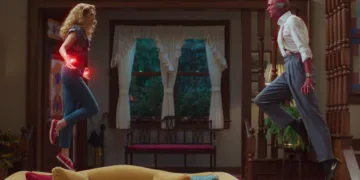
Stasi officers arrive while Martha is wearing a wedding dress she cannot readily remove. The costume obstructs her escape. It is an unusually efficient meeting of farce and social observation, with a professional disguise restricting the professional who wears it. The familiar antagonistic partnership with Kurt supplies flirtation; the dress gives that arrangement a consequence beyond banter.
Martha’s attraction to Kurt and to Stasi officer Friedrich Baumann complicates her independence without automatically invalidating it. Requiring an ambitious woman to remain sexually invulnerable would impose another narrow job description. Honey has room for appetite, calculation and poor judgment within the same character.
Its romantic machinery is conventional enough to place pressure on that freedom, particularly when Martha’s access to serious work keeps taking the form of proximity to a man. The false relationship also permits her to investigate, and Skelly’s initiative prevents the cover identity from accounting for everything she does.
Baumann introduces a different order of constraint. Jannis Niewöhner makes the counter-intelligence officer’s eccentricity inseparable from his authority when he demands Martha’s underwear for a scent record usable by tracking dogs. The request carries the grotesque intimacy of a fetish while retaining an official purpose.
Laughing at its strangeness leaves the enforcement mechanism intact. Martha has been recruited to report on Anderson, and the man making the demand possesses the means to pursue her. The sexual charge of their exchanges develops inside that imbalance, giving the flirtation a threat that charm cannot negotiate away.
Honey also makes this world pleasurable to look at. Distressed browns and deep greens give the interiors a worn density, while patterned clothes, wigs and knitwear keep supplying visual amusement. The design invites enjoyment of objects associated with a constricted life, an awkward transaction the series handles best when someone pays a price beyond embarrassment. Its attractive surfaces need not provide a history lesson to justify their existence. They do, however, make the arrival of an ordinary civilian’s loss especially disruptive, because the viewer has been encouraged to treat this environment as an entertaining place to visit.
Martha’s neighbour Ilse disappears after being reported to the authorities, and her dog Moppel is taken too. The incident interrupts the agents’ world of assumed identities with someone who cannot simply adopt another role. When Baumann later appears with Moppel, an eccentric accessory acquires a history. Ilse’s home has been emptied, and something familiar from it has become part of the official’s life.
Honey premiered on BBC One and BBC iPlayer on November 14, 2026. Created by Emma Moran, the espionage thriller follows an undercover MI6 agent undertaking counterespionage in Berlin in 1982 during the height of the Cold War.
Full Credits
Title: Honey
Distributor: BBC One, BBC iPlayer, ZDF, Fifth Season
Release date: November 14, 2026
Rating: TV-MA
Running time: Approx. 60 minutes per episode (6 episodes)
Director: Toby MacDonald, Michelle Savill
Writers: Emma Moran, Emme Hoy
Producers and Executive Producers: Sally Woodward Gentle, Lee Morris, Emma Moran, Christopher Hall
Cast: Ann Skelly, Nate Mann, Jannis Niewöhner, Rory Kinnear, Sofia Oxenham, Oliver Cudbill, Sonita Henry, Victoria Mayer
Director of Photography (Cinematographer): Wojciech Szepel
Editors: Adam Moss
Composer: David Holmes
The Review
Honey
Honey finds its sharpest comedy in the uses institutions make of private life. Ann Skelly gives Martha the initiative to turn sexual assignments into investigative opportunities, while Emma Moran makes coercion felt through practical indignities. The romantic machinery is familiar, but the wedding-dress escape and Baumann’s grotesque demands give the cultural argument dramatic substance. Stylish and funny, the series keeps the pleasures of espionage entangled with the unequal freedom to participate in its games.
PROS
- Skelly’s resourceful, impatient heroine.
- Sexual comedy grounded in surveillance tactics.
- Farce with concrete political consequences.
- Rich period design and unsettling domestic details.
CONS
- Familiar romantic machinery narrows the possibilities around Martha.