

















The horn interrupts a gift. At a secluded mountain cabin, Orfeo gives Eura a ring with a green stone, and the sound arrives from somewhere beyond their intimacy, loud enough to make the surrounding world suddenly feel occupied. Nobody needs to step into view. In Virgilio Villoresi’s Orfeo, this intrusion gives mortality an acoustic presence before the lovers have words for it. Their happiness continues beneath the possibility of interruption, and the unseen source troubles the scene in a way that a visible threat might have settled.
Even their earlier movements through Milan carry a peculiar fragility. At the Polypus nightclub, wrought iron frames the pianist’s stage and silver candelabras decorate the tables; desire takes shape amid objects arranged with the care of a private fantasy. Elsewhere, an overhead view replaces the lovers with small, dark animated figures crossing a plaza. The change in scale quietly withdraws the apparent security of flesh. People who occupied the screen become things placed within it, their intimacy still legible, their exposure to the surrounding space newly apparent.
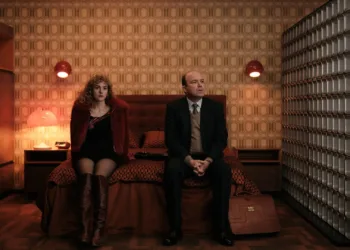
Villoresi’s first feature adapts Dino Buzzati’s 1969 graphic novel Poema a fumetti, also known as Poem Strip, carrying the Orpheus and Eurydice myth into a stylized city of Art Deco ornament and midcentury glamour. Luca Vergoni’s Orfeo plays piano at the Polypus; Giulia Maenza’s Eura is a ballerina. Their attraction passes through a letter and the cabin retreat before she disappears. When he sees her spectral form passing through a doorway, he follows. The passage into the afterlife extends a world that has already begun loosening its hold on human solidity.
Orfeo’s childhood fascination with a villa gives this crossing a disturbing familiarity. Represented in miniature, the building seems faintly restless beneath moving shadows and the uneven pulse of frame-by-frame motion. It existed in his imagination before Eura’s absence supplied a reason to enter. Returning to it brings adult grief into contact with a child’s obscure anticipation, the feeling that something behind an inaccessible wall has been waiting. The miniature’s visible construction does little to dispel that unease. Its smallness suggests a place that might be possessed in thought, while its interior remains beyond his knowledge.
Inside this unstable geography, the possibility of losing a body takes several forms. Floating heads in a forest warn Orfeo away, and Vergoni allows fear and hesitation into his determination to continue; the warnings register against an instinct for survival. Trudi, played by Aomi Muyock, appears as a face projected onto stained glass while the descending figure of Orfeo can become a shadowlike puppet. A face occupies architecture, a man becomes an articulated substitute. The effects let identity migrate between surfaces, making embodiment feel temporary without requiring an explanation of the realm’s rules.
The floating jacket makes that uncertainty intimate. Slipping onto Orfeo, it takes possession of him and forces him to play the piano, borrowing the living musician’s body for its own experience. Here the technical invention enters the character’s most familiar physical activity. At the club, playing allows him to attract another person; under the jacket’s command, the same skill becomes evidence that his body can serve a will he has not chosen. The fingers can still perform. That continuity is unpleasant: what belongs most closely to him remains available after his authority over it has been removed.

Music acquires different kinds of power across these encounters. The piano offers expression and then coercion, while the horn breaks into a private moment from an unidentified distance. Angelo Trabace’s score, moving between playful and melancholic moods, gives the surrounding fantasy an emotional mobility that its figures do not always possess. Marco De Pasquale’s 16mm photography similarly softens the saturated colors into haze. The scenery remains sumptuous, yet its edges seem difficult to hold in focus, as if the desire to look closely could never quite produce certainty about what is there.
There are stretches when that uncertainty becomes less affecting than the sheer activity of presentation. Whip pans and freeze frames send attention toward another interior detail; a camera mounted on a serving tray turns movement itself into an attraction. The jacket scene leaves an altered sense of Orfeo’s vulnerability, while these flourishes often leave the eye waiting for its next diversion. Across 74 minutes, the succession can feel strangely dispersive. I do not need the dream to explain itself, but I begin to miss the pressure of one experience carrying into another as insistently as the images keep changing.
The romance carries a related difficulty. The nightclub encounter, the letter, and the cabin establish infatuation with economy, but they offer limited knowledge of the two people within it. Eura’s dancing and affection for the cha-cha-chá give her small attachments of her own, yet her wishes seldom become a sustained presence beside Orfeo’s desire. Maenza has little room to make that imbalance otherwise. The settings can persuade us that falling in love feels exquisite; they are less able to establish what these particular lovers have learned about each other before separation makes such knowledge impossible.
When the Green Man, played by Vinicio Marchioni, accuses Orfeo of confining Eura within recollection and regret, the film brings this absence of knowledge into its argument. Perhaps the woman’s elusiveness belongs to his inability to see beyond his own attachment. I remain uncertain how much that reading can excuse. Eura has already been so closely fitted to his longing that the accusation arrives without enough resistance from a person we have known independently of him. His grief may be possessive, but the film has given us few means of imagining her outside its possession.
A skull-faced dragoon piercing Eura’s favorite gramophone record with a saber makes that difficulty briefly tangible. The violence reaches a modest personal attachment, something she liked to hear, and suggests how an object can preserve a trace of someone without preserving the person. There is pain available in that distinction. The record also leaves me wanting the ordinary intimacy that would give its destruction greater weight: some fuller acquaintance with Eura’s pleasure in it, some sense of the life to which Orfeo hopes to return her, beyond the beauty of being remembered.
Orfeo premiered out of competition at the 82nd Venice International Film Festival before releasing in Italian theaters in late 2025 and opening in select U.S. theaters on November 13, 2026, via Oscilloscope Laboratories. Directed by Virgilio Villoresi and adapted from Dino Buzzati’s graphic novel Poema a fumetti, the live-action and stop-motion fantasy drama follows a solitary pianist who enters a mysterious, dreamlike afterlife to rescue his lost love.
Full Credits
Title: Orfeo
Distributor: Oscilloscope Laboratories, Double Line
Release date: August 28, 2025 (Venice Film Festival), November 27, 2025 (Italy), November 13, 2026 (United States)
Running time: 1 hour 14 minutes (74 minutes)
Director: Virgilio Villoresi
Writers: Virgilio Villoresi, Alberto Fornari, Dino Buzzati, Marco Missiroli
Producers and Executive Producers: Alessandra Rosso, Chiara Ghidelli, Greta Rossi, Alessandro Del Vigna, Giulio Sangiorgio, Enrico Maria Vernaglione, Virgilio Villoresi
Cast: Luca Vergoni, Giulia Maenza, Aomi Muyock, Vinicio Marchioni, Ettore Altieri, Emanuela Andorno, Lorenzo Talotti
Director of Photography (Cinematographer): Marco Depa
Editors: Virgilio Villoresi
Composer: Angelo Trabace
The Review
Orfeo
Orfeo makes death felt in a horn’s interruption, a body surrendered to an empty jacket, a lover reduced to an animated silhouette. Villoresi’s optical inventions give the fear of disappearance a persuasive texture, and the piano possession makes that fear painfully personal. Yet the restless spectacle scatters dramatic attention, while the brief romance leaves Eura insufficiently known for her absence to wound as deeply as the film’s accusation of possessive grief requires.
PROS
- Miniatures and optical effects make bodily fragility tangible.
- The jacket’s piano possession gives spectacle intimate stakes.
- Sound turns romantic intimacy into an encounter with mortality.
- Hazy 16mm color sustains the dream’s uneasy atmosphere.
CONS
- The brief courtship establishes limited intimacy between the lovers.
- Eura’s wishes remain subordinate to Orfeo’s longing.
- Restless visual flourishes weaken dramatic continuity.