




























Léonard Landry hires Noé because he has a car. The position is an internship in criminal law, with driving and personal supervision among its less educational duties. Landry needs someone to help him function, and recruitment lets him arrange that assistance without relinquishing the title of boss. Accepting help becomes easier when you can issue instructions to the person providing it.
Noé, thirty and running short of routes into the profession, has reasons to accept these terms. That age matters. He has already spent time waiting for an opportunity, which makes this one expensive to refuse. There is something quietly nasty about the arrangement before either man has done much with it: Landry’s need can masquerade as generosity because he possesses the career Noé wants. Noé’s hopes for legal training have to share space with his employer’s immediate needs.
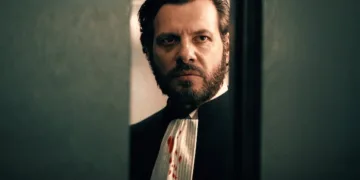
Tristan Séguéla’s The Good Lawyer gives this imbalance an appropriately exhausting origin. Laurent Lafitte’s Landry races between two simultaneous hearings, attempting to satisfy criminal clients whose demands exceed his capacity to meet them. Cocaine and alcohol accompany a working life conducted as though sufficient ingenuity could abolish the need to stop. His increasingly disordered performance ends with a courtroom collapse and cocaine spilling into public view. The two hearings are an excellent dramatic device because they make his delusion measurable. However good his arguments, he has one body and two places to be.
Lafitte understands how closely this man’s competence sits beside his desperation. His rapid delivery retains the force of someone accustomed to making people listen, while bodily agitation exposes the effort required to keep that authority intact. You can recognise the lawyer’s skill without accepting his estimate of its protective powers. The collapse is humiliating partly because it makes persuasion irrelevant. Everyone can see what has happened; Landry’s account of himself has temporarily lost its usefulness. After a short stay in rehabilitation, he has about a week before proceedings that threaten his professional future. He leaves treatment to search for a lawyer willing to take his case.
This is where the film’s treatment of addiction acquires both its interest and its limitation. Landry returns to the habits of bargaining, improvising and recruiting assistance that have organised his working life. His priority is to restore his ability to operate. The film follows that priority so closely that recovery often becomes the suspense of getting him through the next dangerous situation. It makes his resistance to change visible, yet leaves relatively little space for what staying sober could mean once the immediate career emergency has passed. Noé’s presence supplies an appealing practical solution to a problem the screenplay has only partly examined.
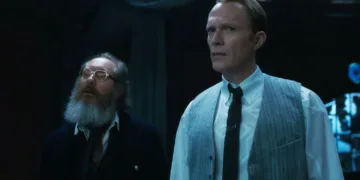
Anthony Bajon gives that solution a human cost. Noé’s caution has work to do whenever Landry’s impulsiveness threatens to undo them. Driving, assisting and intervening accumulate into a relationship whose responsibilities exceed its official description. Their scenes are funny because authority remains with the man requiring supervision. Landry can keep behaving like the senior professional while the aspiring one helps prevent another disaster. The internship has acquired a rather expansive remit (professional development presumably happens somewhere between emergencies).

The affection between them has credibility because assistance takes effort. Noé has to participate in Landry’s difficult days; admiration alone would be much less demanding. His stalled prospects also prevent the relationship from floating free of material need. He can care about Landry and need the opportunity Landry represents. That mixture gives their attachment an uncomfortable texture. It also puts pressure on the film’s warmer impulses: every time the partnership makes Landry easier to endure, someone else is absorbing the consequences of his conduct.
The corporate case enlarges the stakes of this habit. A Congolese witness brings information concerning Varenne, a French energy group facing allegations linked to armed violence in Congo. An NGO is challenging its conduct. Landry sees possibilities in the dispute, including leverage with Iris Saint-Didier, his former romantic partner and a lawyer connected to the company’s defence. He needs her help with his own proceedings. Other people’s claims become useful to his search for representation.
My first objection was that the film makes corporate violence serve a lawyer’s personal emergency. I am less certain that a demand for greater political scope gets at the actual weakness. Landry’s ability to convert distant suffering into something negotiable could itself sustain a sharp character study. His dealings with Iris and corporate leader Anne Lamarck, played by Carole Bouquet, place his private desperation inside arrangements involving substantially greater power. The film has a reason to stay close to him: his immediate needs reveal what he is prepared to make useful. The harder question is how clearly the negotiations expose his obligations to anyone else.
Here the plotting becomes less assured. The simultaneous hearings establish competing demands with almost brutal clarity. Once witness information, corporate interests, Landry’s own case and his history with Iris overlap, the activity grows harder to translate into a precise understanding of his choices. Mélanie Laurent gives Iris a firmness that makes her reluctance to rescue him intelligible. Their past receives too little development, though, for the personal pressure of his requests to acquire the same clarity as their strategic value. We understand why he needs her before we understand enough about what that need asks of her. The legal complications occupy space that might have made the negotiation hurt.
Noé’s interventions keep a smaller, more immediate obligation in view. While Landry seeks permission to continue his career, the intern must help make another working day possible. Learning from him involves driving him, watching for danger and deciding when assistance is required. Noé enters these encounters with his own uncertain professional future, but the employer’s next crisis keeps determining what he needs to do with his time.
The Good Lawyer premiered globally on Netflix on November 9, 2026. Directed by Tristan Séguéla, the French thriller follows a flamboyant criminal defense lawyer who, after undergoing rehab following a courtroom overdose, is given just one week to save his career and prepare for his own trial with the help of a tenacious intern.
Where to Watch The Good Lawyer (2026) Online


Full Credits
Title: The Good Lawyer (Un bon avocat)
Distributor: Netflix
Release date: November 9, 2026
Running time: 1 hour 54 minutes (114 minutes)
Director: Tristan Séguéla
Writers: Tristan Séguéla, Simon Jacquet, Marcia Romano
Producers and Executive Producers: Simon Jacquet
Cast: Laurent Lafitte, Anthony Bajon, Mélanie Laurent, Carole Bouquet, Mark Lewis, Gwendal Kerdelhue
Director of Photography (Cinematographer): Augustin Barbaroux
Editors: Pierre Deschamps
Composer: Amine Bouhafa
The Review
The Good Lawyer
Landry can negotiate almost anything except his own limits. Laurent Lafitte makes that contradiction painfully watchable, while his partnership with Anthony Bajon gives dependence an awkward, affectionate reality. The film is sharpest when professional authority rests with the person requiring supervision. Its corporate negotiations grow muddy, Iris’s history remains thin, and recovery too often means surviving the next emergency. Still, the internship supplies an uncomfortable question that the legal machinery struggles to match: how much care can an employer extract under the heading of opportunity?
PROS
- Lafitte keeps talent and desperation visible together.
- Landry and Noé’s bond carries affection and unequal need.
- Simultaneous hearings give self-deception concrete dramatic form.
- Dry humor exposes the internship’s reversed responsibilities.
CONS
- Recovery receives limited attention beyond immediate crisis management.
- Corporate plotting obscures Landry’s choices and obligations.
- Iris’s underdeveloped history weakens their personal negotiations.